

Arizona remains one of the most dangerous states in the country for bicyclists, and its 37th-place ranking on the League of American Bicyclists’ 2024 Bicycle Friendly State Report Card reinforces that concern. In 2024, the Arizona Department of Transportation recorded 1,379 bicycle crashes statewide, the highest figure in five years and a 21% increase over 2023. About 44 cyclists lost their lives, and more than 1,300 were injured.
- Key Takeaways
- Key Arizona Bicycle Accident Statistics
- Is Arizona Safe For Cyclists?
- Bicycle Accident Trends in Arizona
- What Causes Most Bicycle Accidents in Arizona?
- Bicycle Accident Statistics by County in Arizona
- Bicycle Accident Statistics by Gender in Arizona
- Bicycle Accident Statistics by Age in Arizona
- Bicycle Accident Statistics by Injury Severity in Arizona
- Bicycle Accident Statistics by Area Type
- Bicycle Accident Statistics by Location Type
- Bicycle Accident Statistics by Time of Day
- Bicycle Accident Statistics by Day of the Week
- Bicycle Accident Statistics by Month
- Bicycle Accident Statistics by Weather Conditions in Arizona
- Bicycle Accident Statistics by Weather Conditions in Arizona
- Bicycle Accident Stats by Alcohol and Drug Use
- Bicycle Accident Stats by Alcohol and Drug Use
- E-Bike Crash Statistics in Arizona
- Arizona vs. National Bicycle Accident Comparison
- First Steps to Take If You’ve Been in a Cycling Accident in Arizona
- Conclusion
- Get a FREE case evaluation today
Key Takeaways
- Arizona recorded 1,379 bicycle crashes in 2024, the highest total in nine years, with 44 riders killed and 1,349 injured.
- The widely quoted 21% jump in 2024 is wrong. Crashes rose 5.6%, and bicyclist deaths did not move at all.
- If you ride after dark your odds change sharply, because darkness produces 19.4% of Arizona bicycle crashes and 47.7% of its bicyclist deaths.
- On an unlit road a crash kills the rider 13.5% of the time against 2.2% in daylight, so your lights and your route matter more than any other pre-ride choice.
- A crash on a rural Arizona road is about four times more likely to kill you, and rural roads carry just 3.92% of the state’s bicycle crashes.
- Tucson ranks second and Mesa third among large U.S. cities for bicyclist deaths per resident, the only two in the top three outside California.
- Treat any figure claiming a percentage of bicycle crashes are caused by one behavior with suspicion, because ADOT publishes no cause breakdown for bicycle crashes.
- Being partly at fault reduces what you recover rather than ending your claim, since Arizona applies pure comparative negligence.
Key Arizona Bicycle Accident Statistics
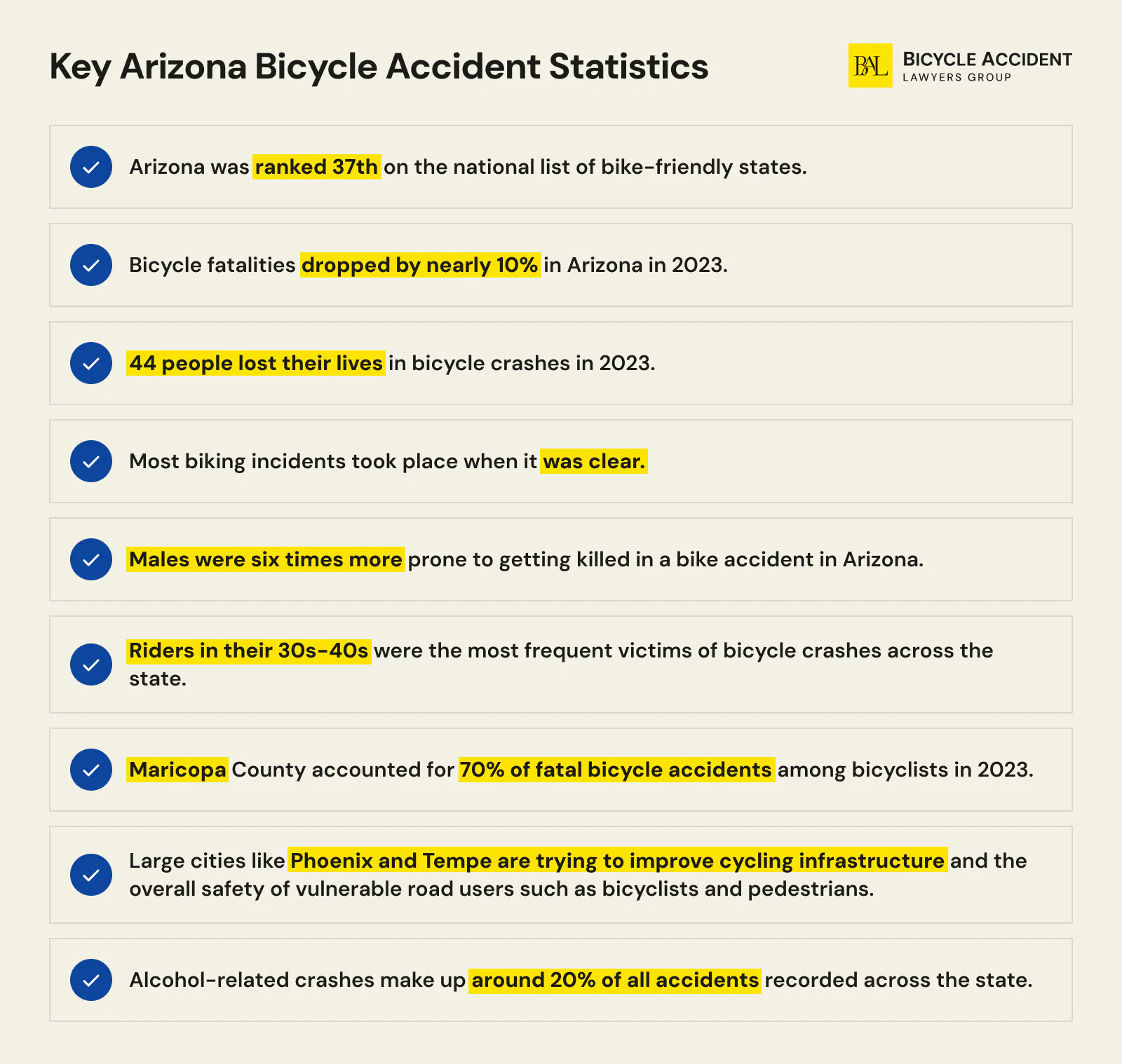
All figures are ADOT’s 2024 crash year unless noted otherwise.
- Crashes, deaths and injuries. Arizona recorded 1,379 bicycle crashes in 2024, with 44 bicyclists killed and 1,349 injured.
- Injury rate. 96.81% of bicycle crashes produced at least one injury, the highest rate of any crash category ADOT tracks.
- Fatality rate. 3.19% of bicycle crashes were fatal, against 12.55% of pedestrian crashes.
- Share of the toll. Bicycle crashes were 1.14% of all Arizona crashes and 3.58% of everyone killed on Arizona roads.
- Darkness. Crashes in the dark accounted for 19.4% of bicycle crashes and 47.7% of bicyclist deaths.
- Counties. Maricopa and Pima together accounted for 82.02% of bicycle crashes statewide.
- Rural roads. Rural Arizona produced 3.92% of bicycle crashes and 15.91% of bicyclist deaths.
- National ranking. Arizona ranked 37th on the League of American Bicyclists’ 2024 Bicycle Friendly State Report Card, which scores policy and infrastructure rather than crash counts.
Trends and conditions
- The decade. Arizona recorded 28 bicyclist deaths in 2014 and 44 in 2024, a rise of about 57%.
- The recent climb. Bicycle crashes rose every year from 2020 to 2024, going from 853 to 1,379 on ADOT’s restated figures, a 61.7% increase in four years.
- Peak hour. The busiest hour for bicycle crashes statewide is 3 PM to 4 PM, matching the peak for Arizona crashes overall.
- Weather. Clear skies covered 1,253 of the 1,379 crashes, or 90.9%.
- Infrastructure. Phoenix plans to add 1,080 miles of bicycle lanes by 2050.
Who gets hurt
- Gender. Male riders were 40 of the 44 bicyclists killed and 1,088 of the 1,349 injured.
- Age. Riders aged 65 to 74 recorded the most deaths of any age group at 11, while riders aged 25 to 34 recorded the most injuries at 233.
- Cities. Tucson ranks second and Mesa third among U.S. cities above 500,000 residents for bicyclist deaths per capita.
- Helmet law. Arizona has no statewide bicycle helmet law. Local requirements for riders under 18 apply in Tucson, Sierra Vista, Yuma, and Pima County.
- Alcohol. Alcohol-related crashes were 27.93% of all fatal crashes in Arizona in 2024, counting every road user.
Is Arizona Safe For Cyclists?
Arizona is a difficult state for cyclists. Riders may share the road with fast-moving traffic, wide arterial streets, and road systems that were not designed with bicycle safety in mind. Some cities have expanded bicycle infrastructure, but the overall safety picture still shows serious risk for people who ride on Arizona roads.
-
Alarming crash rate
Although overall motor vehicle crashes declined in 2024, bicycle crashes in Arizona rose to a five-year high of 1,379. At the same time, total motor vehicle crashes fell by 1.74%, showing that bicycle safety remains a serious problem on Arizona roads.
-
Multiple risk zones
Urban areas remain the highest-risk zones for cyclists in Arizona. About 84% of bicyclist fatalities occur in urban areas like Phoenix, Tempe, Mesa, and Tucson, where high-speed arterial roads and frequent conflict points increase the risk of serious crashes.
-
Helmet use
Arizona requires bicycle helmets only for riders under 18 in Tucson, Sierra Vista, Yuma, Flagstaff, and Pima County. Elsewhere, helmet use is a personal choice, even though research shows helmets significantly reduce the risk of head injury.
-
Motorist awareness
Distracted driving, unsafe passing, and failure to yield remain common causes of bicycle crashes in Arizona. Limited driver awareness about sharing the road with cyclists may also contribute to these collisions.
Arizona’s Cycling Safety Ranking in Context
Arizona’s bicyclist fatality risk remains high by national standards. Based on 44 bicyclist deaths in 2024 and Arizona’s 2024 population estimate, the state’s bicyclist fatality rate was about 5.8 deaths per 1 million residents. That figure helps explain why Arizona is widely viewed as one of the more dangerous states for cyclists.
The League of American Bicyclists ranked Arizona 37th on its 2024 Bicycle Friendly State Report Card. That score does not measure crash counts directly, but it does provide important context. It suggests that Arizona still trails better-performing states in areas such as planning, network quality, and bike-supportive policy.
States that invest more heavily in protected bicycle infrastructure, Complete Streets design, and long-term safety planning tend to perform better over time. Arizona has started moving in that direction. Phoenix’s Transportation 2050 plan includes more than 1,000 miles of planned bicycle lanes, and Tempe has secured federal funding for a bicycle and pedestrian bridge over the Rio Salado. These projects show meaningful progress, but the latest statewide crash data makes clear that infrastructure growth has not yet closed Arizona’s bicycle safety gap.
Bicycle Accident Trends in Arizona
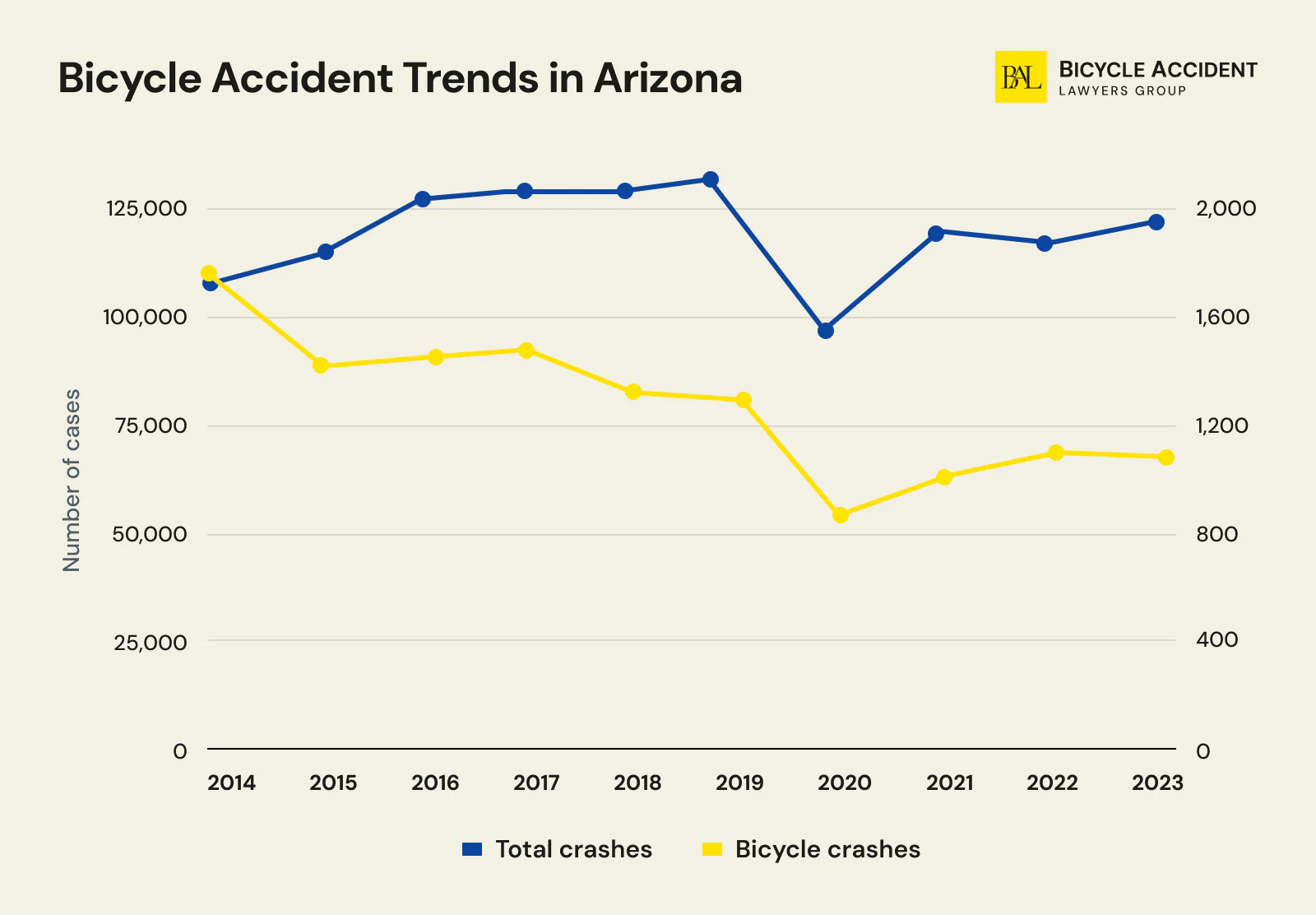
Bicycle crashes in Arizona have risen every year since 2020, going from 853 to 1,379, a 61.7% increase across four years that happened while total crashes in the state fell.
Every row below comes from the 2024 edition of ADOT’s Crash Facts.
|
Year |
Bicycle crashes |
Percent of all crashes |
Bicyclists killed |
Bicyclists injured |
|
2020 |
853 |
0.86% |
32 |
837 |
|
2021 |
1,063 |
0.87% |
45 |
1,042 |
|
2022 |
1,269 |
1.05% |
51 |
1,235 |
|
2023 |
1,306 |
1.06% |
44 |
1,296 |
|
2024 |
1,379 |
1.14% |
44 |
1,349 |
The bicycle share of all Arizona crashes grew from 0.86% to 1.14%, so bicycle crashes rose even against a shrinking statewide total, while deaths peaked at 51 in 2022 and have since settled at 44 for two consecutive years.
Arizona recorded 28 bicyclist deaths in 2014 and 44 in 2024, a rise of about 57%. That comparison spans two editions of the report, so treat it as direction only.
Why most published Arizona bicycle comparisons are wrong
ADOT revises earlier years in each new edition as late crash reports arrive, and the revisions are not small. The 2023 edition put that year at 1,139 bicycle crashes, while the 2024 edition restates it at 1,306, a difference of 167 crashes, or 14.7%.
Taking the current year from the new report and the prior year from the old one produces a jump that mostly is not real. Comparing 1,379 against the superseded 1,139 gives a 21% increase, while comparing it against the restated 1,306 gives 5.6%. The first number has circulated widely, including in an earlier version of this page.
Take both years from the same edition.
Are bicycle accidents increasing in Arizona?
Yes, though not as sharply as the commonly quoted figures suggest. Bicycle crashes rose 5.6% in 2024, going from 1,306 to 1,379 in what is now the fourth consecutive annual increase. Injuries rose 4.1%, from 1,296 to 1,349.
Deaths did not move. Arizona recorded 44 bicyclist deaths in both 2023 and 2024, and the count remains below the 51 recorded in 2022.
Total Arizona crashes fell 1.74% in 2024 and total fatalities fell 6.12% while bicycle crashes rose, so roads got safer last year for people in cars and not for people on bicycles.
Raw crash counts say nothing about how much riding is happening. Arizona has no statewide bicycle count network, so nobody can say whether crashes per mile ridden went up or whether more people simply rode. ADOT reported vehicle miles traveled down 6.59% in 2024, but that measures motor vehicles and says nothing about bicycle exposure, so until automated counts or travel surveys exist these are totals and nothing more.
Every figure here comes from Arizona Traffic Crash Reports filed by law enforcement and compiled by ADOT in Motor Vehicle Crash Facts. Because the data depends on police-reported crashes, incidents nobody reported are not captured. That gap covers many minor collisions and most single-bicycle crashes, where a rider goes down without a vehicle involved.
What Causes Most Bicycle Accidents in Arizona?
Arizona does not publish a cause breakdown for bicycle crashes. The Crash Facts report devotes seven tables to bicycle crashes, covering age, gender, geography, county, lighting, weather and crash history, and none of them records contributing factors.
Percentages like “52% of bicycle crashes involve driver error” circulate widely on Arizona law firm pages, cited to ADOT, and appear nowhere in the report. An earlier version of this page carried them, and they have been removed.
What the statewide driver data shows
Arizona’s 2024 report identifies impairment, speed and distraction as the behaviors behind its crash and fatality totals. These figures cover every crash type.
- Speed. Crashes where speed was too fast for conditions or above the limit produced 417 fatalities and 20,722 injuries, 33.9% of everyone killed on Arizona roads in 2024.
- Distraction. At least 8,289 drivers in 2024 crashes were engaged in some form of distracted driving. ADOT calls this an undercount, since drivers rarely volunteer that they were distracted and some do not survive to be asked.
- Failure to yield. Among all drivers in Arizona crashes, failure to yield the right of way was recorded in 9.77% and speed too fast for conditions in 13.75%.
- Alcohol. Alcohol-related crashes were 27.93% of fatal crashes statewide, and 43.6% of them happened on nights and weekends.
Crash types cyclists encounter most
- Right-hook crashes. A driver turns right across the path of a rider going straight, the most common serious conflict at urban intersections, and one where the driver frequently never saw the cyclist.
- Left-cross crashes. An oncoming driver turns left across a rider’s path, usually after misjudging the closing speed of an approaching bicycle.
- Overtaking crashes. A motorist passes too closely, in violation of Arizona’s three-foot passing requirement under A.R.S. 28-735.
- Dooring incidents. A driver or passenger opens a door into the path of an approaching rider, most often where street parking runs alongside a travel lane.
- Hit-and-run collisions. The driver leaves the scene, so an injured rider may lie unattended, and with no driver identified there is no insurer to claim against.
- Heavy vehicle collisions. Crashes involving trucks and buses carry a much higher fatality risk from the mass difference and the size of the blind spots, and while they are less frequent than car collisions they account for a disproportionate share of deaths.
What cyclists contribute
Rider-side factors include riding against traffic, riding unlit after dark, and road surface hazards such as potholes, loose gravel and railroad crossings.
Single-bicycle crashes rarely enter the data at all. When a rider goes down without a vehicle involved, police are usually not called, so the crash never reaches ADOT’s count. National research on bicycle crash underreporting puts true incident totals well above police-reported figures, which makes every number on this page a floor.
Bicycle Accident Statistics by County in Arizona
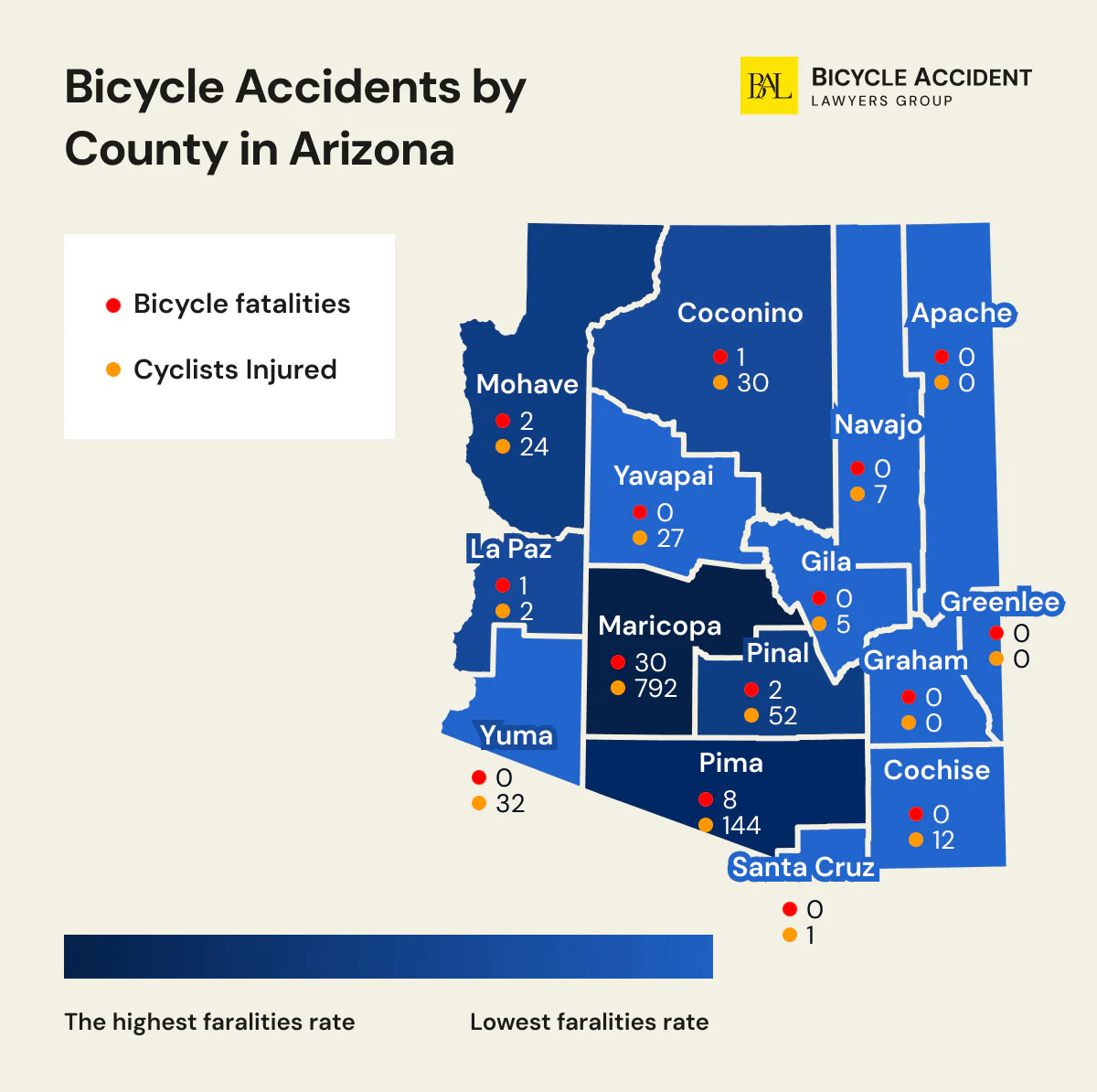
Maricopa County recorded 991 of Arizona’s 1,379 bicycle crashes in 2024, or 71.9% of the state total, and Pima County followed with 140, or 10.2%. Together the two counties accounted for 82.02% of every bicycle crash in Arizona.
|
County |
Total crashes |
Fatal |
Injury |
Bicyclists killed |
Bicyclists injured |
|
Apache |
2 |
0 |
2 |
0 |
2 |
|
Cochise |
16 |
1 |
15 |
1 |
15 |
|
Coconino |
48 |
0 |
48 |
0 |
48 |
|
Gila |
2 |
1 |
1 |
1 |
1 |
|
Graham |
0 |
0 |
0 |
0 |
0 |
|
Greenlee |
0 |
0 |
0 |
0 |
0 |
|
La Paz |
1 |
1 |
0 |
1 |
0 |
|
Maricopa |
991 |
27 |
964 |
27 |
973 |
|
Mohave |
38 |
1 |
37 |
1 |
38 |
|
Navajo |
2 |
1 |
1 |
1 |
1 |
|
Pima |
140 |
9 |
131 |
9 |
132 |
|
Pinal |
53 |
2 |
51 |
2 |
52 |
|
Santa Cruz |
1 |
0 |
1 |
0 |
2 |
|
Yavapai |
48 |
1 |
47 |
1 |
47 |
|
Yuma |
37 |
0 |
37 |
0 |
38 |
|
Total |
1,379 |
44 |
1,335 |
44 |
1,349 |
Maricopa produced 71.9% of crashes and 61.4% of deaths. Pima produced 10.2% of crashes and 20.5% of deaths.
La Paz recorded one bicycle crash in 2024 and it killed the rider, Gila recorded two crashes and one death, and Navajo the same. These are small samples, and they match the statewide relationship between rural roads and fatal outcomes.
Pima recorded a seventh of Maricopa’s crashes and a third of its deaths. Tucson carries the second-highest bicyclist fatality rate of any large city in the United States. Graham and Greenlee recorded no bicycle crashes at all in 2024.
Bicycle Accident Statistics by Gender in Arizona
ADOT data reveals a stark gender disparity in Arizona’s bicycle crash outcomes. A five-year survey reflects the following trends:
-
- Male cyclists are more prone to getting in bike crashes. In 2023, 86% of bicycle fatalities and 78% of injured riders were composed of male bicyclists.
- Female cyclists are five times less likely to get into bicycle accidents.
- The highest rate of female bicycle crashes was recorded in 2022; 9 women lost their lives on the roads of Arizona, and 246 sustained serious injuries.
| Year | Total bicycle fatalities | Male bicyclists killed | % | Female bicyclists killed | % | Total Injuries | Male cyclists injured | % | Female cyclists injured | % |
| 2019 | 30 | 25 | 83% | 5 | 17% | 1,259 | 964 | 77% | 295 | 23% |
| 2020 | 33 | 28 | 85% | 5 | 15% | 812 | 634 | 78% | 178 | 22% |
| 2021 | 45 | 36 | 80% | 9 | 20% | 1,005 | 791 | 79% | 214 | 21% |
| 2022 | 48 | 39 | 81% | 9 | 19% | 1,128 | 882 | 78% | 246 | 22% |
| 2023 | 44 | 38 | 86% | 6 | 14% | 1,128 | 880 | 78% | 240 | 22% |
Nationally, NHTSA reports that male cyclists account for approximately 88% of all pedalcyclist fatalities, closely aligning with Arizona’s 86% figure in 2023. This gender disparity is widely attributed to higher male cycling exposure rates. Men make up a larger share of both commuting and recreational cyclists, and some studies also point to a greater prevalence of risk-taking behavior during rides.
Bicycle Accident Statistics by Age in Arizona
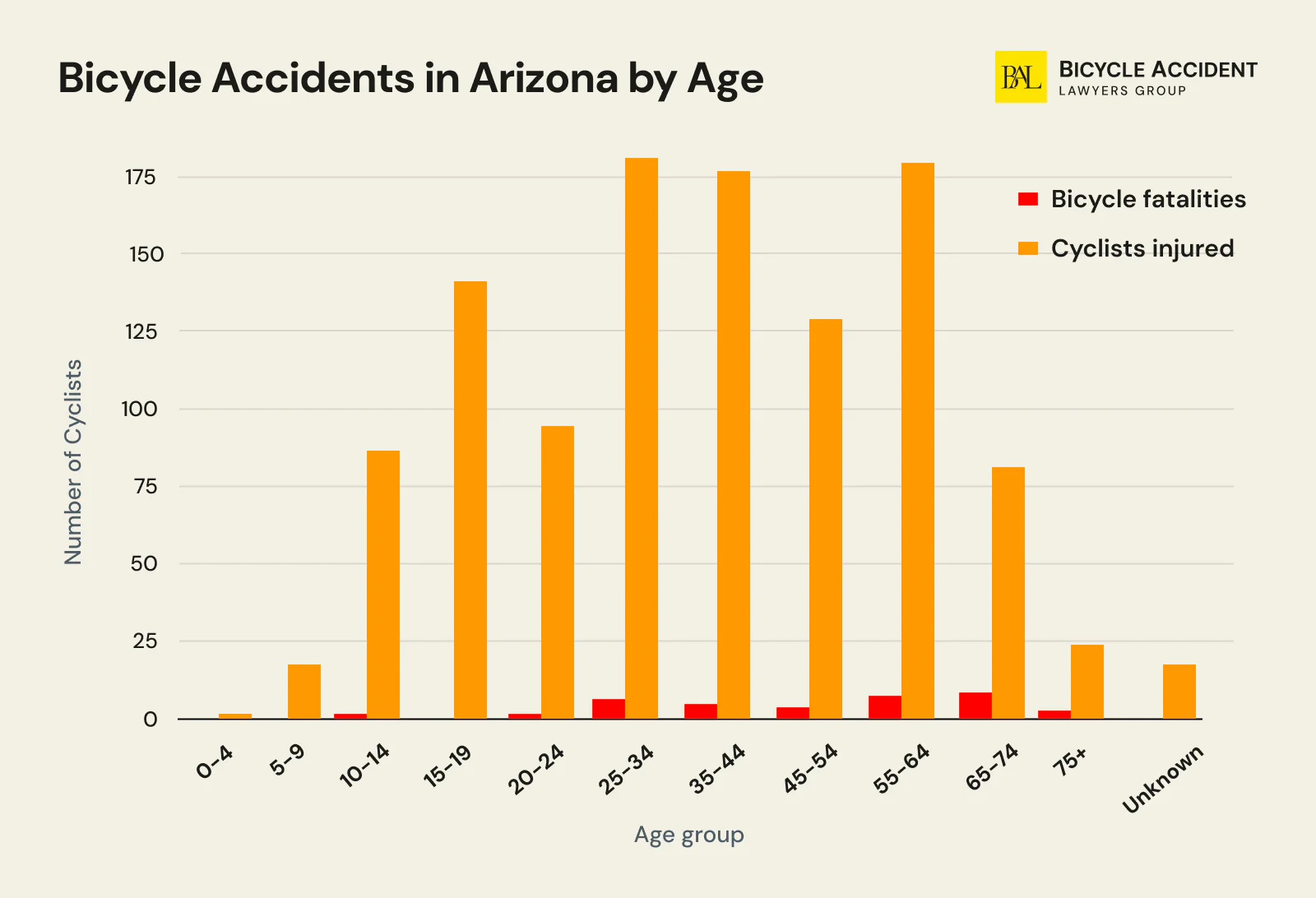
Age is a significant predictor of bicycle crash severity in Arizona. We’ve observed the following trends:
- Older cyclist groups, aged between 55 to 74, have the highest bicycle fatalities.
- Adult riders between 25 and 44 years sustained the most injuries while riding bikes in Arizona.
- Younger children and teenage groups show moderate injury rates.
- The lowest fatality rate in Arizona is among children and younger adults in their early 20s.
- A small number of bicycle accidents remained unreported, which proves the timely reporting of incidents in the area.
| Age | Bicycle fatalities | Cyclists Injured |
| 0-4 | 0 | 1 |
| 5-9 | 0 | 17 |
| 10-14 | 1 | 87 |
| 15-19 | 0 | 140 |
| 20-24 | 1 | 91 |
| 25-34 | 7 | 183 |
| 35-44 | 6 | 178 |
| 45-54 | 5 | 129 |
| 55-64 | 9 | 180 |
| 65-74 | 10 | 82 |
| 75 & Older | 5 | 24 |
| Unknown | 0 | 16 |
As the table above shows, cyclists aged 55–74 account for the highest share of Arizona’s bicycle fatalities according to ADOT’s age and gender data, even though younger age groups sustain more total injuries. This is not unique to Arizona. The CDC reports that adults ages 55–69 have the highest bicycle death rates nationwide based on WISQARS data, and NHTSA research shows the average age of cyclists killed in traffic has been climbing steadily for two decades as America’s cycling population gets older.
Why are older riders more likely to die in the same crash a younger cyclist might survive? The answer comes down to the body itself: reduced bone density, longer recovery times, and a higher risk of traumatic brain injury all make the consequences of a collision more severe after age 55. This reality reinforces why Arizona municipalities need to adopt Safe System design principles that protect every road user, not just the youngest and most resilient.
On the other end of the age spectrum, organizations like Safe Routes to School work with Arizona school districts to reduce pedestrian and bicycle crash risk during school commute hours. This is a contributing factor to the 3 PM–6 PM injury peak observed in Phoenix data discussed later in this report.
Bicycle Accident Statistics by Injury Severity in Arizona
Arizona’s 1,379 bicycle crashes in 2024 produced 44 deaths and 1,349 injuries, and 96.81% of those crashes injured somebody. ADOT sorts the injuries into three grades below a fatality, and the distribution decides what most claims are worth.
|
Severity |
Bicyclists |
Share of injured |
|
Killed |
44 |
n/a |
|
Suspected serious injury |
178 |
13.2% |
|
Suspected minor injury |
841 |
62.3% |
|
Possible injury |
330 |
24.5% |
|
Total injured |
1,349 |
100% |
Source: ADOT 2024 Crash Facts, Section 7.
A suspected serious injury prevents the person from walking, driving or continuing normal activities, which covers most fractures, head injuries and internal trauma, and Arizona recorded 178 of them among cyclists in 2024, roughly one every other day.
222 riders were killed or seriously hurt, 15.9% of the 1,393 people killed or injured in an Arizona bicycle crash. For that group, medical documentation and lost income become the substance of a claim.
The “possible injury” row records what an officer observed at the scene, not what a doctor diagnosed later. Soft tissue injuries and concussions often present hours or days after a crash, so a rider logged as a possible injury can end up with a serious one. Get examined after any crash, however minor it felt at the roadside.
What bicycle crashes cost Arizona
ADOT puts the total economic loss from all Arizona motor vehicle crashes in 2024 at $20.890 billion. It does not break that figure out for bicycle crashes. It does publish the per-person costs it uses, drawn from FHWA crash cost guidance, which makes the bicycle share calculable.
|
Outcome |
ADOT cost per person |
Bicyclists 2024 |
Economic loss |
|
Fatality |
$9,515,371 |
44 |
$418,676,324 |
|
Suspected serious injury |
$550,499 |
178 |
$97,988,822 |
|
Suspected minor injury |
$149,132 |
841 |
$125,420,012 |
|
Possible injury |
$103,145 |
330 |
$34,037,850 |
|
Total |
1,393 |
$676,123,008 |
Arizona bicycle crashes cost the state roughly $676 million in 2024. That is 3.24% of its total crash-related economic loss from 1.14% of its crashes, close to three times what their frequency would suggest.
This figure does not appear in the report. The arithmetic is ours, applying ADOT’s published unit costs to ADOT’s published bicycle counts, and the working is shown above.
Deaths are 62% of the bicycle total, because a fatality costs nearly seventeen times a serious injury. The CDC puts national medical and work-loss costs for bicycle injuries in the billions annually. These are the figures that decide whether a safety project clears a benefit-cost threshold under Safe Streets and Roads for All.
Bicycle Accident Statistics by Area Type
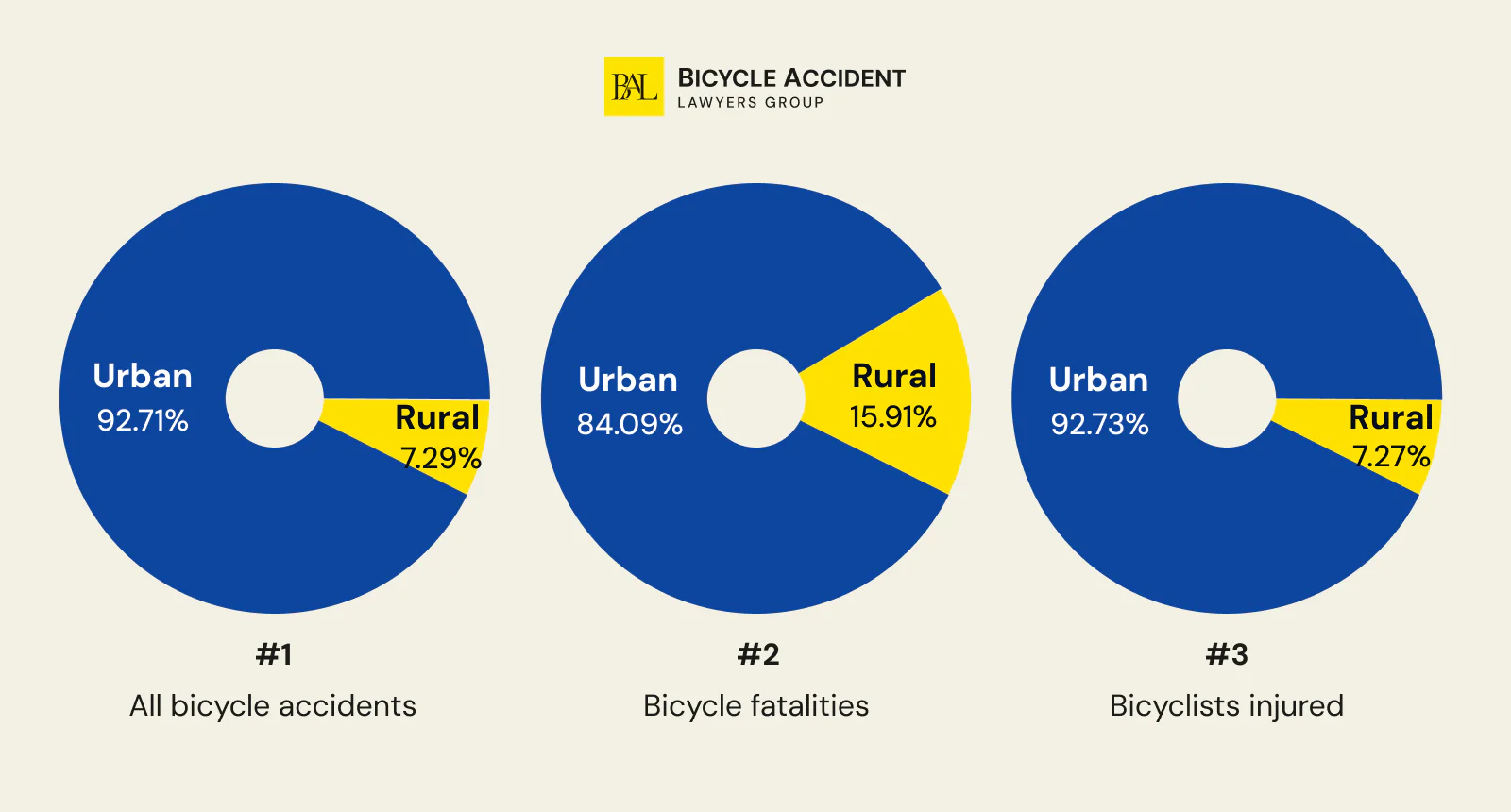
Rural Arizona produced 3.92% of the state’s bicycle crashes in 2024 and 15.91% of its bicyclist deaths, which makes a rural crash roughly four times more likely to kill the rider than an urban one.
|
Category |
Total |
Urban |
Urban share |
Rural |
Rural share |
|
Bicycle crashes |
1,379 |
1,325 |
96.08% |
54 |
3.92% |
|
Fatal crashes |
44 |
37 |
84.09% |
7 |
15.91% |
|
Injury crashes |
1,335 |
1,288 |
96.48% |
47 |
3.52% |
|
Bicyclists killed |
44 |
37 |
84.09% |
7 |
15.91% |
|
Bicyclists injured |
1,349 |
1,301 |
96.44% |
48 |
3.56% |
Source: ADOT 2024 Crash Facts, Table 7-10.
Of 1,325 urban bicycle crashes 37 killed the rider, a rate of 2.8%. Of 54 rural crashes, 7 killed the rider, a rate of 13.0%.
Rural Arizona roads commonly post 45 to 55 mph, and impact speed governs injury severity. Proven countermeasures that lower impact speed, including road diets, speed management and shoulder widening, remain uncommon on Arizona’s rural arterials.
ADOT’s 2023 figures put the urban share of crashes at 92.71%, which made the rural fatality disproportion look about half as severe as it is. The 2024 data revises the crash split toward urban areas while the fatality split holds steady, producing a sharper gap.
Bicycle Accident Statistics by Location Type
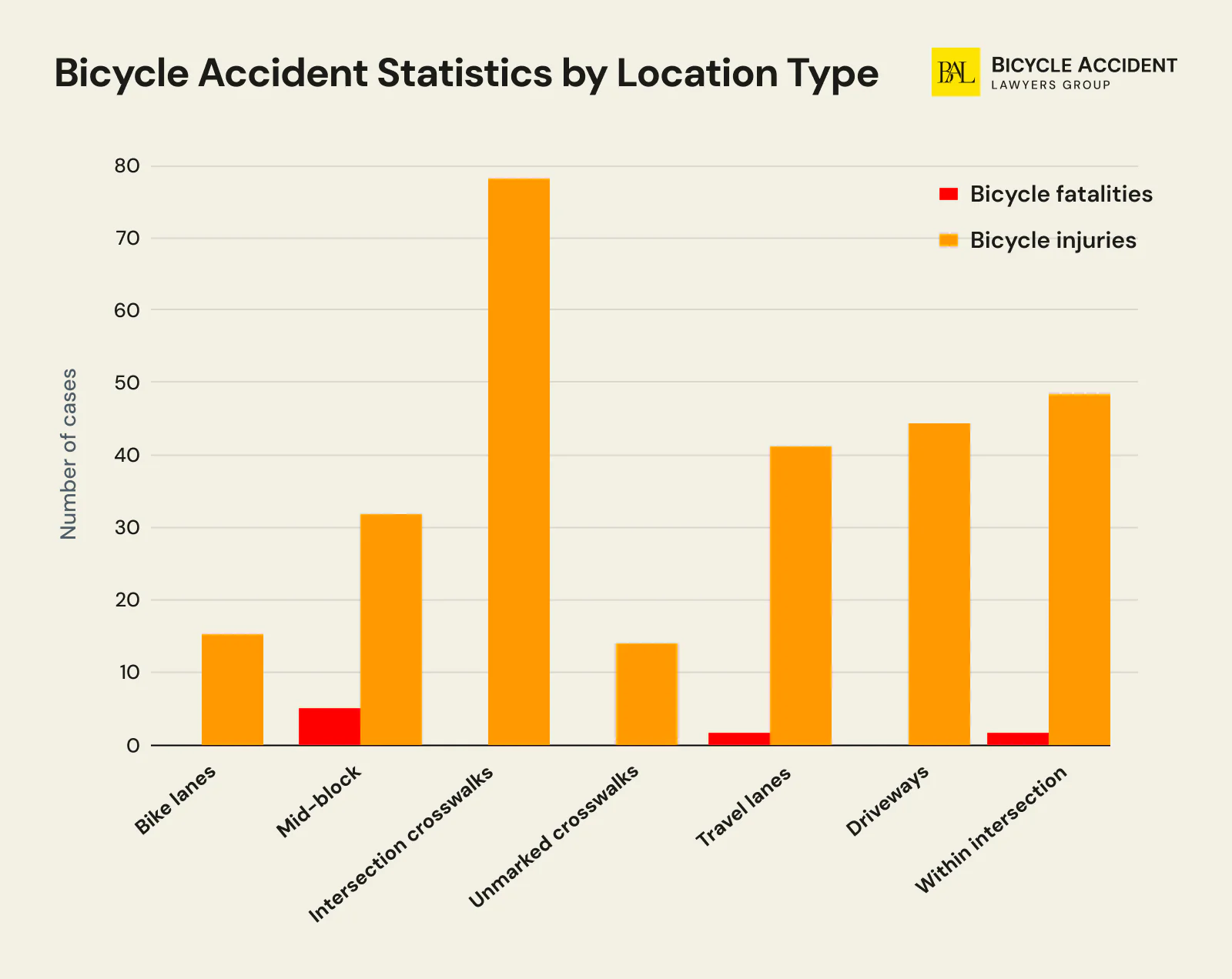
Since Phoenix accounts for the majority of Arizona’s bicycle crashes, location-level data from the largest city in the state reveals where collisions concentrate:
- Driving in dedicated bike lanes still poses a danger, so you must always mind your surroundings.
- Mid-block collisions are the deadliest of all. Over 14% of all bicycle accidents that happen in the location are fatal.
- Over 96% of incidents that inflicted injuries of varying scale on riders took place within intersections.
- Almost 5% of travel lane collisions turn out to be deadly.
| Type of location | All bicycle accidents | Bicycle fatalities | Bicycle injuries | % of total |
| Bike lanes | 16 | 0 | 16 | 6% |
| Mid-block | 37 | 5 | 32 | 13% |
| Intersection crosswalks | 78 | 0 | 78 | 27 |
| Unmarked crosswalks | 13 | 0 | 13 | 5% |
| Travel lanes | 43 | 2 | 41 | 15% |
| Driveways | 44 | 0 | 44 | 15% |
| Within intersection | 51 | 2 | 49 | 18% |
The location data shows that 16 crashes occurred within designated bike lanes, a reminder that not all bicycle infrastructure provides equal protection. Painted bike lanes offer lane delineation through road markings but no physical barrier between cyclists and motor vehicle traffic. Protected bike lanes, by contrast, use vertical separation such as bollards, planters, or raised curbs to prevent vehicle encroachment and eliminate dooring risk from parked cars. Peer-reviewed research consistently shows that protected bike lanes reduce bicycle crash rates by 50–90% compared to painted alternatives, depending on corridor and intersection design.
Most Dangerous Roads for Cyclists in Phoenix
The City of Phoenix analyzed its pedestrian and bicycle crash data to create a High Injury Network (HIN), a map identifying the roads and corridors with the highest concentration of cyclist injuries and fatalities. The most dangerous roads for bicyclists in Phoenix include:
- Indian School Road
- McDowell Road
- Thomas Road
- Buckeye Road
These arterial roads carry high traffic volumes, often lack protected bicycle infrastructure, and feature multi-lane configurations that increase conflict points between motor vehicles and bicyclists.
Most Dangerous Intersections for Cyclists in Phoenix
Phoenix’s HIN data also pinpoints specific intersections with elevated bicycle crash rates. Among the highest-risk intersections identified are:
- McDowell Road and 27th Avenue
- Buckeye Road and 7th Avenue
- Indian School Road and 3rd Avenue
- Thomas Road and 43rd Avenue
Intersection crashes account for the largest share of urban bicycle collisions, driven primarily by right-hook crashes, failure-to-yield violations, and limited sight lines at multi-lane crossings.
Surely, knowing about these high-risk locations in the city won’t rule out a chance of getting hurt in an incident. However, having a committed Phoenix bicycle accident lawyer at hand can make a tremendous difference when you seek a fair Phoenix bicycle accident settlement. Bicycle Accident Lawyers Group is a law firm well-versed in local laws and willing to reach a helping hand should the need arise!
Bicycle Accident Statistics by Time of Day
The most dangerous hour to ride in Arizona runs from 3 PM to 4 PM, which ADOT identifies as the statewide peak hour for bicycle crashes in 2024. The wider afternoon window carries most of the risk. In Phoenix, 32.4% of bicycle crashes happen between 3 PM and 7 PM.
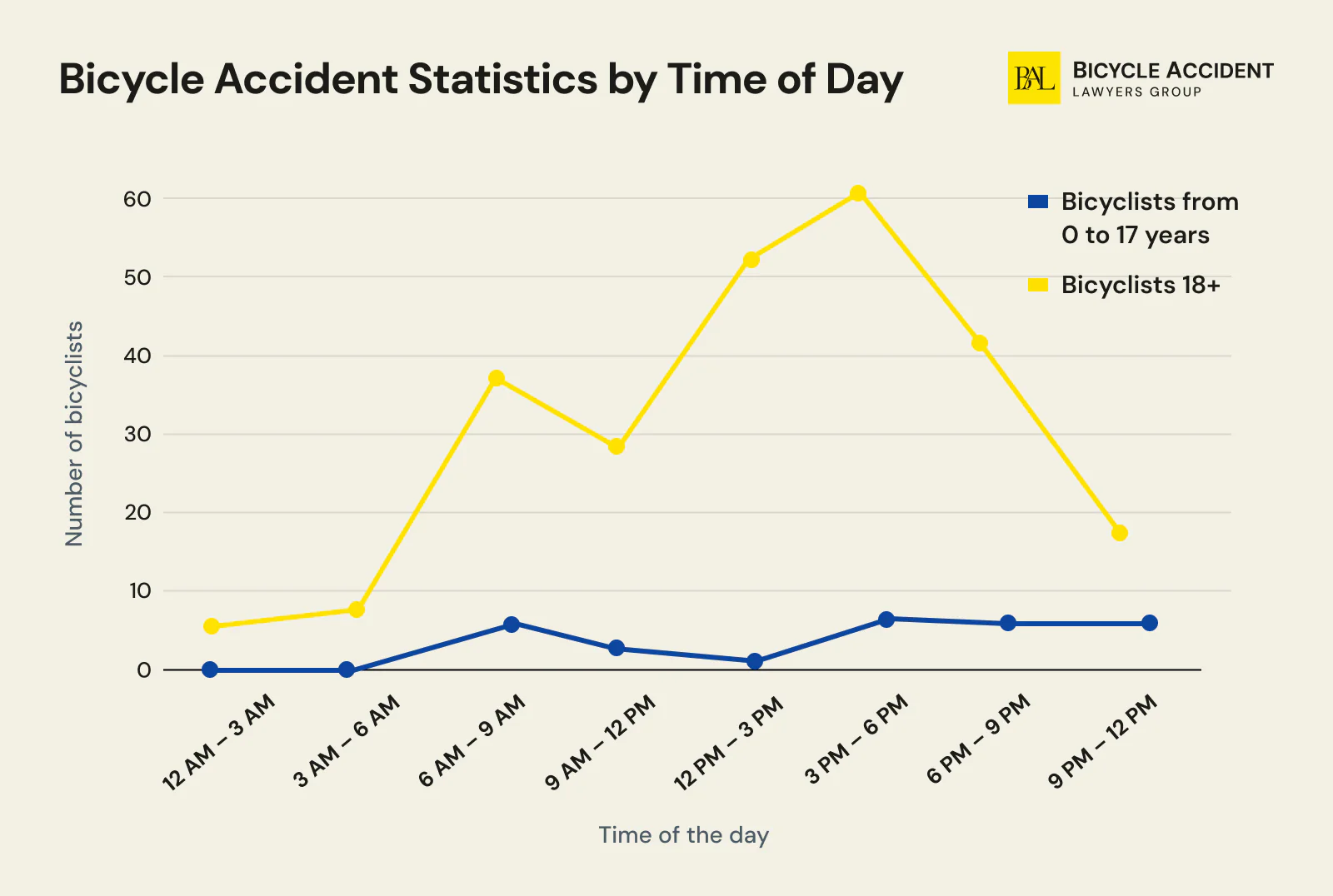
The hourly figures come from the City of Phoenix risk network study published in March 2026, covering 2,737 bicycle crashes from 2016 through 2023. ADOT publishes no hourly statewide breakdown.
|
Hour |
Crashes |
Share |
Hour |
Crashes |
Share |
|
12-1 AM |
23 |
0.8% |
12-1 PM |
151 |
5.5% |
|
1-2 AM |
15 |
0.5% |
1-2 PM |
144 |
5.3% |
|
2-3 AM |
7 |
0.3% |
2-3 PM |
201 |
7.3% |
|
3-4 AM |
10 |
0.4% |
3-4 PM |
212 |
7.7% |
|
4-5 AM |
21 |
0.8% |
4-5 PM |
241 |
8.8% |
|
5-6 AM |
54 |
2.0% |
5-6 PM |
237 |
8.7% |
|
6-7 AM |
89 |
3.3% |
6-7 PM |
198 |
7.2% |
|
7-8 AM |
218 |
8.0% |
7-8 PM |
132 |
4.8% |
|
8-9 AM |
145 |
5.3% |
8-9 PM |
113 |
4.1% |
|
9-10 AM |
105 |
3.8% |
9-10 PM |
85 |
3.1% |
|
10-11 AM |
138 |
5.0% |
10-11 PM |
44 |
1.6% |
|
11-12 PM |
121 |
4.4% |
11-12 AM |
33 |
1.2% |
Crashes track when people ride. The afternoon window from 3 PM to 6 PM combines school dismissal with the evening commute, and a sharp morning spike from 7 AM to 8 AM produced 218 crashes on its own. Between 8 PM and 6 AM, when few people are riding, Phoenix recorded 405 crashes, or 14.8% of the total.
The afternoon peak is a volume peak. The severity peak sits after dark, where statewide lighting data puts 19.4% of crashes and 47.7% of bicyclist deaths.
The 7 AM to 8 AM crashes cluster on school and work commute routes, the window Safe Routes to School programs address.
Bicycle Accident Statistics by Day of the Week
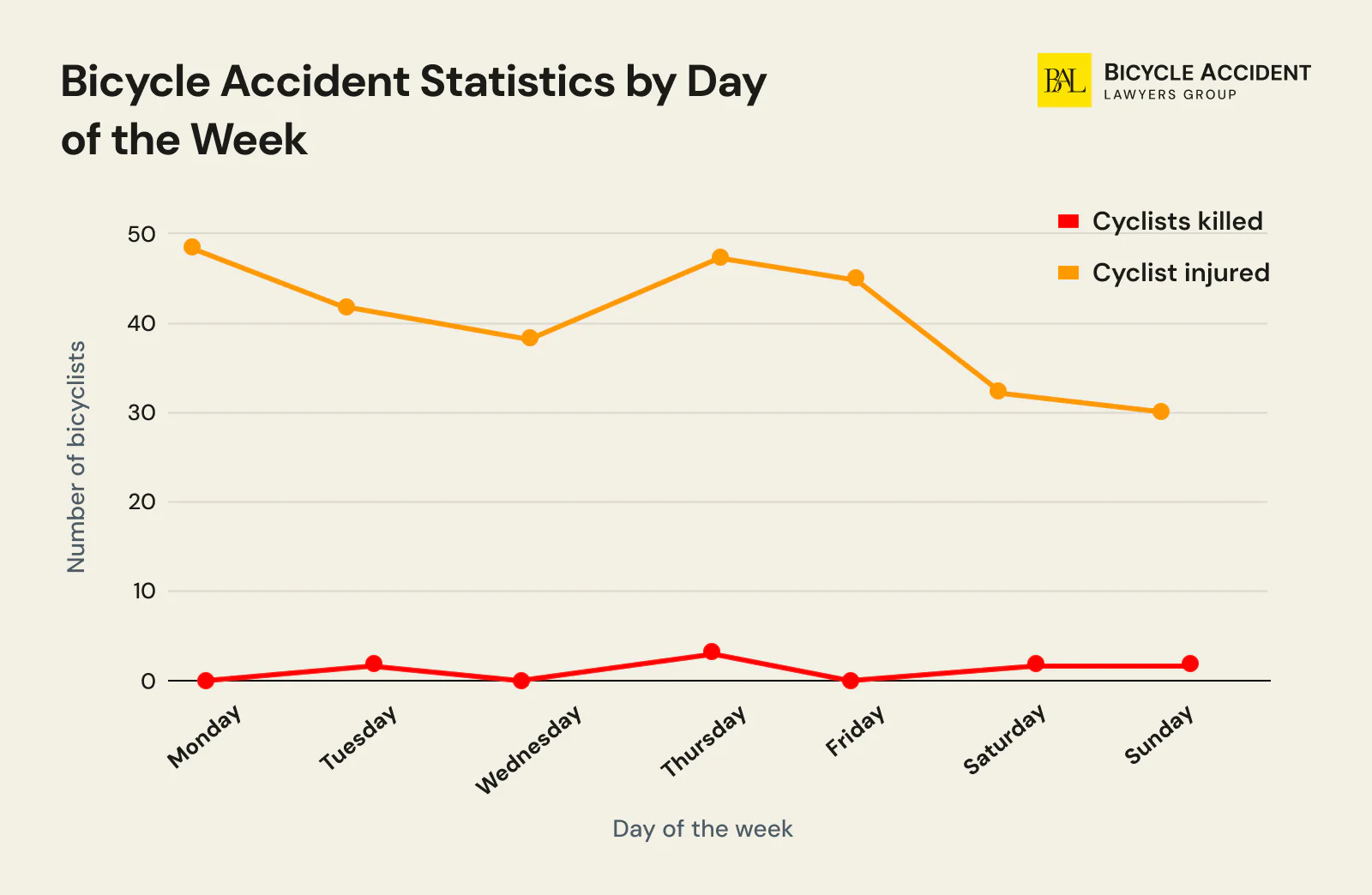
Wednesday is the worst day for bicycle crashes in Phoenix, with 504 recorded from 2016 through 2023, and the midweek block from Tuesday through Thursday accounts for 52.9% of the total. Weekends are the quietest, with Saturday and Sunday together producing 18.3%.
|
Day |
Bicycle crashes |
Share of total |
|
Monday |
364 |
13.3% |
|
Tuesday |
468 |
17.1% |
|
Wednesday |
504 |
18.4% |
|
Thursday |
475 |
17.4% |
|
Friday |
424 |
15.5% |
|
Saturday |
265 |
9.7% |
|
Sunday |
237 |
8.7% |
|
Total |
2,737 |
100% |
Source: City of Phoenix SS4A risk network study, March 2026, covering 2016 to 2023.
Weekdays average 447 crashes per day across the eight years and weekends average 251, so a weekday carries about 1.8 times the crash volume of a weekend day.
Monday is the quietest weekday at 364 crashes against Wednesday’s 504, and Friday sits between the midweek peak and the weekend drop, consistent with lighter Friday commuting.
The table counts crashes and not risk, since nobody knows how many people rode on each day, and it covers Phoenix alone because ADOT publishes no statewide day-of-week breakdown.
Arizona records 43.6% of its alcohol-related crashes on nights and weekends. The weekend risk for cyclists is less about how many drivers are out and more about which drivers are out.
Bicycle Accident Statistics by Month
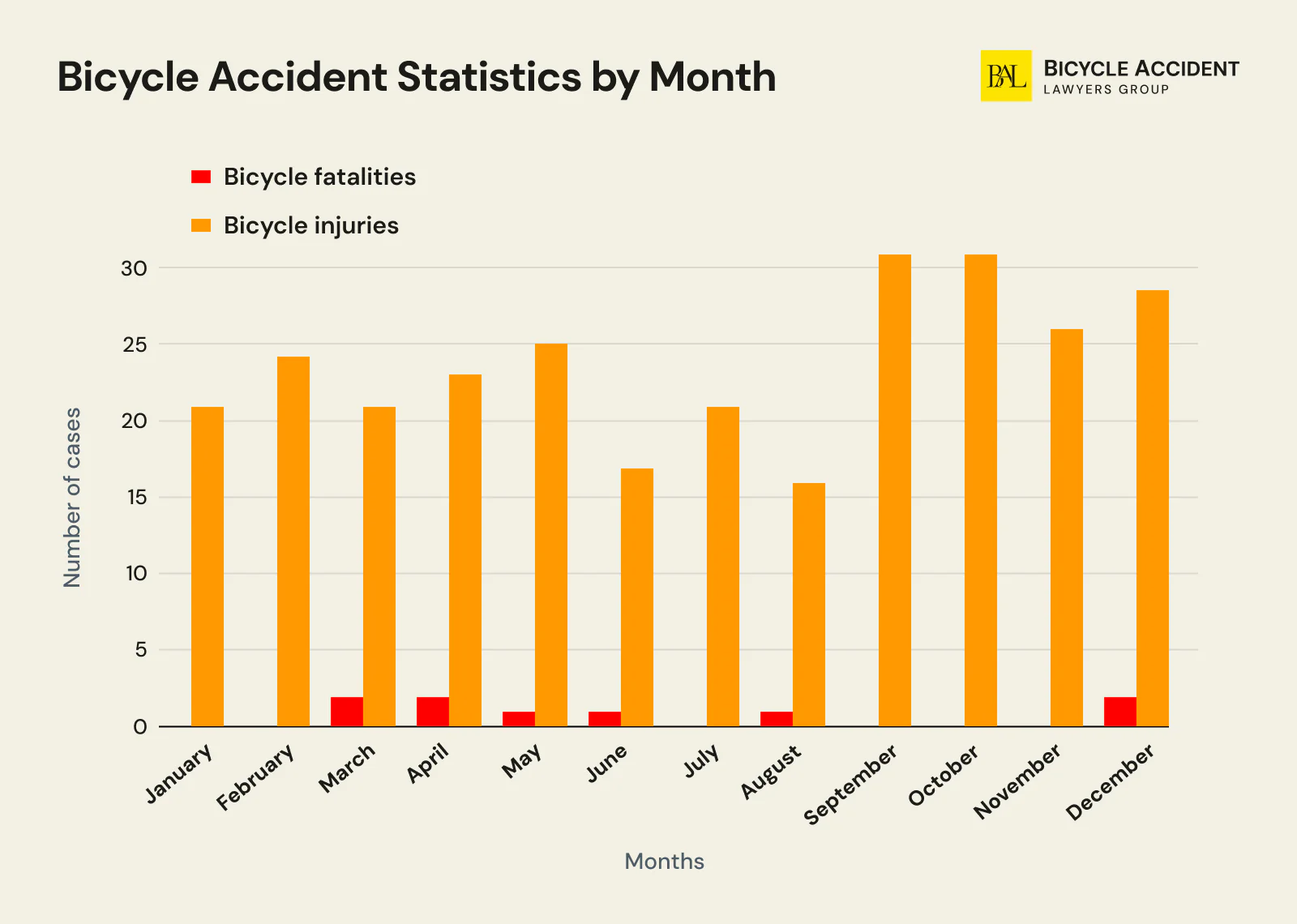
Monthly data is limited to Phoenix, where strong seasonal patterns emerge:
- December, March, and April happened to be the deadliest months for cyclists in Phoenix. Six riders sustained fatal injuries during these months. Limited visibility on the road during the early winter and spring months may be the common denominator for these unfavourable stats.
- Autumn months, especially September and October, saw a surge in bicyclist injuries, potentially due to pleasant weather that led to increased numbers of people biking through the city.
- Extreme heat during the summertime period in Phoenix and Arizona (e.g., Phoenix averages 106°F in July), in general, ensures that there are fewer riders on the streets, thus causing a drop in bicycle fatalities and injuries.
| Month | Bicycle fatalities | Bicycle injuries |
| January | 0 | 21 |
| February | 0 | 24 |
| March | 2 | 21 |
| April | 2 | 23 |
| May | 1 | 25 |
| June | 1 | 17 |
| July | 0 | 21 |
| August | 1 | 16 |
| September | 0 | 31 |
| October | 0 | 31 |
| November | 0 | 26 |
| December | 2 | 28 |
This seasonal pattern is characteristic of Arizona’s Sonoran Desert climate. NOAA records confirm that Phoenix averages daytime highs above 100°F from June through September, naturally suppressing cycling activity during peak summer and creating a bimodal distribution with spring and fall injury peaks.
Bicycle Accident Statistics by Weather Conditions in Arizona
Bicycle Accident Statistics by Weather Conditions in Arizona
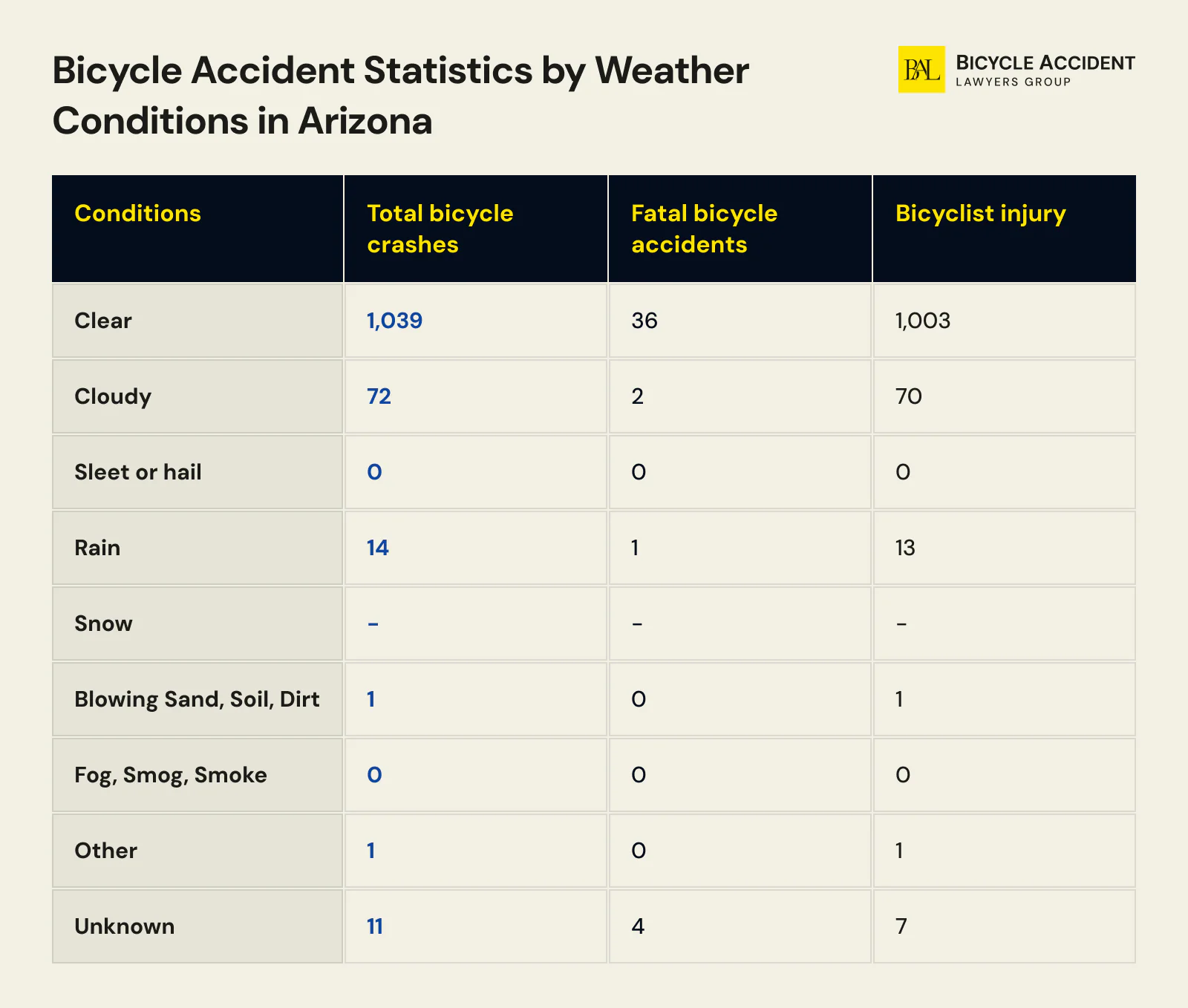
Over 92% of bicycle crashes in Arizona occur in clear weather conditions. Unlike a motor vehicle operator, a cyclist isn’t as protected against potentially unfavourable weather, yet the data confirms that crash causation in the state is predominantly behavioral. It is driven by distracted driving, rider errors, and infrastructure gaps rather than environmental factors. This pattern aligns with NHTSA’s national analysis, which shows that weather is a contributing factor in fewer than 10% of bicycle-involved crashes.
Another factor that may be worth your attention is that 11 bicycle crashes happened under unknown conditions, which stands for a lack of reporting clarity.
| Conditions | Total bicycle crashes | Fatal bicycle accidents | Bicyclist injury |
| Clear | 1,039 | 36 | 1,003 |
| Cloudy | 72 | 2 | 70 |
| Sleet or hail | 0 | 0 | 0 |
| Rain | 14 | 1 | 13 |
| Snow | |||
| Blowing Sand, Soil, Dirt | 1 | 0 | 1 |
| Fog, Smog, Smoke | 0 | 0 | 0 |
| Other | 1 | 0 | 1 |
| Unknown | 11 | 4 | 7 |
Bicycle Accident Stats by Alcohol and Drug Use
Bicycle Accident Stats by Alcohol and Drug Use
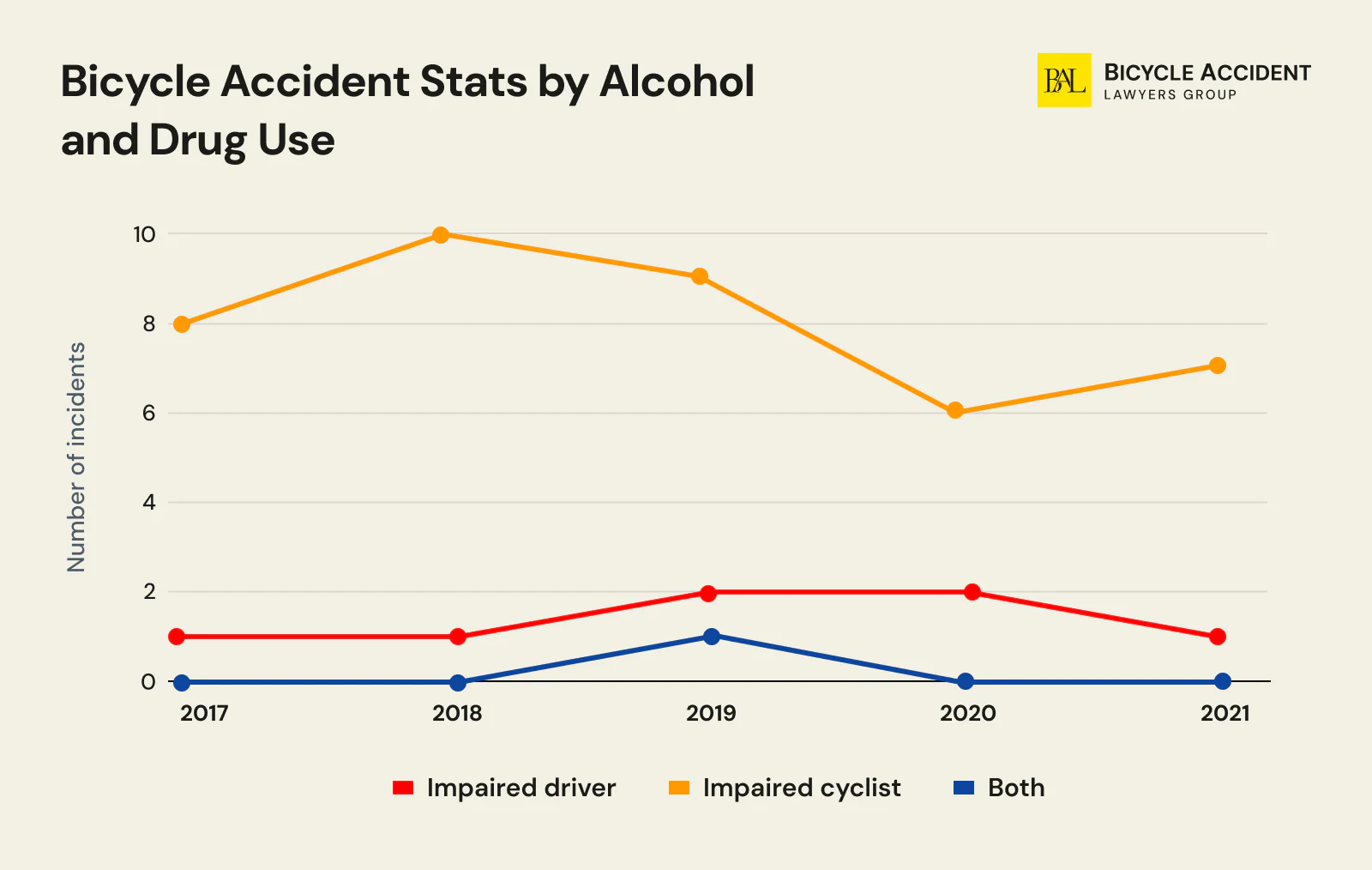
Phoenix’s bicycle-related report provides an in-depth look into bicycle accidents that happened because of alcohol or drug involvement. From the table below, you can see the following patterns:
- Impairment among cyclists is prevalent, rather than among motor vehicle operators who are involved in collisions. The ratio observed over five years is 1:7.
- There was a single accident when both parties involved were operating under the influence, which means that impaired bike riders (above 0.08% blood alcohol concentration (BAC)) were a more isolated risk factor, at least on the streets of Phoenix City.
- It is important to note that 14% of these collisions result in fatalities, and the same percentage of victims sustain serious injuries.
- After 2019, we can observe a slight decline in such collisions, which may signify increased awareness among bicyclists, cyclist safety campaigns, and improved cycling habits.
| Year | Impaired driver | Impaired cyclist | Both |
| 2017 | 1 | 8 | 0 |
| 2018 | 1 | 10 | 0 |
| 2019 | 2 | 9 | 1 |
| 2020 | 2 | 6 | 0 |
| 2021 | 1 | 7 | 0 |
Nationally, NHTSA reports that approximately 22% of bicyclists killed in crashes had a blood alcohol concentration of 0.08 g/dL or higher. Arizona’s data showing a 7:1 ratio of impaired cyclists to impaired drivers in Phoenix bicycle collisions indicates that cyclist impairment is a more prevalent local factor than in many other states.
E-Bike Crash Statistics in Arizona
A note on Arizona’s e-bike data: ADOT’s annual Crash Facts reports do not separately categorize e-bike crashes from traditional bicycle crashes. Every Arizona bicycle statistic in this article — statewide totals, fatality counts, injury figures — covers the full “pedalcyclist” category, which includes e-bike riders. Beginning in 2022, NHTSA reclassified motorized bicycles (including e-bikes) as pedalcyclists in its national FARS data. For e-bike-specific crash statistics, the CPSC Micromobility report remains the most detailed federal source available. Some e-bike incidents may also be miscoded as motorcycle or moped crashes in state databases, meaning the true e-bike crash count is likely higher than what any single source captures.
Arizona classifies electric bicycles under A.R.S. § 28-819 into three classes:
| E-Bike Class | Motor Type | Max Speed | Arizona Path Access |
|---|---|---|---|
| Class 1 | Pedal-assist only | 20 mph | Bike paths and lanes permitted |
| Class 2 | Throttle-assisted | 20 mph | Bike paths and lanes permitted |
| Class 3 | Pedal-assist only | 28 mph | Roadways only; restricted from most paths |
National E-Bike Fatality and Injury Data
Because neither Arizona nor most states publish standalone e-bike crash statistics, the best available e-bike-specific data comes from the CPSC’s national surveillance system. The numbers reveal that e-bikes are now the deadliest category of micromobility device in the United States:
| Metric | Value | Period | Source |
|---|---|---|---|
| E-bike fatalities nationwide | 193 | 2017–2023 | CPSC Micromobility Report |
| E-bike share of all micromobility deaths | 52% | 2017–2023 | CPSC Micromobility Report |
| Male share of e-bike fatalities | 81.3% (157 of 193) | 2017–2023 | CPSC Micromobility Report |
| All micromobility ED visits (e-bikes, e-scooters, hoverboards) | 448,600 | 2017–2023 | CPSC Micromobility Report |
| All micromobility ED visits in 2023 alone | 87,800 | 2023 | CPSC Micromobility Report |
| Growth in annual micromobility ED visits | +158% (34,000 → 87,800) | 2017–2023 | CPSC Micromobility Report |
| Battery/fire-related fatalities (all micromobility) | 39 | 2017–2023 | CPSC Lithium-Ion Battery NPR |
| Battery/fire-related injuries (all micromobility) | 181 | 2017–2023 | CPSC Lithium-Ion Battery NPR |
Note: The first three rows above are e-bike specific. Rows 4–8 cover all micromobility products combined (e-bikes, e-scooters, and hoverboards) because the CPSC does not publish separate e-bike ED visit totals for most reporting years.
E-bikes account for 52% of all micromobility fatalities — more than e-scooters (44%) and hoverboards (4%) combined. The 81.3% male share of e-bike deaths mirrors Arizona’s own 86% male share of all bicyclist fatalities, suggesting the same demographic risk patterns apply to e-bike riders. The American College of Surgeons described e-bikes as “emerging as a public health threat” in 2024.
Why E-Bikes Are an Emerging Concern in Arizona
The core safety concern is speed. Class 1 and 2 e-bikes assist up to 20 mph, and Class 3 models reach 28 mph — roughly double a conventional bicycle’s 12–15 mph average. That speed gap increases impact severity and makes it harder for drivers to judge closing distances at intersections and driveways.
Several Arizona-specific factors make e-bike safety particularly urgent here:
- Crash environment — Arizona recorded 1,379 total bicycle crashes in 2024, a five-year high, and bicyclist and pedestrian fatalities have increased 90% since 2013 while the state’s population grew just 12%. These all-bicycle figures include e-bike riders, and the growth in e-bike adoption is contributing to this upward trend — though the exact e-bike share remains unmeasured in state data.
- Rider experience — Many e-bike riders are new to cycling or returning after long breaks, drawn by the motor assist but potentially less practiced in road awareness and bicycle handling at higher speeds.
- Helmet gaps — Arizona has no statewide helmet mandate for adult e-bike riders. Nationally, NHTSA data shows that 62% of pedalcyclists killed in 2023 were not wearing a helmet a figure that encompasses both traditional cyclists and e-bike riders.
- Nighttime and alcohol risk — Nationally, 53% of pedalcyclist fatalities in 2023 occurred after dark and 34% involved alcohol. These risk factors are amplified at e-bike speeds where reaction margins shrink. Arizona’s bicycle crash data shows a similar pattern, with crashes between 6 PM and midnight disproportionately fatal.
- Battery safety — Beyond crash injuries, the CPSC proposed a federal safety standard in January 2025 after documenting 227 incidents involving e-bike and micromobility battery fires, explosions, and electrical hazards from 2017 to 2023 — resulting in 39 fatalities and 181 injuries nationwide.
As e-bike registrations and shared e-bike accident systems expand in Phoenix, Tempe, and Scottsdale, this category will increasingly shape Arizona’s overall bicycle crash statistics strengthening the case for ADOT to begin tracking e-bike involvement as a distinct crash variable.
Arizona vs. National Bicycle Accident Comparison
Arizona’s bicyclist fatality rate exceeds the national average. Bicycle death statistics nationwide show that with approximately 44 cyclist deaths in 2023 and an estimated 19,114 bicycle commuters statewide, Arizona records roughly 2.62 bicyclist deaths per 1,000 bicycle commuters, placing it among the top 15 most dangerous states for cyclists, based on NHTSA Fatality Analysis Reporting System (FARS) data cross-referenced with Census Bureau American Community Survey figures.
| Metric | Arizona | National |
|---|---|---|
| Bicycle crashes (2024) | 1,379 | ~130,000 (est.) |
| Bicyclist fatalities (2023) | 44 | 1,084 |
| % of traffic fatalities that are cyclists | ~3.4% | 2.9% |
| Urban crash share | 92.7% | 82% |
| Male fatality share | 86% | 88% |
| Cyclist fatalities not wearing helmet | ~60%+ | 62.2% |
First Steps to Take If You’ve Been in a Cycling Accident in Arizona
We won’t speculate on the odds of getting involved in a cycling collision in Arizona because every bicycle accident case is unique. However, our team has rounded up a list of practical steps to take after the crash to ensure your safety and protect your legal rights:
-
Protect yourself
If you can move away from the road, do so. In case you’ve been badly injured, try your best to make yourself visible so that no further harm comes.
-
Call for backup
Dial 911 as soon as you can. The sustained injuries and damage may not be as minor as they seem. While a trained medic will check your well-being, a police officer will ensure that no detail remains unreported.
-
Unleash your inner Sherlock Holmes
The better you document the scene, the easier it will be to assess your losses and file for a success-programmed and all-encompassing claim in Arizona. Take pictures of anything that stands out, no matter how unimportant it may seem.
-
Seek legal help
You can indeed use an online bicycle accident compensation calculator to estimate your losses and fill out the insurance claim form on your own. However, a field-tested legal expert knows all the ins and outs of the Arizona legal system. They have a keen eye for detail that can optimize your compensation, and learn how to negotiate with tricky insurers to deflect lowball offers aimed at you
Conclusion
Bicycle accident statistics in Arizona have an interesting story to tell. It isn’t all about dull figures and estimations. If you pay closer attention to the presented numbers, Arizona law, you will have a clearer picture in mind as to where, when, how, and why bicycle accidents occur. This information will help you enhance your safety and know your legal rights and obligations should anything happen.
Ride smarter, ride safer, and ride more prepared!

Robert Goldwater is a cyclist representing cyclists. He has practiced personal injury and wrongful death law for more than 20 years, graduating with Honors from Arizona State University Law School, and has helped recover over $1 billion for clients, including injured cyclists.