


After a bicycle accident, check yourself for head or spinal symptoms before you move, call 911, and refuse to say you’re fine. Then photograph the scene before it clears. Only 7 to 46 percent of hospital-treated bicycle collisions have a matching police report, per a Berkeley SafeTREC study, so most injured riders have no official account of what happened.
That leaves you to preserve your own bicycle accident claim. What you do in the immediate aftermath determines whether you have a provable position or a story nobody can verify.
- Key Takeaways
- What to Do at the Scene of a Bicycle Crash
- What you photograph and keep
- Get medical care and document your injuries
- The clocks that start the day of the accident
- The police report may be missing or wrong
- When there is no driver to pursue
- Handling insurers and when to call a lawyer
- Get a FREE case evaluation today
Key Takeaways
- Move out of the traffic lane, call 911, and never tell the driver you feel fine.
- Your first 24 hours shape the claim more than anything you do later.
- Ask the responding officer for the report and badge number before you leave the scene.
- Insurers treat your apology as an admission of fault and use it to deny coverage.
- A cracked helmet proves impact and warns of brain injury, so keep it unrepaired.
- Delaying the hospital visit gives the adjuster room to argue your injuries came later.
- Witness names and phone numbers collected at the scene often become your strongest negligence proof.
- Decline any recorded statement and sign nothing from an adjuster until a lawyer reviews it.
- Claims against a government vehicle or road defect can require notice within 30 days.
- Posting about the crash on social media hands the insurer material to shrink your payout.
What to Do at the Scene of a Bicycle Crash
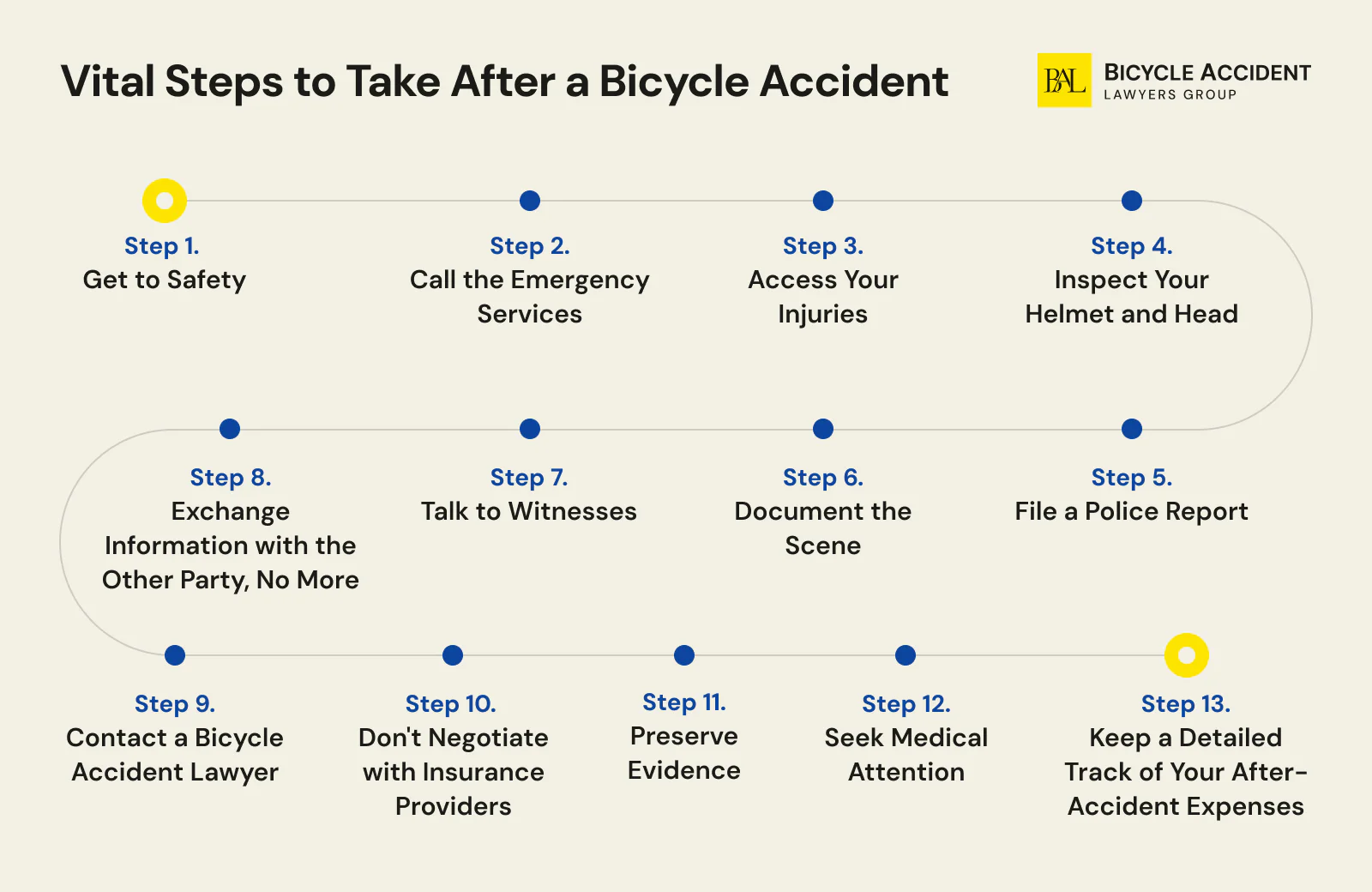
If you suspect a head or spinal injury, stay where you are and wait for EMTs – moving with an undiagnosed neck fracture can turn a recoverable break into a permanent one. Once safe, get clear of the traffic lane and oncoming cars and vehicles with your bike.
- Call 911 and ask dispatch for both an ambulance and a police officer. Reporting an injury gets an officer assigned.
- Describe the events and say nothing more. The insurer will quote any admission that you’re fine months later when arguing your injuries are not serious.
- Take the report number and the officer’s badge number before they leave.
- Witnesses scatter within minutes. Collect witness contact information – names, phone numbers and email – then exchange information with the driver, including the driver’s address, phone number, and license number along with their insurance information.
What you photograph and keep
Take photos of where you were riding and the lighting before anything moves, and preserve evidence by keeping the bike and clothing unwashed. Ninety-five percent of cyclists killed in 2024 died in single-vehicle crashes, so the driver’s account is the default version and your photographs are what challenge it.
- Shoot the lighting, the road markings and your lane position. In 2024, 52 percent of fatal bicycle accidents happened in the dark and 60 percent away from an intersection – insurance companies may use both to argue comparative fault or shift blame onto the rider.
- Photograph the vehicle, its plate and its front. Eighty-nine percent of those killed in serious collisions with a single vehicle in 2024 were struck from the front (NHTSA), so impact marks on the bumper or hood corroborate where the collision happened.
- Keep everything unwashed as physical proof of force. Retrieve doorbell camera footage before the device overwrites, and store all damaged gear where nothing gets cleaned or discarded.
Not wearing a helmet does not end your bicycle accident claim. Young bicyclists had traumatic brain injuries at 11 percent with head protection and 17 percent without in a California study. That defense remains viable in California, New York and Michigan.
Write your own account of what happened before anyone else tells a different story.
Get medical care and document your injuries
Seek immediate medical attention the same day and describe every symptom, not only the worst one. Agreement between police and medical severity ran as low as 49 percent in a California study. The hospital chart, not the officer’s side-of-the-road assessment, is what carries your bicycle accident claim.
- Go the same day, even if you rode your bike home. Adrenaline masks delayed injuries, and any gap between the accident and your first visit is the first thing insurers argue.
- Name every symptom out loud. An unmentioned symptom does not appear in the chart, and the chart is what your attorney uses to build the damages case and calculate your losses.
- Treat any head contact as a possible concussion. Bicycling produced an estimated 596,972 emergency department visits for traumatic brain injuries from 2009 to 2018, more than any other sport. Prompt treatment reduces the risk of long-term health issues and strengthens your position.
- Get the prognosis in writing. Ask about treatment and rehabilitation. Without it insurers value your injuries at what the chart shows today, and that can make a difference in your settlement outcome.
The clocks that start the day of the accident
If no officer put the crash on record, many states let the involved parties file themselves – and several require it on a deadline nobody at the scene mentions.
- California gives you ten days, whatever the fault. Form SR-1 covers bodily harm, death or property damage over 750 dollars, and late filing risks license suspension.
- Massachusetts allows five days. The filing covers death, bodily harm or damage over 1,000 dollars, and the clock starts from the date of the crash.
- Vermont cuts it to 72 hours. The filing covers damage reaching 3,000 dollars, and failing to document the incident may bring a civil penalty.
- Alaska publishes a form for incidents police did not investigate. Form 12-209 is due within ten days for your own insurance company.
- New York publishes a separate bicycle form for accidents with no moving motor vehicle. It asks for position, lighting, direction of travel and movement (NYS DMV form), so a fall in a driveway or cycling lane still counts.
Since 2022, federal crash data counts motorized bicycle operators as pedalcyclists, and a collision involving only motorized bicycles is not captured at all.
File the documents your state requires before the deadline.
The police report may be missing or wrong
The police filing establishes liability in a bicycle accident claim, but for a cyclist it is neither guaranteed nor accurate. Matching records exist in only 44 to 75 percent of hospital-treated pedestrian situations (Berkeley SafeTREC); for bicycle incidents the match rate drops further.
- The narrative thins out at night. A Boston study found that statements in traffic safety filings miss much of the information in standardized forms, and officers recorded more details during the day and when the rider was visibly injured.
- Officer discretion decides what the description says. A Texas A&M course for officers concedes gray areas in bicycle and pedestrian law that can work against you when insurers review the filing.
- Cyclists matched records at roughly half the rate of other users in a Sussex linkage study, against 67 percent for vehicle occupants and 72 percent for pedestrians.
Read yours the day it lands and correct every error. Check the license plate, your position and the severity classification. A filing that says “complaint of pain” when you have a fracture will follow your bicycle accident claim into every negotiation and reduce your settlement.
The driver of the car that hit you benefits from every field that goes unchecked.
When there is no driver to pursue
When the driver fled and was never identified or carried no insurance, your bicycle accident claim runs against your own policy or a public entity. Information on the person who fled was available in only 47 percent of hit-and-run situations.
Hit-and-run is the ordinary situation for bike accident cases – an estimated 10,076 injuries in 2023, or 20.2 percent of the total, up from 15.1 percent in 2017.
- Your own uninsured motorist policy answers a hit-and-run crash and a collision with an uninsured driver. Underinsured motorist coverage fills the gap when the at-fault policy’s limits fall short of your full compensation.
- One in three motorists cannot fully pay a serious case. 33.4 percent of US drivers were uninsured or underinsured in 2023, so your own insurance coverage is often the only path to fair compensation.
- A road defect or city vehicle follows a different process. Chicago publishes a bicycle liability form, and Illinois’s one-year statute of limitations for lawsuits against local entities is shorter than the general personal injury deadline.
- A collision with no motor vehicle at all is still grounds for recovery. Dooring, a pothole or a defect that collapses your wheel all produce recoverable losses, and what you document yourself is the only support for your position.
Handling insurers and when to call a lawyer
The insurer’s adjuster will call before you know what your injuries are worth. Insurance companies may offer a quick settlement that does not account for your full losses, including lost wages, ongoing treatment, and rehabilitation.
- Decline the recorded statement and confirm the refusal in writing. Do not give statements to the insurance company without consulting an accident expert or bicycle accident lawyer, because insurers use your own words to reduce or deny compensation.
- Sign nothing until you know the full extent of your losses. Accepting an early settlement means forfeiting compensation for pain, lost wages, and future care. If insurers refuse a fair resolution, your attorney can file a lawsuit on your side for full compensation.
- Stay off social media while your bicycle accident claim is open. Insurance companies may use a single post to raise issues with your position and deny compensation.
A bike accident lawyer with experience handling bicycle accident cases works on a contingency fee. Their clients pay nothing unless they recover compensation. The first step is a free consultation to discuss your rights. Your attorney can handle the insurance company’s calls and protect your rights.

Robert Goldwater is a cyclist representing cyclists. He has practiced personal injury and wrongful death law for more than 20 years, graduating with Honors from Arizona State University Law School, and has helped recover over $1 billion for clients, including injured cyclists.