

The most common cause of serious bicycle accidents is a broadside crash at an intersection, where an automobile and a rider cross paths, accounting for about 35% of fatal and serious crashes.
The top factors are unsafe velocity (16.5%), failing to yield (16.3%), and improper turning (15%). In 82% of fatal crashes, the front of the automobile struck the cyclist, meaning the person behind the wheel never saw the rider (NHTSA, 2023).
In 2023, 1,166 cyclists were killed in traffic crashes in the United States, the highest number ever recorded (NHTSA, 2025). Preventable cycling deaths have risen 37% over the past decade. Roughly 120,000 bicyclists visit emergency rooms with crash-related harm every year.
Because crashes also involve pedestrians, road hazards, dogs, and other riders, not just careless motorists, knowing the accident common causes helps you ride defensively and protect your legal options if a crash happens. Bicycle accident victims who understand these patterns are better prepared to file a claim and seek compensation.
- Key Takeaways
- What Causes Most Bicycle Accidents?
- What Drives These Crashes? Behavior, Violations, and Hazards
- What Else Causes Cycling Crashes Besides Cars?
- When and Where Do Most Bicycle Accidents Happen?
- What Are the Most Common Injuries After Bicycle Accidents?
- How Do Bicycle Accidents Vary by State?
- Who Is Liable After a Cycling Crash?
- How Can a Personal Injury Lawyer Help After a Cycling Crash?
- Get a FREE case evaluation today
Key Takeaways
- Broadside crashes lead. Intersections are the number-one serious crash type, about 35% of fatal and serious crashes.
- They hit riders head-on. In 82% of fatal crashes, the front struck the bicyclist, a sign they never saw the person riding.
- Darkness is deadly. In 2023, 53% of cycling fatalities happened in the dark.
- Helmets save lives. About 75% of cycling deaths involve a head wound, and protective headgear cuts serious head-harm risk by 60%.
What Causes Most Bicycle Accidents?
Broadside crashes at intersections made up 34.9% of fatal and serious cycling crashes in 2023 and have been the number-one crash type for three straight years.
Behind those crash types sit the behaviors that cause them. The top three primary factors are unsafe speed (16.5% of serious crashes), failing to yield the right of way (16.3%), and improper turning including right-hook crashes (15.0%).
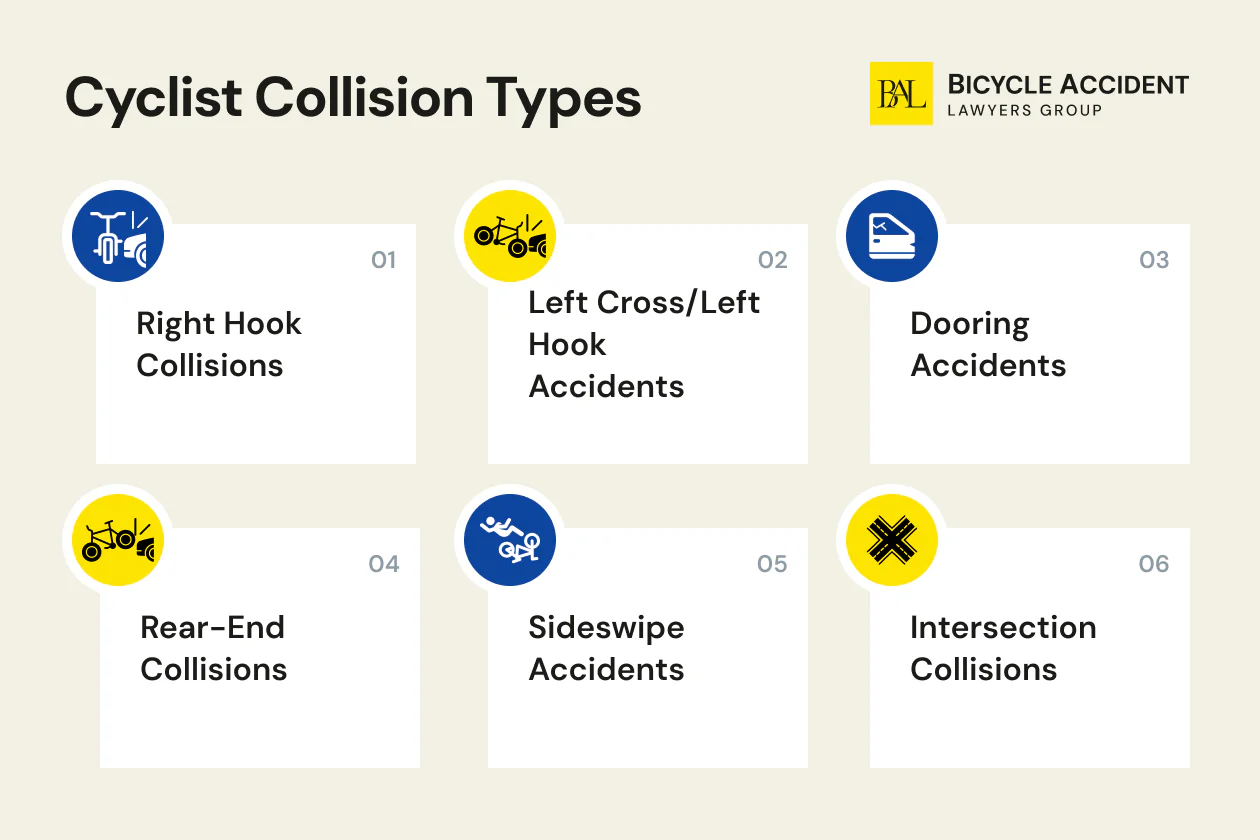
The Six Most Common Crash Types Between Bikes and Cars
Most collisions between automobiles and cyclists fall into six repeating patterns. Recognizing these patterns lets riders spot the danger early and improve their safety.
- Right hook. Someone passes a cyclist and then turns right across their path without checking mirrors or blind spots. Stay out of the space to the right of anything that may turn.
- Left cross. An oncoming driver turns left across the path of a cyclist going straight. They misjudge the bike’s pace or, for lack of attention, do not see it. Because the impact is often close to head-on, the consequences are severe. Make eye contact with left-turning automobiles.
- Dooring. Someone in a parked car opens a door without looking, sending it directly into a passing rider. City studies put dooring at roughly 7% to 13% of cycling crashes. Ride at least one car door width away from parked automobiles, even if that means taking the lane.
- Rear-end. An automobile strikes a cyclist from behind, usually because the person behind the wheel followed too closely or never saw the rider. Distracted driving, high speeds, and low visibility all shrink the ability to judge the gap. Clear lane positioning and bright lights give those behind the wheel more time to react.
- Sideswipe. A passing automobile moves too close and clips the rider with a mirror or fender. Most states require at least three feet of passing space. Take the full lane when it is too narrow to share safely.
- Intersection accidents. Many accidents at intersections involve a right-of-way or red-light violation. Failure to yield is the single biggest contributing factor in cycling crashes, involved in about 21% of them. Slow down and confirm cross traffic has stopped before you enter.
What Drives These Crashes? Behavior, Violations, and Hazards
When a law-abiding rider gets hit, the cause usually traces back to how the person behind the wheel behaves, whether either party breaks traffic laws, or the condition of the pavement itself. Both parties bear a duty of care on the road. Failing to yield alone accounts for about 21% of cycling crashes.
Behind the Wheel
Distraction (someone glancing at a phone to text for two seconds at 30 mph travels almost 90 feet blind) accounts for 9% of fatal crashes and 15% of crashes resulting in personal injury (NHTSA, 2024).
Velocity matters: the faster an automobile is moving, the worse the consequences for those involved. Impairment from alcohol, drugs, and fatigue slows judgment. In 2023, 14% of those driving and 18% of riders involved in fatal cycling crashes had a blood-alcohol level of 0.08 or higher.
Traffic Violations
Failing to yield at intersections, improper turns, and running red lights are the violations that most often put a rider on the ground.
The law does not excuse anyone because the mistake was brief or unintentional. Victims of such violations may be entitled to damages through a personal injury claim.
Hazards and Environmental Factors
Solo and fixed-object crashes make up 22.6% of serious cycling crashes. Potholes, loose gravel, sunken drainage grates, and construction debris all upset two-wheeled balance, and poor road conditions hide them until it is too late.
Wet weather and fog reduce traction, and weather changes increase the chance of a collision.
These hazards point to a lack of maintenance, which can make a local public authority liable if it knew about the danger and left it unfixed. An experienced personal injury lawyer can investigate dangerous road conditions and help those affected hold the responsible entity accountable.
What Else Causes Cycling Crashes Besides Cars?
- Hit-and-run. Some motorists fail to stay at the scene, leaving victims to rely on witnesses, camera footage, or memory. When the person who fled is never found, the rider’s main option is uninsured motorist coverage, and recovery depends on acting fast. Report the crash to police immediately. Insurance companies may resist paying full value, so a lawyer experienced with such circumstances can help those affected recover what they are owed.
- Cycling versus pedestrians. When a rider and a walker share the same space, a crash can happen. Failing to yield to a pedestrian is a common cause. Slow down to walking pace around foot traffic.
- Rider-on-rider. Two cyclists can crash as easily as two automobiles, especially on a narrow path. Hold a straight, predictable line on your bike and signal before you move.
- Dog chases. A dog giving chase can trigger a crash. As the rider increases pace to escape, they may lose control, and their awareness drops. Slow down rather than sprint, and put the frame between you and the animal.
- Group riding. In a pack, one person braking without warning can set off a domino crash. Clear hand signals and called-out hazards keep a group riding smoothly and upright.
When and Where Do Most Bicycle Accidents Happen?
Most serious bicycle crashes happen in cities, in dim conditions, and in warmer months. In 2023, 81% of bicyclist fatalities occurred in urban areas, and about 82% happen on arterials and collector roads, the faster streets riders are forced to share.
In 82% of fatal crashes, the front of the automobile struck the rider, meaning they never saw the person riding. SUVs increase the risk of severe harm to a cyclist by about 55% compared with a passenger automobile.
About 23% of cycling deaths occur between 6 p.m. and 9 p.m., when commuters and fading daylight overlap (IIHS Fatality Facts, 2024). Summer and early fall see the most deaths because more people are riding. Using reflective gear and lights during these hours cuts exposure.
What Are the Most Common Injuries After Bicycle Accidents?
Without a steel frame, airbags, or crumple zones, the force goes straight into the rider. Severe injuries from cycling crashes leave those harmed facing long healing periods and mounting medical costs. The injuries below are what bicyclists report most often.
- Road rash. When a rider slides across pavement, the result ranges from a scrape to a deep abrasion. Contaminated wounds can become infected, and scarring on the face can be permanent. Damages in a personal injury case could include compensation for scarring and ongoing treatment.
- Fractures. Instinctive bracing during a fall often breaks a wrist, arm, or collarbone. These fractures can leave chronic pain that limits everyday tasks. Income lost during healing is part of what those harmed can pursue.
- Head trauma. About 75% of cycling deaths involve a head wound, and 65% of bicyclists killed in 2023 were not wearing a helmet (IIHS, 2024). A properly fitted helmet cuts the odds of serious head harm by 60% and traumatic brain harm by 53%.
- Spinal and internal damage. Spinal cord harm, whiplash, and internal organ damage can cause permanent paralysis or death. Consulting a personal injury lawyer early in recovery can protect your financial future.
How Do Bicycle Accidents Vary by State?
Crash causes shift with geography. Rural areas see more crashes from drivers overtaking cyclists on open stretches, while urban areas see more failing-to-yield crashes at intersections.
- Florida: The deadliest state, about 8,400 cycling crashes in 2023, 83% of fatal crashes blamed on driver error.
- California: 145 cycling deaths in 2023, down 21% from 2022.
- Pennsylvania: Bike accidents rose sharply between 2022 and 2024.
- Illinois/Chicago: Dooring causes about 20% of Chicago cycling crashes.
- New York City: Record-low cycling fatalities in 2025, crediting Vision Zero.
- Georgia: Only 12% of cyclists killed were wearing head protection.
Men account for 83% of cycling deaths. Riders aged 55 to 64 are the age group most likely to be killed, even though younger riders are harmed more often. Between 2016 and 2018, Black Americans died while cycling at more than four times the rate of white Americans, a disparity tied to fewer protected lanes and poorer road maintenance in lower-income areas.
Who Is Liable After a Cycling Crash?
The liable party is most often the driver, but it can also be a government road authority or a manufacturer. Liability requires evidence of negligence and proof that the responsible party’s conduct caused the rider’s harm.
A personal injury lawyer can evaluate the case and identify all who are liable in pursuit of justice.
- Negligent drivers. Most vehicle accidents trace back to someone who breached their duty to operate safely. Inattention, dooring, unsafe passing, and aggressive conduct all point to fault. Insurance companies often try to minimize what they pay, so having an injury lawyer negotiate on your behalf protects the damages you recover.
- Government entities. A city or county can be liable when a pothole, missing sign, or uncleared debris causes a crash. The authority generally must have known about the hazard and failed to fix it, and public-entity claims often carry short filing deadlines. Neglected infrastructure caused by deferred maintenance is a recognized basis for liability.
- Manufacturers. A snapped bicycle frame or failed brake can make the manufacturer liable, provided you can show the product was defective when you received it.
How Can a Personal Injury Lawyer Help After a Cycling Crash?
A personal injury lawyer investigates the crash and negotiates with insurance that often opens with a lowball offer. Damages in these situations could include medical bills, lost wages, pain and suffering, and home care. If negotiations stall, the injury lawyer can take it to trial.
Many lawyers handle bicycle injury cases on behalf of cyclists injured while riding every day. Most lawyers who represent bicycle accident victims offer a free consultation and work on a contingency fee, meaning you pay nothing upfront.
Our team helps clients at every stage. If you are unsure whether your situation is worth pursuing, contact us for a free consultation to receive legal advice. Our clients experience dedicated representation from start to finish.

Robert Goldwater is a cyclist representing cyclists. He has practiced personal injury and wrongful death law for more than 20 years, graduating with Honors from Arizona State University Law School, and has helped recover over $1 billion for clients, including injured cyclists.