

On a bike you have no frame or airbag to absorb a crash, so your head often takes the impact against the road or a car. Brain injuries can change how you work, sleep and think for months afterward. Helmet use cuts head injury risk by about half, although none is concussion-proof.
- How Common Are Head Injuries in Bicycle Accidents?
- What Types of Head Injuries Happen in Bike Crashes?
- Who Is Most at Risk of Head Injuries on a Bike?
- Do Helmets Prevent Head Injuries in Bike Accidents?
- What Should You Do After Hitting Your Head in a Bike Crash?
- What Are the Long-Term Effects of a Bicycle Accident Head Injury?
- Can You Get Compensation If You Weren’t Wearing a Helmet?
- Talk to a Bicycle Accident Lawyer
- Get a FREE case evaluation today
How Common Are Head Injuries in Bicycle Accidents?
Head injuries show up in about one in three bicycle accident injuries treated in an emergency room and in most bicyclist deaths.
| Outcome | Share with a head injury | Years | Source | Out of |
| Emergency room cases | 32% | 1984-1988 | Sacks et al., JAMA, 1991 | all U.S. ER-treated bicycle injuries |
| Emergency room cases | 18.9% | 2020-2024 | Ajmera et al., preprint, not yet peer reviewed | 54,115 bicycle ER visits in a NEISS sample |
| Hospital admissions | 67% | not stated | CDC, MMWR, 1995 | bicycle-related hospital admissions |
| Deaths | 62% | 1984-1988 | Sacks et al., JAMA, 1991 | all bicycling deaths (2,985 with a head injury) |
| Deaths | 75% | not stated | Cochrane review, 1999 | bicyclist deaths |
Each row comes from a different study, so compare rows with caution. For scale, U.S. emergency rooms treated about 454,000 injuries involving bicycles and their accessories in 2024.
What Types of Head Injuries Happen in Bike Crashes?
Concussions are the most common types of head injuries in bike crashes, while skull fractures, hematomas, cerebral contusions and diffuse axonal injury are rarer and more serious.
- Concussion signs, such as headaches, dizziness, nausea and trouble concentrating, can appear hours or days after the accident.
- Skull fracture is a break in the skull from a direct impact, sometimes with swelling, confusion or loss of consciousness.
- Bleeding inside the skull (intracranial hematoma) can happen around the brain or within it. With one type, an epidural hematoma, you can feel fine for hours during a lucid interval before getting worse, so it can be missed at the scene.
- Brain bruising (cerebral contusion) damages brain tissue, usually from the head hitting the road or a vehicle. A severe case may need surgery to relieve pressure on the brain.
- Torn nerve fibers (diffuse axonal injury) happen when the brain twists inside the skull. It is among the most serious types, and some survivors need long-term recovery.
A concussion usually gets better with rest over days or weeks, while a bleed usually gets worse.
Who Is Most at Risk of Head Injuries on a Bike?
Children under 10 are more likely than older cyclists to suffer head injuries when they crash according to a 1994 Consumer Product Safety Commission report, although far fewer children die.
Fatal accidents fall mostly on adult riders in cities. These IIHS figures cover all cyclist deaths in accidents with vehicles, not only head injuries. Of the 1,075 cyclists killed in accidents with motor vehicles in 2024, 89% were 20 or older and 81% died in urban areas. The same figures show these safety risk factors:
- 68% of those killed were not wearing one.
- 18% of riders 16 and older who died had a blood alcohol level of 0.08 or higher.
Do Helmets Prevent Head Injuries in Bike Accidents?
Bicycle helmets reduce head injury risk by 48% and serious head injury risk by 60%, based on a 2018 review of 55 studies, but they do not reliably prevent concussions.
Protection varies by injury. The same review found helmets cut brain injury risk by 53%, death or serious injury by 34% and facial injuries by 23%, with no clear effect on neck injuries.
Helmet use works on direct impact. The foam absorbs the blow and spreads force over a larger area. It protects best against a skull fracture and the bleeding that can follow one.
Concussion is the gap. A concussion comes from the brain moving inside the skull, so you can suffer one even when the protection does its job. The 53% figure covers brain injury as a whole, and for concussion alone the evidence is weaker. In one 2021 trauma-center study, riders with helmets had concussions as often as those without.
You may see an 85% figure. It comes from one 1989 Seattle study, and NHTSA agreed in 2013 to stop using it.
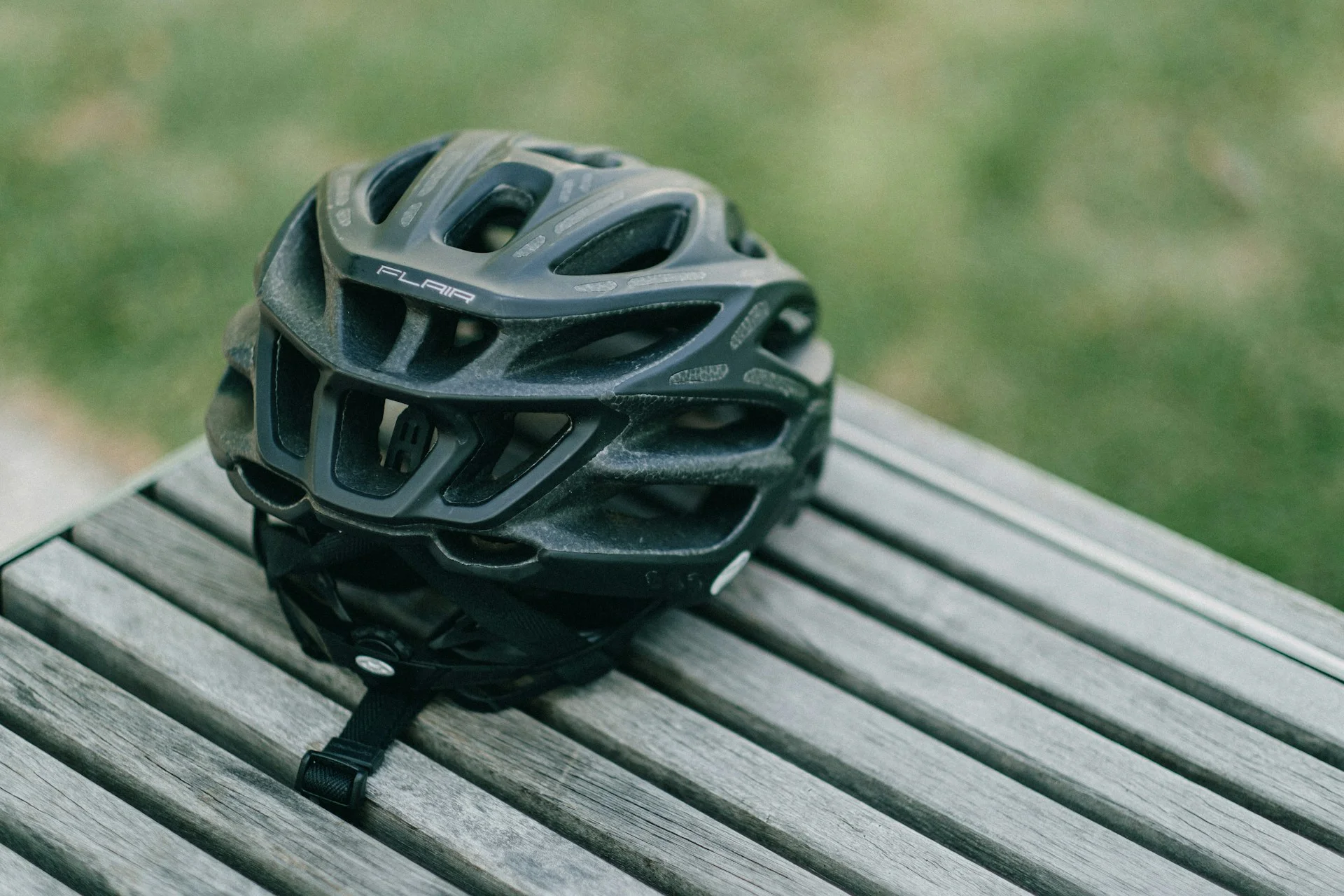
Fit and replacement affect how well it protects. The NHTSA two-finger rule: two fingers above the eyebrows, straps forming a V at each ear, two fingers under the chin strap. Replace it after any impact, even if it looks intact.
What Should You Do After Hitting Your Head in a Bike Crash?
Seek medical attention right after hitting your head in a bicycle accident, even if you feel fine, because symptoms can appear hours or days later. Adrenaline can mask them until it wears off. Prompt medical attention also creates a medical record linking your injuries to the accident.
Go to the emergency room right away for a worsening headache, repeated vomiting, growing confusion, slurred speech, weakness or numbness, one pupil larger than the other, a seizure or any loss of consciousness. These danger signs, listed by the CDC, can mean a brain bleed that needs an urgent scan.
- Call 911. Paramedics can spot signs you might miss, and the police report documents the accident.
- Stay still and check for effects. Look for dizziness, confusion, nausea or trouble focusing before you stand up.
- Take photos. Photograph the scene, your bike, your injuries and your helmet. Keep it as evidence, since damage shows where the impact landed, and do not ride in it again.
- Tell the doctor you hit your head. A normal CT scan shows no bleeding at that moment, but it cannot rule out a concussion.
- Track your recovery daily. Note head pain, light sensitivity, sleep problems, memory issues and mood changes as they happen, and rest until a doctor clears you to ride.
What Are the Long-Term Effects of a Bicycle Accident Head Injury?
Of the roughly 60,000 ER visits a year for a bike-related brain injury, most (83%) end with the patient sent home, and about 14% end with an admission or transfer, according to CDC figures for 2009-2018. Going home does not mean the injury is over.
Most people recover from a concussion within a few weeks. Some patients still have symptoms months later, a pattern doctors call post-concussion syndrome, with head pain, dizziness and slowed thinking that outlast the bruises. Moderate or severe head injuries can change work and family life for good, and the worse the initial injury, the higher the risk of lasting problems.
Recovery costs often go well beyond the initial medical bills. Long-term costs include:
- Physical therapy and cognitive rehabilitation to rebuild memory, attention and planning skills.
- Specialist consultation and follow-up imaging as conditions change over the following months.
- Lost wages or reduced earning capacity when you cannot return to the same work
- In-home assistance from a family member during the weeks you cannot manage alone.
Keep every follow-up appointment, because those records show what your treatment costs if you file a personal injury compensation claim.
Can You Get Compensation If You Weren’t Wearing a Helmet?
You can still recover personal injury compensation if you were not wearing one. Whether the lack of one can reduce damages depends on the state, and three rules decide it.
- Admissibility comes first. Many states bar or limit evidence that you rode without one, some even where a helmet law applies, while others let a jury weigh it.
- Causation comes next. It goes to your damages, not to who caused the accident. Where the evidence is allowed, the insurer has to prove one would have prevented or reduced specific head injuries, which can be harder to show for concussion.
- Any reduction is usually applied through comparative fault, lowering your whole award by a share of fault that depends on your state. Some states instead treat it as a failure to mitigate damages, which can limit the reduction to the damages tied to the injuries one would have prevented.
Every state also sets a deadline to file a personal injury lawsuit, two years in Arizona. A claim against a city, county or state agency can require a written notice of claim within months of the accident, such as 180 days in Arizona and 90 days in New York.
Riding without one does not, on its own, stop you from filing a claim with the driver’s insurance company, so get legal advice about your rights before you decide.
Talk to a Bicycle Accident Lawyer
If a driver caused your bicycle accident, BALG’s attorneys deal with the insurance company, document your injuries and estimate the cost of your future care while you recover. After a fatal bicycle accident, the firm represents families in wrongful death claims.
BALG works on a contingency-fee basis, so there is no attorney’s fee unless we recover compensation for you. Schedule a free consultation at (888) 521-6377 or contact us online.

Robert Goldwater is a cyclist representing cyclists. He has practiced personal injury and wrongful death law for more than 20 years, graduating with Honors from Arizona State University Law School, and has helped recover over $1 billion for clients, including injured cyclists.