


Bike accidents cause harm ranging from minor skin scrapes to life-changing head injuries. The most common include soft-tissue damage, broken bones (especially the collarbone), and head wounds.
Head injuries alone cause more than 60% of fatal cycling outcomes. In 2023, US hospitals treated 341,774 nonfatal cases.
Of those, roughly 50,000 involved motor vehicles, and 1,166 people died. If you have been hurt in a bike accident, a personal injury lawyer near you can review your situation.
Key Takeaways
- Head injuries are the deadliest. They occur in 22% to 47% of injured cyclists and cause more than 60% of bicycle-related deaths (AAFP, 2001; CDC MMWR, 2021).
- The collarbone breaks most often. The clavicle is the single most common fracture in cycling (clavicle fracture review, 2017), and the shoulder area is involved in 44% of bony upper-limb injuries (Tan et al., 2022).
- A bicycle helmet cuts head injury risk dramatically. Helmets reduce serious head injuries by 69% and fatal cranial wounds by 65% (Olivier & Creighton meta-analysis, 2017).
- Some conditions appear hours later. Concussion and internal bleeding can surface after the adrenaline fades, so seek medical attention even if you feel fine.
What Are the Most Common Injuries in Bicycle Accidents?
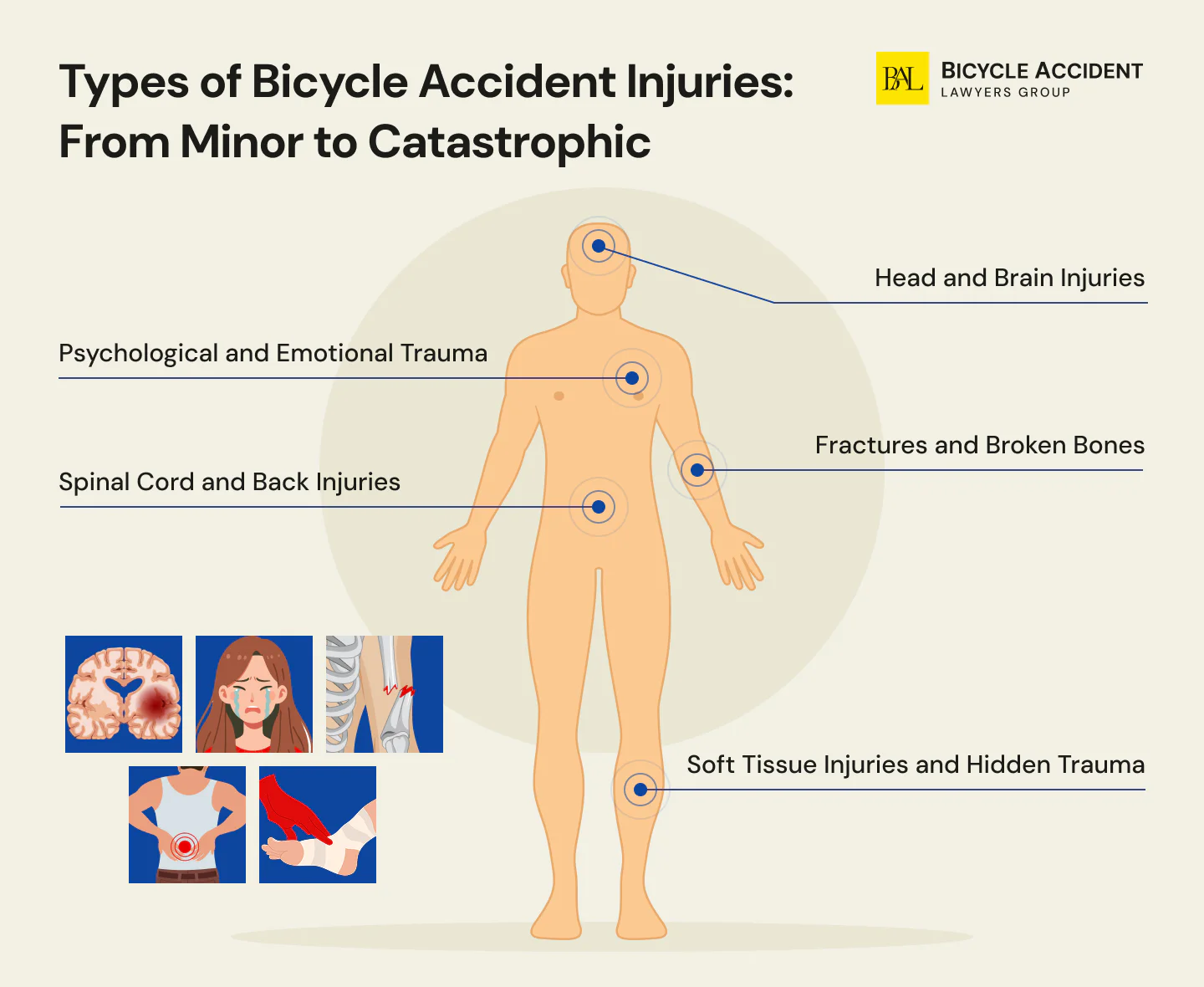
Soft-tissue damage and bone injuries are the most common conditions after bicycle accidents. Head injuries are the most likely to be fatal. A single crash often causes several types at once.
Below are the categories that bicycle riders face most often, how common each is, and how long recovery usually takes.
| Injury | What it is | How common | Typical recovery |
| Head and brain | Concussion to severe traumatic brain injury | 22 to 47% of those hurt (AAFP) | Days to lifelong |
| Fractures | Broken collarbone, wrist, hip, ribs | Collarbone is the single most common break | 6 to 12 weeks (clavicle) |
| Road rash | Skin abrasion from friction against pavement | Nearly universal in falls | Days to weeks; deep wounds may leave marks |
| Soft tissue | Muscle, tendon, ligament strains | Very common | Weeks to months |
| Facial and dental | Broken nose, cheekbone, teeth, eye | Frequent in front-impact collisions | Weeks; some need surgery |
| Spinal cord | Nerve damage, paralysis | Less common, often permanent | Often permanent |
| Internal | Organ bruising, internal bleeding | Serious crashes | Varies; can be emergent |
How Dangerous Are Head and Brain Injuries?
Head injuries cause more than 60% of fatal bicycle outcomes and most long-term harm. Between 2009 and 2018, US hospitals logged 596,972 visits for bicycle-related traumatic brain injury (TBI).
The National Highway Traffic Safety Administration also tracks these deaths in its yearly traffic safety data.
Severity ranges from a mild concussion to a skull fracture. The most dangerous form is an intracranial hematoma, a blood clot that puts pressure on the brain and causes brain damage. Symptoms such as headache, dizziness, and light sensitivity can last for weeks.
Treatment ranges from rest for mild cases to surgery and long-term support for severe TBI. In one study of 594 patients, 45% got better within two weeks and 96% by eight weeks.
A 2017 meta-analysis looked at 40 studies and more than 64,000 people. It found bicycle helmets cut serious head injuries by 69% and fatal head injuries by 65%. Yet in 2024, 68% of cyclists who were killed were not known to be wearing one.
What Bones Do Cyclists Break Most Often?
The collarbone is the bone cyclists break most often. When a cyclist reaches out to break a fall, the force travels up the arm to the clavicle.
In a 2022 study, the shoulder area made up 44% of bony upper-limb injuries, the wrist 28%, and the forearm 18%. About 30% of upper-limb cases needed a hospital stay.
Cyclists also commonly break the wrist, hip and pelvis, ribs, and arm bones. Wrists take heavy force on impact, and broken wrists often lead to weeks in a cast.
Some cases need wrist surgery. Feet are also at risk when clipped into pedals, because the pedal holds the foot in place while the body moves on impact.
A simple clavicle fracture heals in 6 to 12 weeks for adults. Complex or shifted breaks may need surgery with plates and screws. A broken rib can puncture a lung and turn into an emergency.
Road Rash and Soft-Tissue Injuries
Road rash is the most familiar cycling wound and the most underrated. Friction against pavement strips away the outer skin layers and can press debris into the tissue. This raises the risk of infection. Even minor cuts and scrapes from a bike accident need cleaning and care to lower infection risk.
If grit is not fully cleaned out, it can heal into the skin as a lasting “road tattoo.” This is why deep scrapes sometimes need surgical scrubbing (called debridement) and follow-up care to help healing.
Soft-tissue injuries often come with road rash. Bicycle riders often strain the muscles and tendons of the shoulder, neck, back, and lower legs, or hurt their hands in a fall. These conditions heal over weeks to months with rest. Good care of swollen areas can speed recovery.
Facial and Dental Injuries
Facial injuries are common because the face often hits the handlebars, the vehicle, or the road first. Facial fractures are among the most painful.
Common results include broken noses, shattered cheekbones, orbital fractures (breaks around the eye socket), dental damage, and cuts that leave marks.
Eye injuries are a serious concern, since debris near the socket can threaten sight. The 2017 meta-analysis found that helmets reduced facial injuries by about 33%.
Spinal Cord and Other Catastrophic Injuries
Spinal cord injuries are less common but among the most devastating. A spinal cord injury can cause permanent changes to movement and sensation below the position of the wound.
Depending on the position of the condition, a person might experience partial or complete paralysis. Even a mild spinal cord injury can alter body function.
Other catastrophic outcomes include amputation when a limb is dragged under a vehicle. People who suffer catastrophic injuries including moderate-to-severe brain injuries can permanently lose cognition, mobility, and speech. Severe cases may need lifelong nursing home care and ongoing support.
What Internal Injuries Can a Bike Crash Cause?
Because 82% of fatal cyclist collisions involve the front of a vehicle striking the cyclist, the torso area often absorbs a direct blow. That force and pressure can bruise or rupture organs, cause internal bleeding, or collapse a lung.
Treatment for internal conditions often requires emergency surgery, and the recovery timeline depends on which area of the body is affected and the position of the impact.
Which Injuries Show Up Hours or Days Later?
Adrenaline masks pain after a crash, so a cyclist can feel fine while a serious issue develops. Concussion symptoms often surface hours later, which is why anyone who took a hard hit should seek immediate medical attention.
Internal bleeding follows the same pattern, as does whiplash, which typically stiffens the back and neck the next morning. After any hard crash, get a medical evaluation even if you feel fine, then watch for new symptoms for 24 to 48 hours.
A prompt medical record ties your condition to the crash. If you later pursue a claim for accident injuries, a gap between the crash and your first doctor visit is the first thing an insurer uses to argue the conditions were not that serious.
How Many People Are Injured in Bicycle Accidents?
In 2023, US hospitals treated 341,774 nonfatal bicycle-related conditions, including falls, mechanical failures, and solo accidents. The CDC counts roughly 120,000 emergency department visits a year for crash-related bicyclist injuries.
For motor-vehicle traffic accidents, NHTSA recorded 49,989 people hurt in 2023, up 8% from the year before. Data from the Highway Traffic Safety Administration show that accidents involving bicycles and motor vehicles result in far worse outcomes than solo crashes among cyclists in the United States.
| Three ways to count US bike injuries (2023) | Count |
| All ER-treated bike injuries | 341,774 |
| Crash-related ER visits | ~120,000 |
| Injured by motor vehicles | 49,989 |
Car accidents and truck accidents involving those on bicycles cause far more serious injuries. For common causes and factors behind a bike crash caused by a driver, see our guide to bicycle accident causes.
What Does Recovery and Compensation Look Like?
Recovery ranges from days to a lifetime, and so does the cost. Treatment options vary by the type and severity of the condition, and many people need ongoing care even after returning home.
When a driver causes a crash, a personal injury lawyer near you can help pursue a claim to recover two forms of compensation: economic (medical bills and lost wages) and non-economic (pain and suffering). You can estimate what your situation may be worth with our bicycle accident settlement calculator.
An experienced attorney can also handle wrongful death claims when bicycle accidents result in a loss of life. Whether your situation involves catastrophic or common injuries, a personal injury lawyer near you can provide an evaluation to assess your legal position. Many offer a free legal consultation and work on contingency, meaning you pay nothing upfront for their services.
How Can You Lower Your Risk?
A properly fitted bicycle helmet is the single most effective step a cyclist can take. Front and rear lights counter the low-visibility accidents that cause most fatalities among cyclists, and predictable lane position prevents the intersection collisions that lead to the worst outcomes. Riding with hands on the handlebars, maintaining the correct body position on the bike, and staying visible to road users are factors you can control.
If you have already been hurt, an attorney can determine whether you are owed compensation. Contact a personal injury lawyer near you for a no-cost consultation.

Robert Goldwater is a cyclist representing cyclists. He has practiced personal injury and wrongful death law for more than 20 years, graduating with Honors from Arizona State University Law School, and has helped recover over $1 billion for clients, including injured cyclists.