

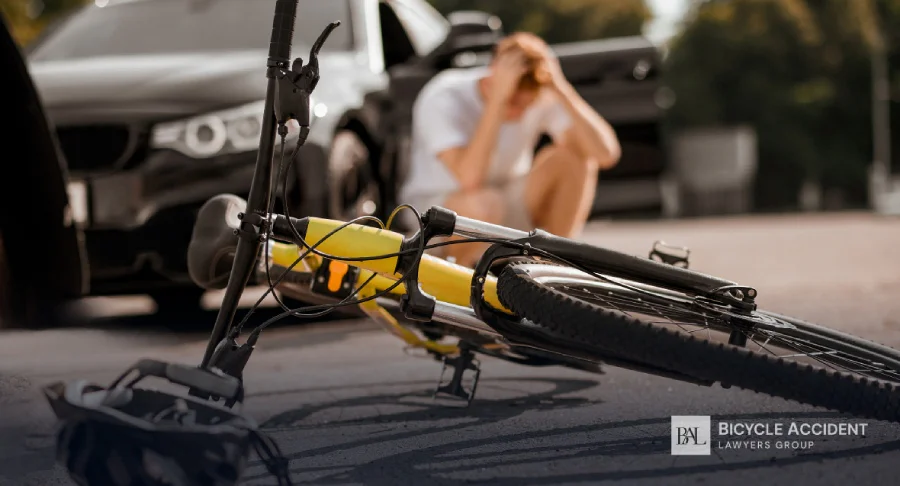
A bicycle accident claim is a coverage dispute long before it is ever a lawsuit. The first question is not how much you can get, but whose coverage pays. That depends on whether your state runs on no-fault or tort-based rules, which is why so much advice about bicycle accident claims online is confidently wrong for the person reading it.
This guide covers every step of the process in the order it actually happens, focusing on the most common kind of bicycle accident, one against a driver or their insurer. If your bicycle accident involves a motorcycle accident, pedestrian accident, rideshare accident, or truck accident with a cyclist, the same principles around compensation and reporting apply. A lawyer with experience in bicycle accidents can provide legal guidance tailored to the incident.
- Key Takeaways
- Which Insurance Pays First After a Bicycle Accident?
- What Other Coverage Applies After a Bicycle Accident?
- What should you do in the first hours after a bike crash?
- What documentation builds a bicycle accident claim?
- Who is at fault, and what happens if you were partly to blame?
- What Damages Does a Bicycle Accident Claim Cover?
- What Decides How Much Your Bicycle Accident Claim Is Worth?
- Why you should not settle before your condition stabilizes
- What Is the Deadline to File a Bike Accident Claim?
- Talk to a bicycle accident lawyer before you sign anything
- Get a FREE case evaluation today
Key Takeaways
- Your settlement tracks injury severity, with minor crashes clustering near $3,000 and severe cases reaching $500,000.
- See a doctor immediately, because every treatment gap gives adjusters an argument your injuries came elsewhere.
- Up to five separate policies can pay your claim, and the order you access them matters.
- If the driver carries state minimum coverage, your recovery may cap around $15,000 despite larger losses.
- In Arizona, California, Florida, Texas and Pennsylvania you get two years to file suit.
- Suing a city or county shortens your clock drastically, sometimes to 90 days in New York.
- Opening offers typically run 40 to 60 percent of case value, so never accept the first.
- If you crashed in Alabama, Maryland, North Carolina or Virginia, any fault at all bars recovery.
- Hire a lawyer once your filing deadline sits inside 90 days or liability is disputed.
- Keep the damaged helmet and bike unrepaired, because insurers treat that gear as physical evidence.
Which Insurance Pays First After a Bicycle Accident?
Which insurance pays first depends on your state’s system. The practical difference is money now versus money later.
- No-fault (Florida and similar states). Your own auto policy pays your early medical bills and part of your lost wages, no matter who caused the crash. Florida drivers carry at least 10,000 dollars in Personal Injury Protection, which pays 80 percent of medical bills and 60 percent of lost wages.
- At-fault (California and similar states). You file a third-party liability claim against the driver’s auto insurer, and no money moves until fault is sorted out. Wage loss is usually paid once, as part of a settlement that may be a year away. Many drivers carry only their state’s minimum coverage, which can be as low as 25,000 dollars per person.
No-fault benefits do not cover pain and suffering. To reach the driver’s insurance for the rest, your injuries generally have to cross a serious injury threshold: something permanent, a significant loss of function, or permanent scarring. Below that line, the capped PIP benefit is the whole claim.
What Other Coverage Applies After a Bicycle Accident?
Several layers sit behind the first one, paying in rough order: the liable driver’s coverage, then your own auto coverages, then your health insurance plan.
The Liable Driver’s Liability Coverage
In a tort-based state, this is the primary source, covering your medical costs, lost income, and pain and suffering up to the driver’s limits. When those limits are low, your own coverages become the real path to recovery. Insurance companies look for any gap to reduce what they owe.
Uninsured and Underinsured Motorist Coverage (UM/UIM)
Roughly one in eight drivers carries no coverage at all, according to the Insurance Research Council. If the driver who hit you was one of them, or fled the scene, UM/UIM pays from your own auto policy even though you were not in a car. Many bicycle accident victims are unaware of their rights under this coverage.
Medical Payments Coverage (MedPay)
An optional add-on to your auto policy that pays medical expenses regardless of fault, usually between 1,000 and 10,000 dollars. Insurance may cover early damages like the ambulance ride and the emergency room visit while liability is still being sorted out, so medical treatment does not wait on the insurance company.
Health Insurance
Your health insurance plan may pay your medical costs, but it does not cover lost income. Insurers do not absorb the expense either. Your health insurer can assert a subrogation lien, taking repayment out of your settlement before you see the balance.
Homeowner’s or Renter’s Coverage
This applies when no motor vehicle was involved, such as a collision with another cyclist, a solo fall caused by a road defect, or theft of the bicycle itself. Coverage details vary, and this type may also apply to incidents where a car accident is not involved.
You do not need to own a car to access car insurance after a crash. In no-fault states like Florida, a cyclist with no auto policy can still be covered by the policy of a relative in the same household.
What should you do in the first hours after a bike crash?
What you do in the next hour matters more than anything that happens in the months after it. Get out of traffic first, then work through this list:
- Call 911 and ask for the police, even if the driver wants to handle it privately. Drivers who are apologetic at the roadside often tell a very different story once their insurer gets involved. A police report locks in the facts before that happens.
- Do not apologize or guess at fault. Give the officer the facts and stop there. Anything else gets quoted back at you later.
- Get to a doctor the same day. Concussions, internal injuries and soft-tissue damage can stay quiet for hours. If there is a gap between the crash and your first medical visit, an insurer will find it and use it. In a no-fault state like Florida, that visit is not just smart. It can be a condition of getting any PIP benefits at all.
- If the driver leaves, you still have a claim. Get the plate, the make, the color and the direction, and report it the same day. A hit-and-run typically runs through your own uninsured motorist coverage, which has its own notice deadline written into the policy, not the state code.
What documentation builds a bicycle accident claim?
Your claim lives or dies on what you can prove, and most of that proof has a shelf life. Protect it in this order:
- Photograph everything at the scene. Your bike, the vehicle, the road, the traffic signals and your injuries. Wide shots first, then close-ups of damage.
- Get witness names and phone numbers. People leave. Do this while they are still standing around.
- Request nearby camera footage immediately. Business surveillance cameras can overwrite in as little as 24 to 72 hours. City traffic cameras usually last 30 to 90 days. Neither will be saved for you unless you ask.
- Do not repair or clean the bicycle. A bent frame and a cracked helmet tell the story of how hard you were hit in a way no repair invoice ever will.
- Save every bill, referral, prescription and pay stub. Get a letter from your employer confirming the work you missed. If it has a dollar amount attached to your injury, keep it.
Who is at fault, and what happens if you were partly to blame?
Liability decides whether you recover and how much. Proving a driver was responsible takes three things: they owed you a duty of care, they breached it, and that breach caused your injuries.
Most of these bicycle accidents turn on ordinary driver conduct: dooring, failing to yield, turning across a bike lane, and a distracted driver drifting into the bicycle lane. Fault assessments in bicycle accidents depend on the specific facts, witness statements, and available evidence.
What happens when you share blame depends on your state’s rule:
- Pure comparative negligence. Your compensation drops by your share of responsibility. A rider found 20 percent to blame on a 200,000 dollar award recovers 160,000 dollars.
- Modified comparative negligence. You recover compensation only while your share stays below the bar, which is 51 percent in Florida. Cross it and you recover nothing.
- Contributory negligence. In a small number of states, any share of blame can bar recovery outright.
Not wearing a helmet does not bar a claim, though an insurer may use it to argue a lower figure.
What Damages Does a Bicycle Accident Claim Cover?
A bicycle accident claim covers more than the ambulance ride. Lawyers sort damages into economic damages (losses with receipts) and non-economic losses (the ones without).
- Medical care, past and future. What you have been billed plus what your medical treatment is projected to cost. Future expenses may include surgeries, physical therapy, home modifications, and long-term support.
- Lost income and loss of earning capacity. Wages you missed, plus the value of work you can no longer do. This claim involves your ability to support dependents or return to your previous career.
- The bike and everything on it. Cyclists routinely undercount this. Damage to the bicycle may run on a separate statute of limitations, so confirm both deadlines.
- Pain, suffering, and lost enjoyment. Often the largest part of damages when injuries are serious. Includes being unable to ride, sleep, or function as you did before.
- Emotional harm. Anxiety, depression, and the fear of returning to the road after serious injuries are claimable in most states as part of the broader action.
- Wrongful death. Where bicycle accidents prove fatal, a wrongful death action may be filed by surviving family members. Damages may include funeral expenses, lost future income, and loss of companionship.
What Decides How Much Your Bicycle Accident Claim Is Worth?
No honest source can give you an average bicycle accident settlement. Value is set by five things that vary in every case.
- How badly you were hurt, and whether anything is permanent.
- What medical costs add up to, including future care you have not had yet.
- What you lost in income, now and going forward.
- Your share of blame, which cuts the figure directly.
- The coverage limits available, which cap compensation no matter how strong the case is.
That last one decides more cases than people expect. Insurance policy limits are a hard ceiling, so a catastrophic injury against a minimum-limits driver can be worth far more than anyone can actually collect. That is the point where your own underinsured motorist coverage becomes the real source of recovery.
Why you should not settle before your condition stabilizes
The release you sign ends the claim for injuries you have not finished treating. Doctors call the point where your condition levels off Maximum Medical Improvement. Before you reach it, nobody knows what your claim is worth.
- A release is final. It settles future consequences as well as the ones you have already had.
- Early offers arrive early for a reason. The cheapest moment to close a claim is before its full cost is visible.
- Financial pressure is the mechanism. Offers land while bills are stacking up and income has stopped.
Wait for the medical picture to stabilize before you agree to a number.
What Is the Deadline to File a Bike Accident Claim?
Two separate clocks run on a bicycle claim, and the shorter one is the one riders miss. The statute of limitations sets how long you have to file suit, varying by state from one year to six. Insurance and government notice periods run much sooner. Florida conditions PIP benefits on treatment within 14 days, and a claim involving a city or public road can carry a notice deadline measured in months.
For the filing deadline in your state, see our bicycle accident statute of limitations by state guide.
Talk to a bicycle accident lawyer before you sign anything
A conversation costs nothing and does not commit you. Call us for a free consultation. We will tell you which policy should be paying, what your claim still needs documented, and whether the number in front of you reflects what the injury will actually cost you. We handle bicycle accident cases on a contingency fee basis, so you pay nothing unless we recover compensation for you.

Robert Goldwater is a cyclist representing cyclists. He has practiced personal injury and wrongful death law for more than 20 years, graduating with Honors from Arizona State University Law School, and has helped recover over $1 billion for clients, including injured cyclists.