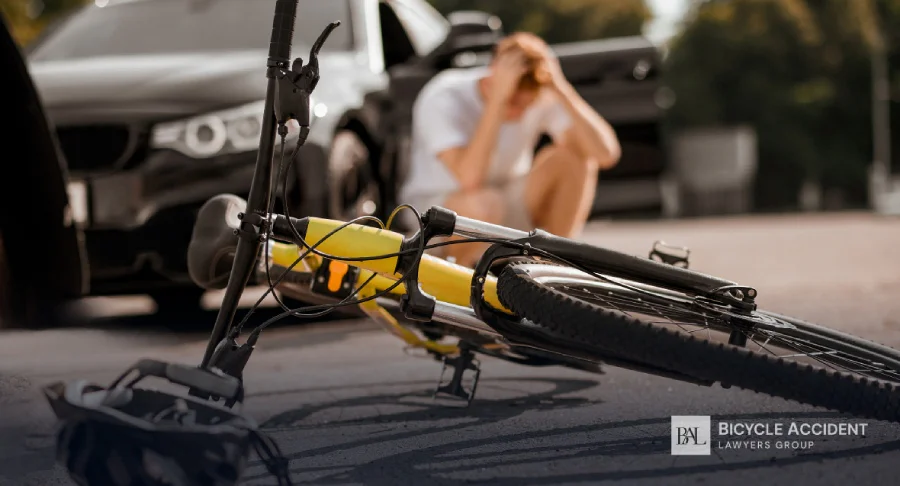

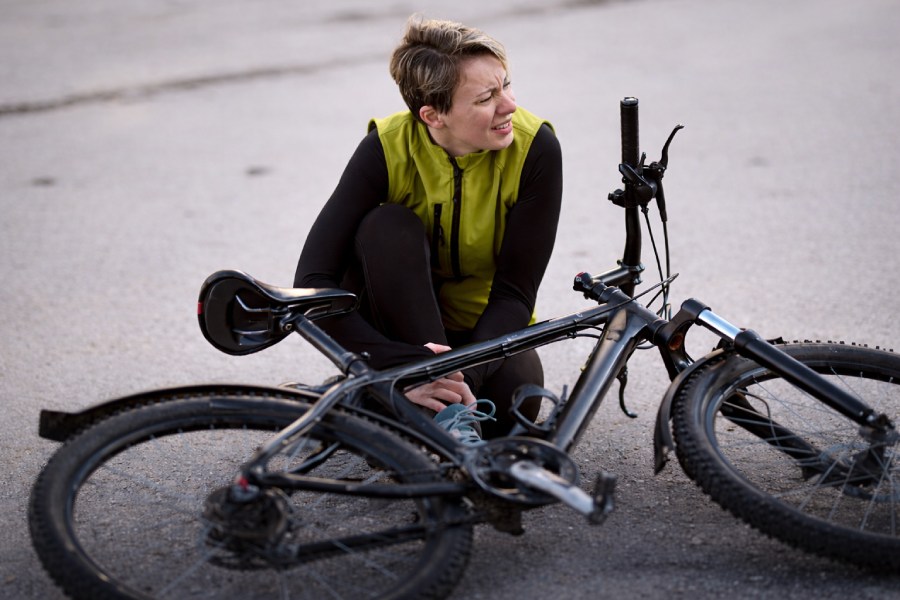
A car door, loose gravel, a slick rail. Without a bike helmet, any of these common hazards can cause serious injury in seconds. Your skull takes the full impact when nothing stands between it and the pavement.
Head injuries and traumatic brain injury
The injuries you sustain in a bicycle accident are far more severe when you’re not wearing a helmet. Concussions, contusions, and traumatic brain injury (TBI) all become more likely. TBI is damage from forceful impact, and it ranges from brief disorientation to permanent cognitive impairment.
Without protection, your skull absorbs the full force of the crash. Even a solo fall can cause severe brain trauma: memory loss, personality changes, or seizures. Head injuries are the leading cause of cyclist deaths across all crash types, and the majority of those killed weren’t wearing helmets. That is why a helmet isn’t just a comfort item — it’s the single most effective piece of safety equipment you can wear.
Facial injuries and skull fractures
Not wearing a helmet also increases your risk of skull fractures, facial lacerations, jaw fractures, and broken teeth. Your face is often the first point of contact in a crash, and the long-term consequences can include permanent scarring and sensory loss. These injuries don’t just affect your health — they affect the value of your claim and the cost of your recovery.
Bike accident without helmet statistics
If you ride without a helmet, you face worse outcomes at every level of injury severity. Bicycle head injury statistics show a consistent pattern across federal crash records and peer-reviewed research, and the gap between protected and unprotected riders is wide.
Here’s what the data shows:
- In 2022, 62% of cyclist fatalities involved riders who were not wearing helmets.
- Unprotected cyclists are roughly three times more likely to die from head injuries than those who wear one.
- More than 1,100 cyclists were killed on U.S. roads in 2022, and 1,155 deaths were reported in 2023 — the highest total on record.
- Head trauma is the primary cause of fatal cycling injuries.
How helmets reduce injury severity
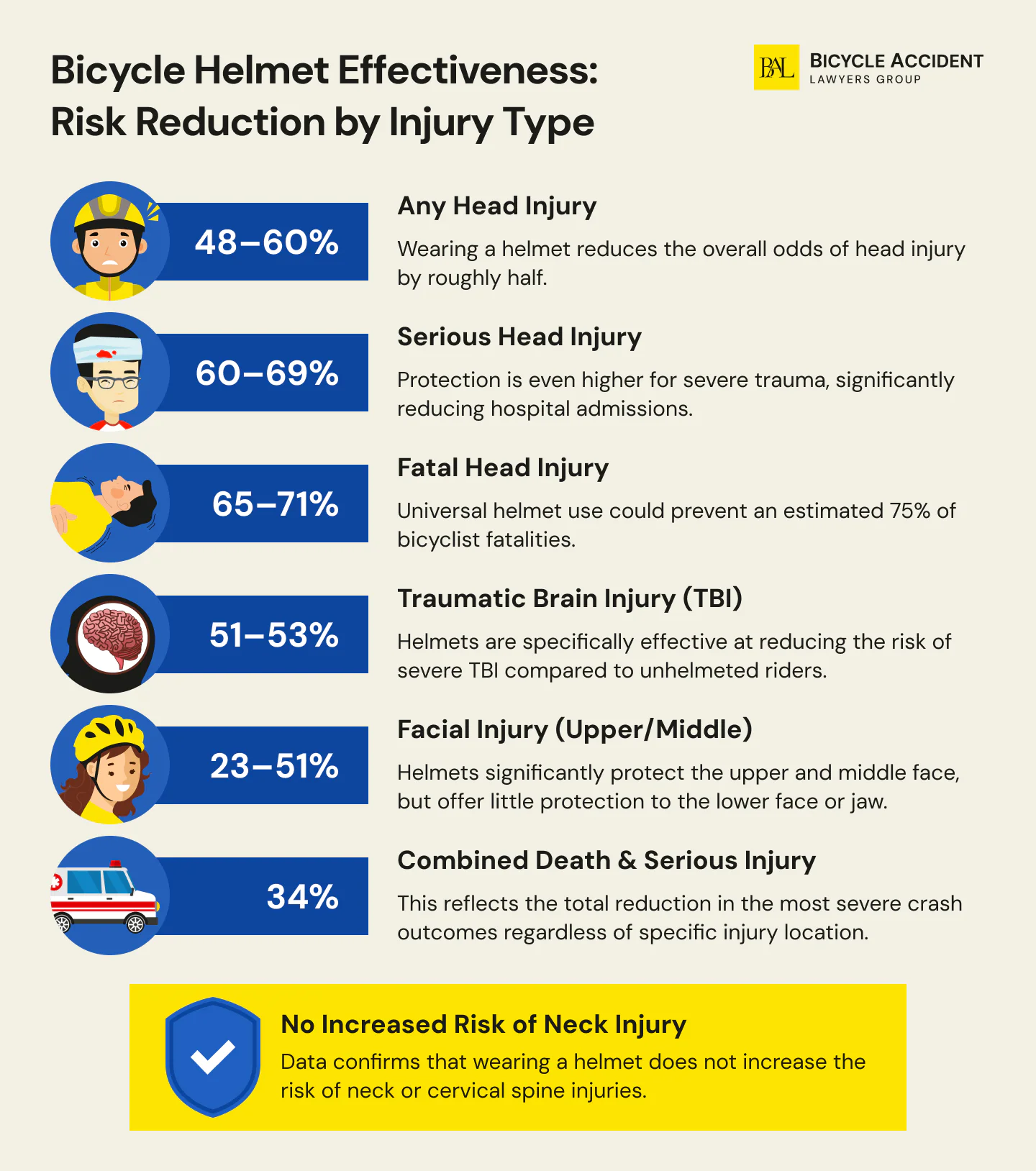
Wearing a bicycle helmet cuts your risk of head injury by roughly half compared to riding without one. A meta-analysis of over 64,000 cyclists found that protected riders had 51% lower odds of head injury, 69% lower odds of serious head injury, and 65% lower odds of a fatal one.
A separate review of 55 studies found similar results: 48% reduction in head injuries, 53% reduction in traumatic brain injuries, and 34% reduction in combined fatal and serious outcomes. Neither analysis found any increase in neck injuries — a concern you may have heard but that the data doesn’t support.
Data from a US trauma registry analysis of 6,267 cyclists with intracranial hemorrhage backs up these numbers. Only 25% were wearing protective headgear. Among them, helmet use was linked to 51% lower odds of severe TBI and 44% lower odds of death.
Risk Reduction by Injury Type
| Injury Type | Risk Reduction | What This Means |
| Any Head Injury | 48 to 60% | Wearing one cuts your overall odds of head injury roughly in half. |
| Serious Head Injury | 60 to 69% | Protection is even stronger for severe trauma, with fewer hospital admissions. |
| Fatal Head Injury | 65 to 71% | Universal use could prevent an estimated 75% of cyclist fatalities. |
| Traumatic Brain Injury (TBI) | 51 to 53% | Effective at reducing severe TBI compared to unprotected riders. |
| Facial Injury (Upper/Middle) | 23 to 51% | Protects the upper and middle face but offers little protection to the lower face or jaw. |
| Combined Death and Serious Injury | 34% | Total reduction in the most severe crash outcomes across all injury locations. |
| Neck Injury | No increased risk | Wearing one doesn’t increase the risk of neck or cervical spine injuries. |
E-bike riders face even higher stakes. A Swiss Level 1 trauma center study found that e-bike crashes were associated with a greater likelihood of moderate to severe TBI compared with conventional cycling. Higher travel speeds — often 20 to 30 mph — increase impact forces and worsen outcomes. If you ride an e-bike, a helmet isn’t optional.
How does riding helmetless affect your legal rights?
The physical risks are only half the equation. Riding without one can also carry financial and legal consequences that many cyclists don’t expect. Laws, insurance settlements, and liability rules vary by state, but the risk to your compensation is real.
Are cyclists required to wear helmets?
It isn’t illegal to ride a bike without a helmet under federal law. Only 22 states have statewide helmet laws, and most apply only to riders under 16 to 18. In most U.S. jurisdictions, adult cyclists face no legal obligation to wear one.
However, where these laws exist, they correlate with 20 to 55% reductions in head injuries among covered populations. That track record can influence how claims are evaluated after a crash. So even where wearing one isn’t legally required, riding without it may still affect your settlement.
Can riding without a helmet reduce your compensation?
Yes. Riding unprotected can reduce the compensation you recover after a bicycle accident. Insurance companies routinely argue that not wearing a helmet increased the severity of your injuries and that head protection would have reduced the damage.
This argument relies on comparative negligence — a fault-sharing rule used in most states that reduces your damages by your percentage of responsibility. For instance, a cyclist without head protection who suffers a brain injury may see their claim reduced by 20 to 40%. The exact reduction depends on your jurisdiction and the specific facts. In states without adult helmet mandates, this defense carries less weight. But a reduced settlement still affects your recovery for medical expenses, lost wages, and pain and suffering damages, whether your claim is filed locally or as part of a bicycle accident settlement in Pennsylvania or another state.
Common myths about bike helmets
If you’ve resisted wearing one, you’re not alone. The reasons most cyclists give don’t hold up against the evidence. The dangers of not wearing a bike helmet are backed by decades of crash data, yet these myths persist and bicycle accidents without one remain far too common.
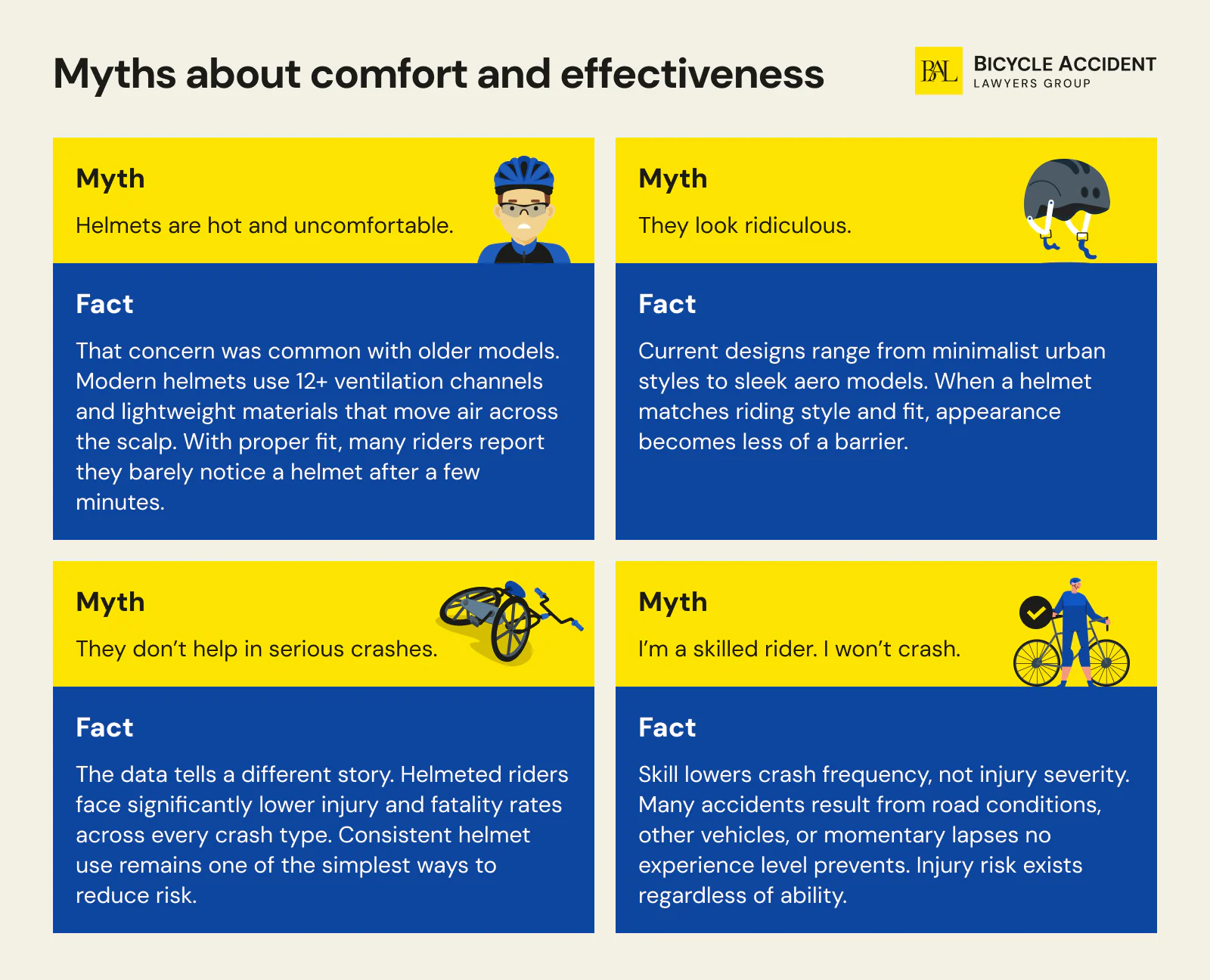
Myths about comfort and effectiveness
“Helmets are hot and uncomfortable.” That concern applied to older models. Modern designs use 12+ ventilation channels and lightweight materials that move air across your scalp. With proper fit, most riders report they barely notice one after a few minutes.
“They look ridiculous.” Current options range from minimalist urban styles to sleek aero models. When the fit and style match your riding, appearance is less of a factor.
“They don’t help in serious crashes.” Protected riders have lower injury and fatality rates across every crash type studied. Wearing one on every ride is one of the simplest ways to reduce your risk.
“I’m a skilled rider. I won’t crash.” Skill lowers crash frequency, not injury severity. Many bicycle accidents result from road conditions, other vehicles, or momentary lapses that no experience level prevents. The risk exists regardless of your ability.
Do helmets matter on short, low-speed rides?
Yes. They’re especially effective in low-speed falls, which account for a large share of cycling head injuries. While riding, your head sits roughly 5 to 6 feet above the ground. Even a stationary tip-over from that height can generate enough force to cause a concussion.
Single-vehicle crashes like falls, loss of control, or striking a curb don’t require speed to cause serious harm. The foam liner increases stopping distance, which reduces impact energy even at walking pace. Most cycling accidents happen during routine rides close to home, where you may feel safest but the danger of riding without a helmet is just as real. That is why consistent use matters on every ride, not just the long ones.
How do you choose and fit the right one?
The objections above don’t hold up, and the data backs that. The question that remains is which model to buy and how to fit it properly.
Safety standards and technology
All bicycle helmets sold in the United States must meet Consumer Product Safety Commission (CPSC) certification for impact protection. Beyond that baseline, several technologies offer added crash protection:
- MIPS (Multi-directional Impact Protection System): targets rotational brain injuries using a low-friction liner that redirects angled impact forces.
- WaveCel: absorbs both direct and rotational energy through a collapsible, honeycombed structure.
- Snell Memorial Foundation certification: a more rigorous voluntary standard for riders who want the highest level of tested protection.
For most riders, any CPSC-certified option with MIPS or WaveCel provides strong protection. Quality models start around $50.
Proper fit and encouraging children to wear one
A properly fitted helmet follows the 2-2-2 rule:
- It sits about two finger-widths above your eyebrows.
- Two fingers fit between your chin and the strap.
- The side straps form a V-shape just below each ear.
A loose or tilted fit offers far less protection, so check fit before every ride and adjust straps as needed. Replace any helmet involved in a crash or showing visible impact damage, even if it looks intact.
Children face the highest rates of bicycle-related head injuries, so consistent use matters most for young riders. Starting early is the most effective approach:
- Start with the first bike or tricycle.
- Let children choose their own color or design. This increases consistent use.
- Wear one on every ride. Parents who model the behavior have the strongest influence on whether children follow through.
Making it routine for every family ride builds the habit that protects them when it counts.
Resources
The statistics and claims in this article draw from the following peer-reviewed research and federal agency data:
- NHTSA (2024). Traffic Safety Facts: Bicyclists and Other Cyclists, 2022 Data. National Highway Traffic Safety Administration. crashstats.nhtsa.dot.gov
- Olivier, J. & Creighton, P. (2017). Bicycle injuries and helmet use: a systematic review and meta-analysis. International Journal of Epidemiology, 46(1), 278–292. 40 studies, 64,708 injured cyclists. academic.oup.com
- Høye, A. (2018). Bicycle helmets – To wear or not to wear? A meta-analysis of the effects of bicycle helmets on injuries. Accident Analysis & Prevention, 117, 85–97. 55 studies, 179 effect estimates. PubMed
- Joseph, B. et al. (2017). Bicycle helmets work when it matters the most. American Journal of Surgery, 213(3), 413–417. US trauma registry, 6,267 cyclists. sciencedirect.com
- IIHS (2025). Fatality Facts: Bicyclists. Insurance Institute for Highway Safety. iihs.org
- NTSB (2019). Bicyclist Safety on US Roadways: Crash Risks and Countermeasures. Safety Study SS-19/01. ntsb.gov (PDF)
- Papakonstantinou, K. et al. (2019). Comparison of the Incidence and Severity of TBI Caused by E-Bike and Bicycle Accidents. World Neurosurgery, 128. sciencedirect.com
- CPSC. Bicycle Safety. US Consumer Product Safety Commission. cpsc.gov

Since his academic days at the UC Berkeley School of Law, Robert Goldwater has remained a committed advocate for victims of other people’s negligence. His tort law background, together with his unquenchable thirst for justice, helped young Robert found a now-successful law firm – Bicycle Accident Lawyers Group, gathering same-minded and promising attorneys from all over the country.