
Pennsylvania bike laws give a bicycle the same rights and responsibilities as a vehicle under 75 Pa. Cons. Stat. § 3501. The grant is real but thin. Two written exceptions sit inside it, and a $10 fine covers the whole chapter. The rules you argue about on the road are rarely the ones that decide money after a collision. The passing clearance, the tort election, and the evidence shield decide it.
A motorist owes you four feet when passing, and 3510 keeps helmet non-use out of a civil case. The third rule is the limited tort election on your own car policy, which the statute never applies to you on a bicycle, one way or the other. That silence is where money changes hands. This guide walks the chapter of bicycle laws rule by rule and says what each section does to your claim, and what it does not.
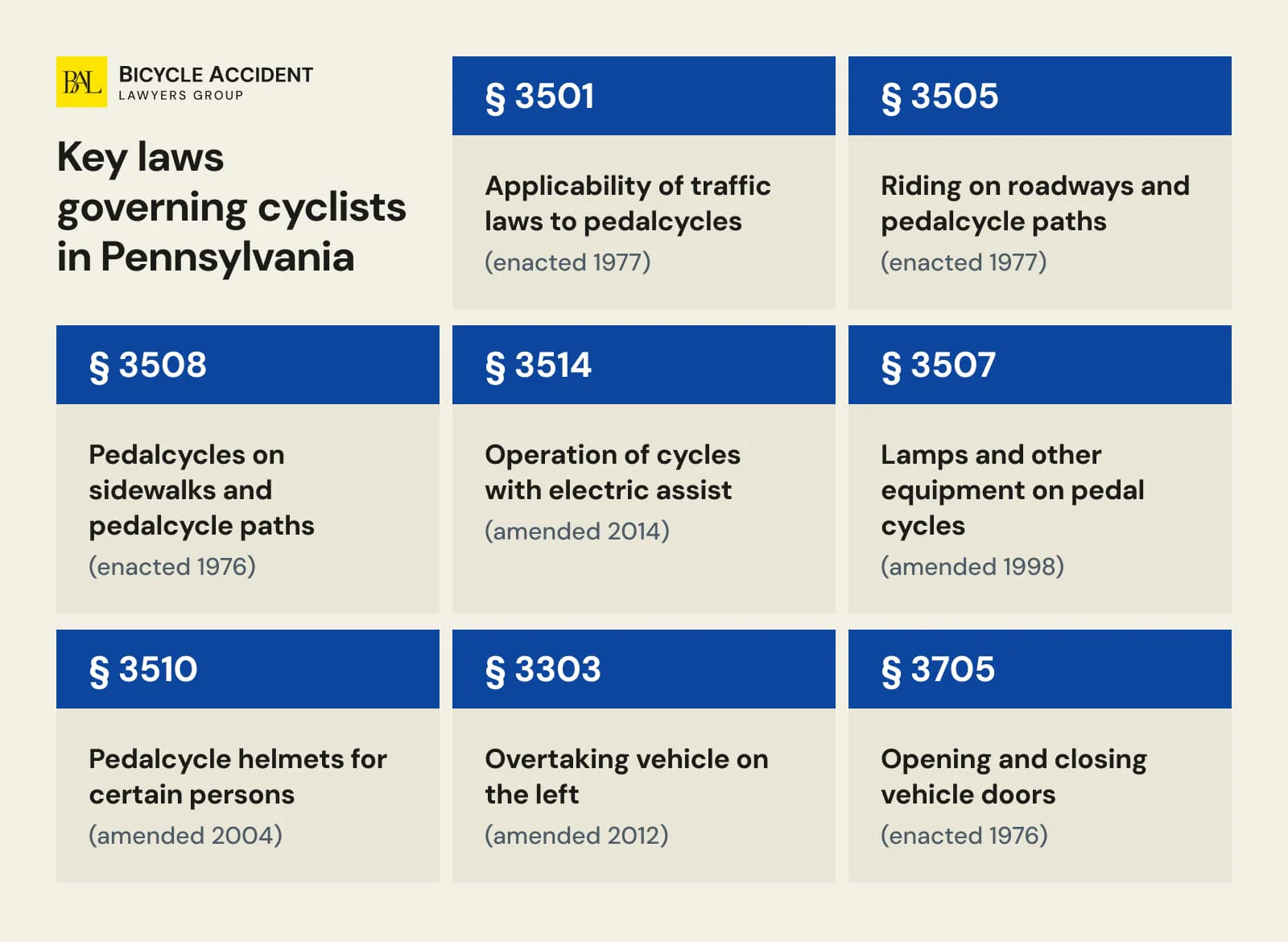
Key Bicycle Laws at a Glance
Bicycles Are Vehicles Under Pennsylvania Law
You ride with the same duties as any driver under Title 75. Pa. Cons. Stat. § 3501 grants your bicycle that status. Two written exceptions narrow the grant. The bicycle chapter carries its own provisions, and any provision that by its nature cannot apply to a bicycle does not reach you. Pennsylvania traffic laws apply in practice. Registration and inspection do not.
Section 102 defines a motor vehicle as self-propelled. A bicycle runs on human power, so it is a vehicle but not a motor vehicle. In addition, that distinction decides what you can recover. The limited tort election on your car insurance does not follow you onto a bike, so you can pursue full compensation.
Rider Rights and Lane Position on the Road
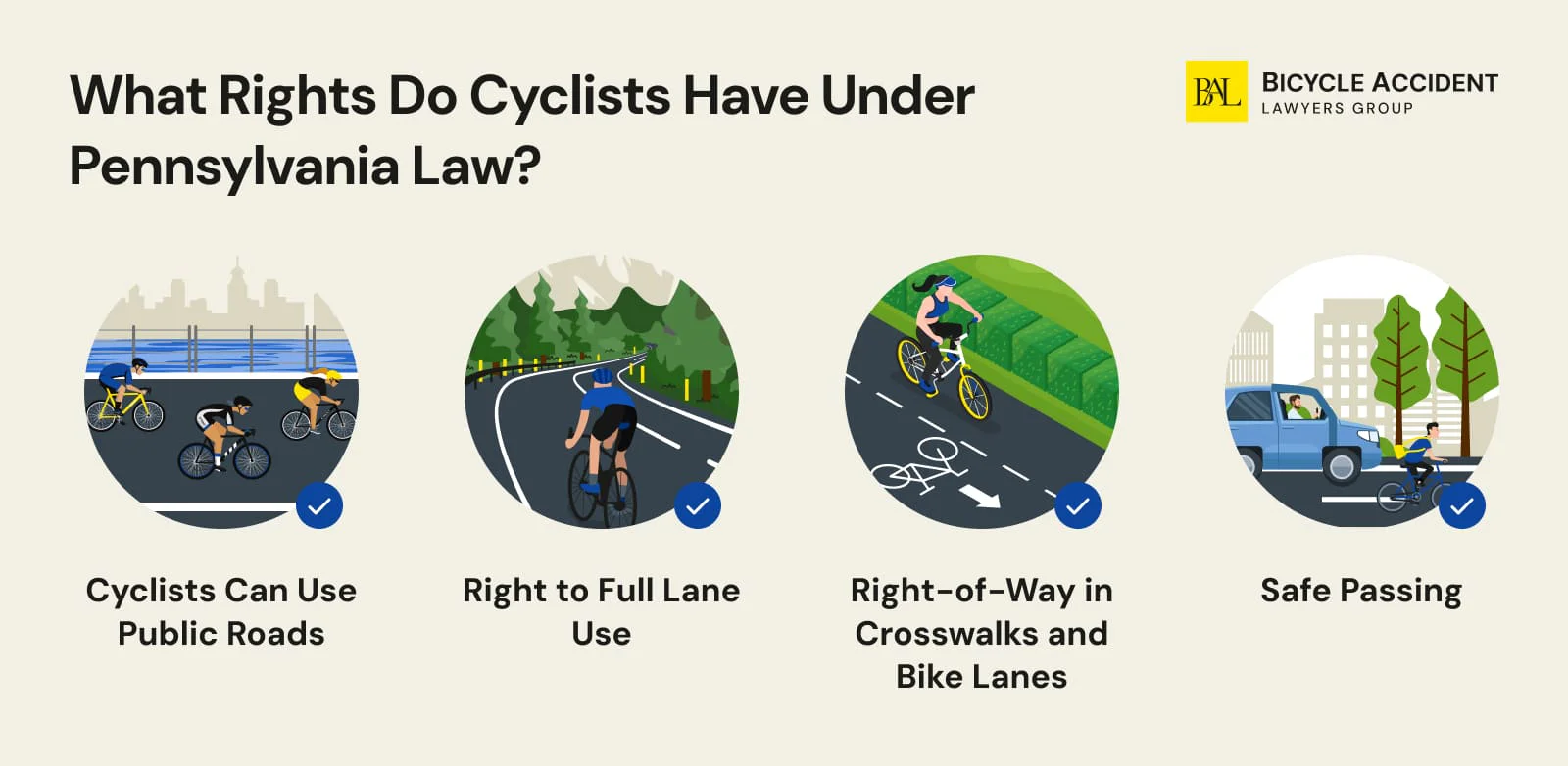
Your right to the roadway comes from 3501. The keep-right duty is a separate rule, and it is not as strict as it reads. Under Title 75, section 3505(c) sends a pedalcycle slower than traffic to 3301(c), where the statute states that persons riding pedalcycles upon a roadway shall ride “as close as practicable to the right hand curb or edge of the roadway.” That phrase carries seven exceptions:
- Too narrow. 3301(c)(2)(ii) exempts a one-way-each-way roadway entirely, so on most two-lane roads a cyclist can take the full lane.
- Hazards. 3301(c)(2)(i) lets you use any portion of the roadway to avoid an unsafe surface or other road hazard.
- Turning and overtaking. 3301(c)(1) lets you make a left turn at an intersection or driveway, and allows passing another vehicle proceeding in the same direction.
- Left edge. On a one way roadway with two or more marked travel ways, 3505(d) lets you ride as near the left hand margin as practicable.
- Path use. Act 151 of 1998 deleted 3505(f), mandatory path use, so neither bike paths nor trails are required.
- Two abreast. Cyclists may ride two abreast on the roadway, except on paths set aside for the exclusive use of pedalcycles (3505(e)).
- The shoulder. 3505(b) lets you ride the right hand shoulder of a highway in the same direction as traffic, and never requires it.
These provisions set how much roadway you can claim after a collision.
Helmet Law and the Evidence Shield
Not wearing a helmet cannot hurt your injury claim in Pennsylvania. Section 3510(c) states that your choice not to wear one cannot be used as proof in any civil action, cannot support a jury instruction, and cannot count as contributory negligence. That protection blocks the argument that helmets would have reduced your head injuries.
The rule covers only cyclists under age 12, and the $25 maximum penalty under 3510(d) is dismissed if you show you obtained a helmet.
- Under 12. A person riding, riding as a passenger, or sitting in an attached restraining seat or trailer must wear an approved bicycle helmet.
- The cure. Show proof that you acquired an approved helmet, before or at the hearing, and under 3510(b.2) the court must dismiss the charge.
- Religious exemption. 3510(b.3) excuses a child for religious reasons if the family’s church authorities provide a statement.
- Lender immunity. 3513 protects anyone who lends helmets, unless they acted intentionally or with gross negligence.
If you rode bare-headed and a car hit you, no insurer can use Pennsylvania law to cut your claim.
Safe Passing Laws: The 4-Foot Rule
Section 3303(a)(3) states that any operator overtaking a cyclist must leave at least 4 feet of clearance and slow to a careful and prudent reduced speed.
- Four feet. Pennsylvania adopted the four-feet minimum in Act 3 of 2012, while most states set the bar at three feet.
- Speed. The same sentence states the requirement for a careful and prudent reduced speed. That is the half most drivers skip, and it sits on top of the due care every driver already owes.
- Crossing over. A no-passing zone is not an excuse to squeeze past. 3307(b.1) says plainly that it “is permissible to pass a pedalcycle” in accordance with 3303(a)(3) and 3305. The double yellow line drivers blame for the close pass is the one line the Vehicle Code lets them cross for you. If oncoming traffic makes crossing unsafe, they must stop and wait behind you until the way clears.
- Bike lanes. The duty attaches to overtaking a bicycle traveling in the same direction, and motor vehicles get no written exception for designated cycling areas, shoulders, or wide roads (3303(a)(3)).
- Your claim. An operator who violates the four-feet rule hands you negligence per se, direct proof of fault rather than an argument about it.
The passing distance decides who pays.
Taking the Lane After Commonwealth v. Linton
Riding slowly in the travel lane is not automatically illegal in Pennsylvania. The Supreme Court held that 3364(b)(2) sets a fact-bound reasonableness test, not a speed threshold. The court decided it 5-2 on 17 June 2025 and remanded (No. 11 WAP 2024).
- The facts. Linton rode a two-lane state highway in Butler Township at 12 mph in a 45 zone and 19 mph in a 55 zone. Several vehicles travelling in the same direction passed him before a state trooper stopped him.
- The stakes. A $25 fine ran four years to the state Supreme Court.
- The holding. In Commonwealth v. Linton the justices called for a fact-bound assessment of reasonableness. That rejected both the argument that you never have to leave the roadway and the rule that you must whenever faster traffic approaches.
- The dissent. Two justices warned that the section gives bicyclists “no safe harbor or even an easily ascertainable rule.”
- Marked areas. A painted cycling zone does not settle it either, because 3364(b)(2) turns on the facts of your ride, not on where the paint happens to sit.
- Your ride. Drivers may still complain and an officer may still cite you, so nothing here promises a safe street.
After a collision the insurer will reach for impeding the normal flow, and Linton is what you answer it with.
Pennsylvania Bicycle Crash Statistics
Pennsylvania recorded 1,350 bicycle collisions in 2025, the highest total in five years and a 76% rise from 766 in 2021. Twenty-eight cyclists died, up from 19 in 2024 (PennDOT).
- Collisions climbed each year, from 766 in 2021, 810 in 2022, 1,100 in 2023, 1,271 in 2024 and 1,350 in 2025.
- Injuries reached 1,335 in 2025, a 77% rise from 754 in 2021.
- Bicycles take a small share of incidents and a larger share of deaths, at 1.2% of Pennsylvania’s reported collisions in 2025 but 2.7% of its traffic deaths.
- Most of it happens in daylight. PennDOT puts 67.9% of bicyclist fatalities and 75.7% of injuries in daylight, the reverse of the walker pattern (PennDOT).
A visibility defense under the lighting rules does not reach an incident at two in the afternoon. The Bicycle Coalition’s crash page sets out what to do first, and their resources cover next steps for cyclists and their families.
A statewide count proves nothing about your own collision, and neither does the accident report. 3751(b)(4) keeps the copy of a police report out of the trial record, so the claim rests on the officer’s testimony, the physical proof, and what the other party said at the scene.
Limited Tort and Insurance After a Bicycle Collision
Your limited tort election probably does not follow you onto a bicycle, because 1705 is written around a person occupying a motor vehicle.
The statute is silent, and a court filled the gap. In L.S. v. Eschbach, 874 A.2d 1150 (Pa. 2005), the state Supreme Court held that a limited tort election did not bar a struck pedestrian’s claim for pain and suffering. That was a pedestrian case, and the statutory silence it relied on covers you the same way.
Your own uninsured and underinsured coverage probably is not barred either. 1731(d)(2) shuts off UM and UIM noneconomic damages only for anyone already precluded under 1705. Rump v. Aetna, 710 A.2d 1093 (Pa. 1998), applied the bar to someone hurt in a motor vehicle collision, not to you on a bicycle.
Your own auto policy pays the medical bills first, regardless of fault:
- 1713(a) puts the policy naming you as insured at the top of the first-party priority list, then a policy covering you as a household resident.
- If there is no car in the household, 1713(a)(4) sends a non-occupant to the policy on any motor vehicle involved in the collision.
The coverage itself is elective. 1731 makes the offer mandatory and the purchase optional. Rejecting it takes a signed form, so if you signed one you have nothing behind a hit-and-run driver.
Fault and Deadlines on a Pennsylvania Bike Claim
Your recovery vanishes at 51% fault. 42 Pa. Cons. Stat. § 7102 sets that bar in Pennsylvania. Below it, modified comparative negligence reduces your compensation by your exact percentage of fault.
- The fifty-one percent bar. An adjuster who nudges your share of the blame past half does not trim the claim but ends it. Fault gets argued long before anyone discusses a settlement figure.
- Two years. That is the deadline to file suit on your own injury claim under 42 Pa. Cons. Stat. § 5524(2). A missed filing ends the action whatever the medical records show.
- A child’s clock. The claim is paused until the eighteenth birthday. 5533(b)(1) keeps the period of minority out of the two-year clock, so a parent who waits is not forfeiting the child’s own claim.
- Government claims. A claim against PennDOT or a municipality needs written notice first. 5522(a) gives you six months from the injury to file that statement with the government unit. Miss that deadline and a pothole claim can die quietly while you are still in physical therapy.
- Your own conduct. This is where the percentages come from. A missing light at night hands the insurer a comparative negligence argument. Helmet non-use is different, because 3510(c) keeps it out of a civil action entirely.
Settle the fault percentage early, because every rule in this chapter stops mattering if the adjuster writes the wrong number down. Contact a bicycle injury attorney before that happens.
Cyclist Duties and Prohibitions
An insurer hunts these rules for anything you broke, because your fault share comes off your recovery (42 Pa. Cons. Stat. § 7102).
- The bans. No person shall cling to moving vehicles, no extra riders are permitted on parts not designed for passengers, and 3506 states that at least one hand must stay on the handlebars at all times.
- Earphones and earbuds. Under traffic laws, 3314 bars operating a vehicle unless the operator removes all headphones or earbuds before riding. The statute reads “wearing or using one or more headphones or earphones.” Earbuds fall under the same prohibition, and a single earbud breaks it. The only exception is a single-ear headset for a cellular telephone.
- Signals. Under Title 75, every person riding a pedalcycle on a roadway shall give signals before every maneuver. 3334 sets that requirement, and 3336 lets you signal a right turn with your right arm extended straight out, or indicate a left turn with the left arm raised. In practice, arm signals remain the minimum standard for bicyclists on Pennsylvania roadways. A cyclist who extends an arm in the proper direction satisfies the duty, and any visible arm signal counts. Failure to give proper signals is a common basis for comparative fault arguments.
Where You Can Ride in Pennsylvania
The Vehicle Code closes one class of road to bikes. Every other public street is open to you, subject to local ordinance.
- Freeways. Section 3511 bars riding a pedalcycle on a freeway. PennDOT can open a stretch where no alternate route exists, and there you must be 18 or older or accompanied.
- Sidewalks. Sidewalk rules change block to block. No person shall ride a sidewalk in a business district unless permitted by official traffic control devices (3508). In addition, local laws in many Pennsylvania cities add their own restrictions on sidewalks and shared-use paths.
- Pedestrian right-of-way. You owe pedestrians the right-of-way on a sidewalk. A cyclist shall yield and give an audible signal before overtaking pedestrians on shared paths (3508). Ride through a crosswalk and you fall outside the protection that 3542 gives pedestrians, because 102 defines a person on foot. Dismount and you qualify.
E-Bike Laws in Pennsylvania
Pennsylvania puts every e-bike into a single legal category, not the three-class system other states use. Standard bicycles and e-bikes share the same chapter of the Vehicle Code.
A pedalcycle with electric assist weighs no more than 100 pounds and carries a motor rated at 750 watts or less. It must be “capable of a speed not more than 20 miles per hour on a level surface when powered by the motor source only”. That tests what the motor can do, not where assist tapers off.
The restriction is on the machine. A federal Class 3 e-bike doing 28 mph is not legal here, and House Resolution 351 only asked the Joint State Government Commission to study a change. Several states have adopted three-tier systems, but Pennsylvania has not.
3514 sets 16 as the minimum age for e-bikes. In practice, enforcement on age varies across the state.
Required Equipment and Lighting
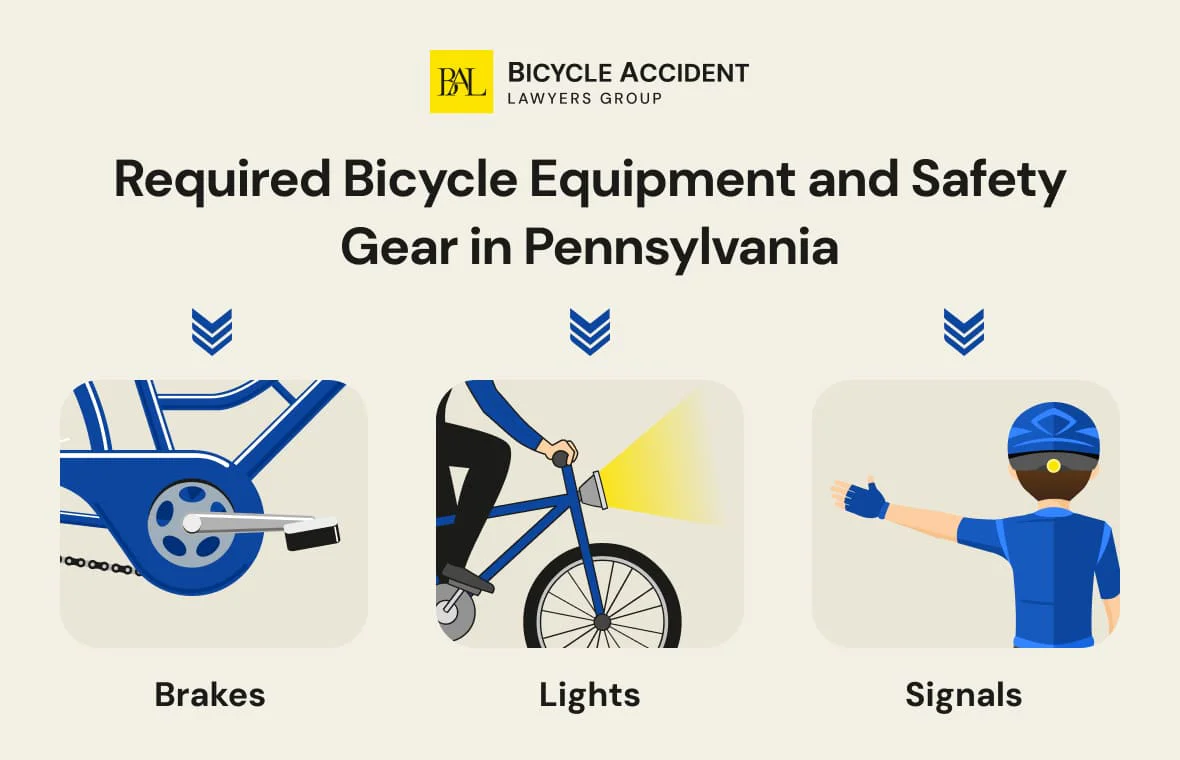
Your bike needs brakes and lights to ride legally in Pennsylvania. 75 Pa. Cons. Stat. § 3507 sets the standard: a brake that can stop you within 15 feet from 15 mph, and a front lamp from sunset to sunrise.
- Brakes. Bicycles must stop within 15 feet from 15 mph on dry, level, clean pavement (3507(c)). Failure to meet the braking requirement in practice is a basis for comparative fault.
- Front lamp. From sunset to sunrise you need a front lamp emitting white light visible from at least 500 feet (3507(a)).
- Worn lights. A light you wear on your body satisfies the requirement if it is visible at that distance, so you do not have to mount it on the bike.
- Rear reflector. A red rear reflector visible from at least 500 feet is required on the right side, and a rear light is permitted on top of it.
- Side visibility. An amber device on each side completes the set.
A missing headlight is the first thing an insurer reaches for after a night crash.
Can You Get a DUI on a Bicycle in Pennsylvania?
Yes. The DUI provisions reach a person operating a vehicle, and 3501 subjects you to the duties of a driver. A first offense brings probation, a $300 fine and a criminal record under 3804(a), with a penalty that can include mandatory treatment. 3804(e)(2)(iii) leaves your license alone if the first offense is ungraded.
Driver Duties Toward Cyclists
Driver behavior leads to the most fatal collisions on Pennsylvania roadways. Drivers carry the statutory burden to yield at each intersection, slow when passing you, and check mirrors before opening a door on the traffic side. Paul Miller’s Law (3316.1) took effect 5 June 2025. After the warning year closes 6 June 2026, a hand-held device draws a $50 citation and penalty that becomes part of your collision file. Contact an attorney with the information in a cyclist’s collision report early, because it strengthens the claim.
Dooring Accidents
A dooring incident gives you a statutory violation to build your claim on. 75 Pa. Cons. Stat. § 3705 bars opening a vehicle door until it is reasonably safe and clear of traffic, including bikes near a parking area. It also bars leaving a door open on a traffic side longer than loading takes.
The rule says no person, not no driver, so a rideshare passenger who doors you carries the same liability. 42 Pa. Cons. Stat. § 7102 still trims your damages by your share of the fault and bars recovery at 51%.

Robert Goldwater is a cyclist representing cyclists. He has practiced personal injury and wrongful death law for more than 20 years, graduating with Honors from Arizona State University Law School, and has helped recover over $1 billion for clients, including injured cyclists.