

Yes, in most states you can face charges for riding a bike under the influence. Statutes covering “any vehicle” include bicycles; those saying “motor vehicle” usually do not. That can bring fines, potential jail time, a criminal record, and in some states the loss of your license. Many people assume biking home is the responsible choice, but DUI laws do not always agree. The penalties can follow you for years.
We read the impaired-driving statute in all 50 states and D.C. Seventeen make impaired riding a chargeable DWI or DUI, 23 leave room for related charges, 10 exempt riders outright, and Georgia is unresolved.
- Key Takeaways
- Which Word in Your State’s DUI Statute Decides the Case
- What Is a DUI on a Bike Called?
- What Happens If You Are Convicted?
- Does a Cycling DUI/DWI Affect Your License?
- Your Record, Priors, and Expungement
- Will a DUI/DWI Show Up on a Background Check or Affect Your CDL?
- Can You Get a DUI on an E-Bike or Scooter?
- DUI Charges Even Where No Cycling Law Exists
- What Actually Gets a Rider Stopped
- Can You Refuse a Breath Test While Riding?
- Which States Can Charge You With a Bicycle DUI?
- How Common Are Alcohol-Related Cycling Fatalities?
- How Can You Fight a DUI/DWI Charge for Riding?
- Is Biking Home Drunk the Responsible Choice?
- The Costs Nobody Warns You About
- Get a FREE case evaluation today
Key Takeaways
- You can face a chargeable bicycle DUI in 17 states, according to the statutes reviewed here.
- If your state’s DUI law says “any vehicle,” your bicycle is almost certainly covered.
- A “motor vehicle” statute usually cannot reach your pedal bike, though a motor changes everything.
- Ride an e-bike after drinking and you face full DUI exposure in most states.
- Arizona excludes bicycles from its DUI code, but reckless driving or endangerment charges still apply.
- Even in exempt states, you risk public intoxication, disorderly conduct, or open-container charges.
- Your rider DUI can count as a prior that escalates a future driving DWI.
- Implied consent rarely reaches cyclists, so no one can force your breath test in most states.
- If you hold a CDL, a DUI conviction can disqualify you from commercial driving for one year.
- Your impaired ride can cut your injury payout if a driver hits you.
Which Word in Your State’s DUI Statute Decides the Case
A DUI statute covering “any vehicle” reaches a bicycle, because most codes define the term as any device transporting a person upon a highway. A “motor vehicle” law usually cannot touch a pedal cycle; a bicycle does not meet that definition in any state code we reviewed.
Fla. Stat. 316.193 makes it a DUI to drive or be in “actual physical control” while impaired by alcohol or other substances. Section 316.003 sweeps in bicycles, golf carts, and riding lawnmowers. “Actual physical control” matters: in some states you can be charged sitting on a stationary cycle.
The threshold is the same as the driver’s face: 0.08% blood alcohol concentration, with Utah lower at 0.05% (Utah Code 41-6a-502).
What Is a DUI on a Bike Called?
Many of you are mostly familiar with the notion of Driving Under the Influence (DUI). However, there are other acronyms that come up when you research the topic. They often leave the reader wondering whether they stand for the same thing or are entirely different. Let’s start with simple explanations:
- DUI — Driving Under the Influence:
- DWI — Driving While Intoxicated
- OWI — Operating While Intoxicated
- BUI — Bicycling Under the Influence
DUI is a nationwide term used to describe the act of driving a vehicle under the influence of alcohol or other forbidden substances. DWI can be used interchangeably, but it depends on a separate state’s statutes. For instance, in North Carolina, DWI is used against parties with blood alcohol levels over 0.08%. At the same time, in Texas, the same acronym is applied to adults and DUI concerns younger operators (under 21).
OWI is a lesser-used term, but it also describes operation of a vehicle while under the influence of alcohol or drugs. Yet, in some cases, it can be applied to parties who aren’t even moving at the moment of the citation.
BUI is the least common acronym since it affects people operating bikes, and only a few states have it in use.
What Happens If You Are Convicted?
A DUI/DWI conviction for riding impaired carries consequences: fines from hundreds to thousands of dollars, stacked court costs, potential jail time up to a year, and mandatory alcohol education programs. The result in most states is a misdemeanor. California is the outlier: capped fine, no jail (CVC 21200.5). If the DUI case involves drugs, the penalties can increase.
Does a Cycling DUI/DWI Affect Your License?
Whether a riding DUI suspends your license depends on the state.
- Full suspension, same as a DWI. Pennsylvania treats a riding DUI under the same DWI statute; sanctions, jail, and suspension apply. Florida goes further: revocation, and the result counts as a prior.
- Structurally untouchable. Illinois excludes human-powered devices from its code, so a drunk rider faces charges like disorderly conduct that never trigger suspension.
- Split by age or device. California’s adult infraction adds no DMV points for riders 21 and over. Under-21 riders face one year of suspension. Utah applies full DUI to cyclists yet leaves the license alone.
Your Record, Priors, and Expungement
A riding DUI is a misdemeanor on your record in most chargeable states, can count as a prior that escalates a future DWI, and is not always expungeable. Florida: identical to a DWI, prior-eligible, permanent. California: expungeable, no points. If you hold a commercial driver’s license, speak with a DUI defense attorney.
Will a DUI/DWI Show Up on a Background Check or Affect Your CDL?
A misdemeanor DUI/DWI surfaces on background checks for jobs, housing, licensing, and insurance. In many DUI cases, individuals underestimate how far it reaches into daily life.
Commercial drivers face a harsher standard. Under FMCSA regulations, a DUI/DWI conviction or BAC of 0.04% while operating a commercial vehicle triggers a one year CDL disqualification (49 CFR 383.51), barring you from driving a school bus or hauling hazardous materials. If you hold a CDL, get an attorney involved before you say a word. Lawyers and law firms with DWI experience offer a free consultation to clients in this situation.
Can You Get a DUI on an E-Bike or Scooter?
The legal answer changes when a motor is involved. Many states classify e-cycles and e-scooters as motor vehicles, so a full DUI applies even where a pedal cycle is exempt.
- The motor closes the exemption. A “human-powered” carve-out stops once a motor assists. Illinois, Michigan, and Oklahoma leave room for standard DUI on a qualifying e-cycle while exempting pedal cycles. Individuals face the same DWI sanctions as a person driving, including ignition interlock requirements.
- New York wrote a separate law for it. VTL 1242-a is the only purpose-built e-cycle impaired-riding statute we found.
- 2026 law enforcement is an e-cycle story. A Seminole County assistant principal was arrested for DUI on an e-cycle after deputies warned him not to ride home (ClickOrlando, July 17, 2026). Winter Springs officers charged a rider who fell off an e-cycle at 3 a.m. (ClickOrlando, February 10, 2026).
- Scooters and skateboards. A motorized scooter is a conveyance in most codes; kick scooters and skateboards are not, though public-impairment charges apply.
If you ride anything motorized after drinking, assume full DUI until your state says otherwise.
DUI Charges Even Where No Cycling Law Exists
No riding DUI in your state does not mean you avoid DUI charges. Officers reach for public intoxication, disorderly conduct, reckless driving, reckless endangerment, and open-container violations. Arizona excludes bicycles from its DUI code, yet reckless driving or endangerment can be a felony. Arkansas has no DUI law for riders, but public-drunkenness brings probation or jail days.
Open-container laws are the quiet trap. In Florida the statute covers anyone operating any vehicle on a public roadway, bicycles included. Across exempt states, the riding may be legal, but the impairment rarely is. Reckless driving and related charges can rival a DWI in some jurisdictions.
What Actually Gets a Rider Stopped
The practical stop trigger is a visible open container. Police and officers also respond to falls or swerving into traffic. In the 2026 DWI cases we reviewed, the trigger was a tall can in the rider’s hand (CHP Merced, July 2026), a fall in front of officers, or a lane departure. This behavior draws attention regardless of whether your state has a DUI law covering riders.
Once stopped, officers can issue field sobriety tests and request a breath test. In states like Pennsylvania, implied consent extends to riders, so refusing a chemical test carries consequences. What you say matters; your rights are the same as in any DWI encounter. A lawyer with DUI experience can review the results and advise on next steps.
Can You Refuse a Breath Test While Riding?
Implied consent requires motorists to submit to a breath test, but these laws almost never reach riders on traditional cycles.
- Why do riders usually skate by? Even where DUI applies, implied consent covers motorists only. Nobody can force a breath test or blood test the way they can on a person driving. Colorado: DUI applies, but consent is excluded for riders (CRS 42-4-1301.1).
- What that means for your case. No mandatory breath test means the prosecution builds from officer observations, field sobriety tests, and whatever you volunteer. Without reliable test results, the case weakens.
- When refusal backfires. Where implied consent applies, refusal of a breath test goes against you at trial and gives officers grounds to dig further. Talk to an experienced DWI lawyer before you decide; the choice shapes your case and the result.
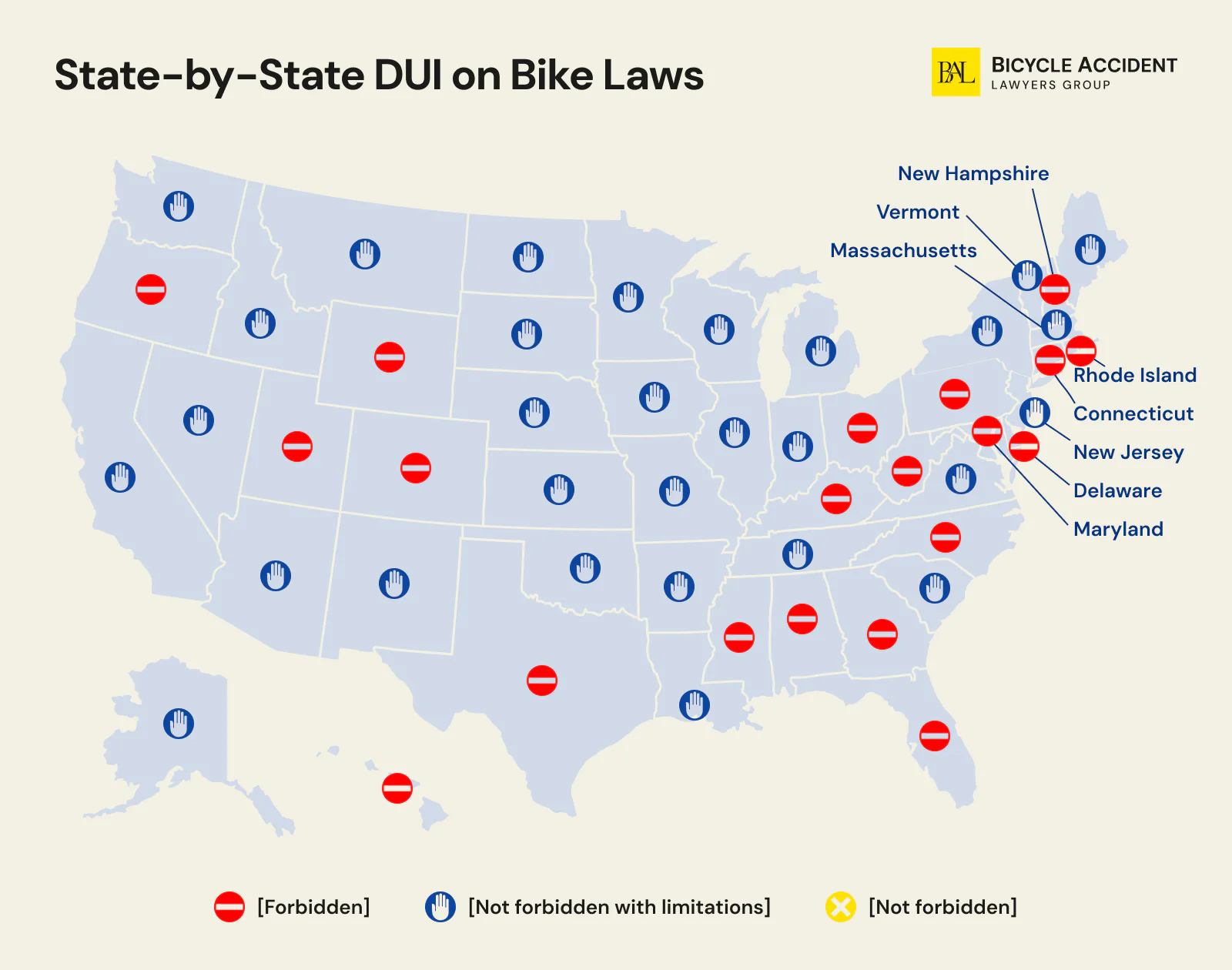
Which States Can Charge You With a Bicycle DUI?
Every state draws the line by how its statute defines a “vehicle.” For an independent summary, see the League of American Bicyclists BUI chart.
- Forbidden (17 states). Chargeable DUI/DWI, full DWI in most, a lighter citation in a few like Oregon and Delaware.
- Allowed with limitations (23 jurisdictions, including D.C.). DUI statute excludes pedal cycles, but other charges and traffic violations can apply.
- Allowed (10 states). General statutes do not apply to riders.
- Contested (Georgia). DUI technically applies, but sentencing consequences are stripped out.
| State | Status | Rule in brief |
| Alabama | Forbidden | Covered. First offense: $600–$2,100, up to a year, suspended driving privileges. |
| Alaska | Allowed with limitations | DUI covers motorists only. Public intoxication applies. |
| Arizona | Allowed with limitations | ARS 28-101 excludes human-powered transport. Reckless driving or endangerment possible. |
| Arkansas | Allowed with limitations | Not covered. Public drunkenness: up to $500, probation, or 30 days. |
| California | Allowed with limitations | CVC 21200.5: $250 max, no jail, expungeable (21+). Under-21: driving privileges suspension. |
| Colorado | Forbidden | Covered (CRS 42-1-102). Full DUI and DWAI at 0.05%. No license points. |
| Connecticut | Forbidden | Bikes and e-cycles covered. Over $500, jail, probation, community service. |
| Delaware | Forbidden | Impaired-riding rule with jail. Violations not added to driving history. |
| Florida | Forbidden | Full DUI (Fla. Stat. 316.193): $500–$1,000, up to 6 months, revocation. Prior-eligible. |
| Georgia | Contested | DUI applies but 40-6-291(a) strips sentencing: misdemeanor ($1,000, 12 months), no driving privileges impact. Unresolved. |
| Hawaii | Forbidden | Covered. Jail, probation, 14-hour program, 72 hours community service. |
| Idaho | Allowed with limitations | DUI covers motorists only. Public impairment or disorderly conduct available. |
| Illinois | Allowed with limitations | 625 ILCS 5/1-217 excludes human-powered transport. E-cycle DUI: Class A misdemeanor, $2,500, a year max. |
| Indiana | Allowed | Neither bikes nor e-cycles covered. Public impairment or reckless driving applies. |
| Iowa | Allowed with limitations | Cycles and low-speed e-cycles exempt. Reckless behavior or public-impairment offenses possible. |
| Kansas | Allowed with limitations | No statewide rule. Wichita BUI: up to $500 or six months. |
| Kentucky | Forbidden | Impaired riding illegal, no sanctions below 0.05 BAC. E-cycles face standard DWI. |
| Louisiana | Allowed with limitations | DWI covers motorists only. Public impairment or jail applies. |
| Maine | Allowed with limitations | Impaired-operation statutes cover motorists only. Traffic violations or reckless-riding citations apply. |
| Maryland | Forbidden | Covered. Up to a year, $1,000 fine. E-cycles included. |
| Massachusetts | Allowed with limitations | DUI excludes human-powered cycles. Citations for hazardous conditions possible. |
| Michigan | Allowed with limitations | OWI covers motorists; pedal cycles exempt. High-power e-cycles may trigger fines, jail, suspension. |
| Minnesota | Allowed with limitations | DWI covers motorists only; pedal cycles excluded. E-cycles may trigger DWI. Reckless conduct possible. |
| Mississippi | Forbidden | Covered. $250, up to 48 hours jail, alcohol safety programs. |
| Missouri | Allowed | DUI covers motorists only. Bikes and standard e-cycles exempt. Reckless driving can draw charges. |
| Montana | Allowed | Both traditional and e-cycles excluded from DWI. |
| Nebraska | Allowed with limitations | DUI does not apply to traditional cycles. Dangerous riding citable. |
| Nevada | Allowed | Not covered. Serious collision can bring charges. |
| New Hampshire | Forbidden | DUI covers all conveyances. Up to $500, screening, education program. |
| New Jersey | Allowed | Courts confirmed DUI covers motor vehicles only. Reckless riding: disorderly-person act. |
| New Mexico | Allowed with limitations | Not covered under DUI law. Reckless behavior carries consequences. |
| New York | Allowed with limitations | Exempt from DWI (VTL 1192). E-cycle: $300 fine, up to 15 days (VTL 1242-a). |
| North Carolina | Forbidden | Standard and electric cycles covered (20-138.1). Tracks DWI: jail, suspension. |
| North Dakota | Allowed | Exempt since 2023 (HB 1506). $200 sanction for road threats. |
| Ohio | Forbidden | All cycle types covered. Jail, suspension, probation. |
| Oklahoma | Allowed with limitations | Pedal cycles not covered. Motorized e-cycles can trigger standard DUI. |
| Oregon | Forbidden | Impaired-riding statute (ORS 814.040): $500 fine, no record impact. |
| Pennsylvania | Forbidden | DUI code applies to riders. Same DWI consequences: probation, jail, suspension. |
| Rhode Island | Forbidden | Covered. $100 fine, up to 60 hours community service or a year in jail. |
| South Carolina | Allowed with limitations | DUI focuses on motorists. E-cycles may face sanctions. Public impairment applies. |
| South Dakota | Allowed with limitations | DUI excludes human-powered conveyances. Disorderly conduct possible. |
| Tennessee | Allowed with limitations | DUI targets motorists. Reckless riding or driving possible. |
| Texas | Allowed | DWI covers motorists only (Penal Code 49.04). Public intoxication: endangering yourself or others. |
| Utah | Forbidden | DUI at the lowest BAC limit, 0.05%. No license impact. Jail applies. |
| Vermont | Allowed | Excluded from the motorized classification. Reckless riding separately citable. |
| Virginia | Allowed | DUI covers motorists only. Exempt, though other offenses can apply. |
| Washington | Allowed with limitations | Exempt from DUI. Officers can move impaired person to safety (RCW 46.61.790). |
| West Virginia | Allowed with limitations | Pedal cycles not covered. E-cycles: up to six months, $500 sanction. |
| Wisconsin | Allowed | OWI covers motorists only. Reckless behavior or public endangerment chargeable. |
| Wyoming | Forbidden | All cycle types covered under DWI law. Jail, probation, suspension. |
| Washington, D.C. | Allowed with limitations | DUI may apply, enforcement varies. Contributory negligence applies. |
How Common Are Alcohol-Related Cycling Fatalities?
An estimated 22% of cyclists killed in 2023 had a blood alcohol concentration of .01 g/dL or higher, and impairment was reported in 34% of fatal US bicyclist crashes that year (NHTSA, Traffic Safety Facts 2023). That year 1,166 people died and 49,989 were injured on US roads while riding.
IIHS Fatality Facts count 1,075 bicyclists killed in 2024, among the highest tolls in years. Across all US traffic deaths, about 30% in 2023 involved impairment. These results underscore why DUI laws exist even for individuals on two wheels.
How Can You Fight a DUI/DWI Charge for Riding?
A DUI charge for riding is defensible on the same grounds as a DWI for driving. First move: a DUI defense consultation with a defense lawyer or law firm, not a plea. Defense attorneys can build defenses depending on the case.
- The stop. A police officer needs reasonable suspicion. Biking at night is not a crime; a stop built on a hunch falls apart in court.
- The arrest. Probable cause has to exist before the cuffs, not afterward.
- The tests. Field sobriety tests were validated for drivers beside cars, not riders after a climb. Courts have suppressed field sobriety tests results in DUI cases with improper conditions.
- The BAC procedure. Calibration records, wait periods, and rising-BAC timing are attackable defenses.
- The breath test. A lawyer can challenge breath test results on calibration, timing, and circumstances of administration. Testing accuracy is one of the most common defenses in DWI cases.
A DWI conviction stays with you. A free consultation costs an hour. Talk to a defense lawyer or DWI attorney before you plead. The right DUI defense makes a difference in the result of your case.
Is Biking Home Drunk the Responsible Choice?
The only way to avoid a DUI/DWI is to not ride impaired. In 17 states the ride is a chargeable DWI; in the other 33 you risk public-impairment or open-container charges. Biking reduces the danger to others, but alcohol was involved in 34% of fatal US cycling crashes in 2023 (NHTSA, Traffic Safety Facts 2023: Bicyclists).
The Seminole County arrest shows the pattern: deputies warned the rider, and the ignored warning became the arrest. Lock the cycle, take a rideshare. Even though many people see biking as the safer answer, the legal outcome can be just as damaging to your life as a DWI for reckless driving.
The Costs Nobody Warns You About
- SR-22 filing. A riding DUI/DWI triggers a high-risk insurance requirement. Clients of DWI lawyers report this cost exceeds original court sanctions.
- Ignition interlock. Even though the DUI/DWI occurred while riding, some courts require an ignition interlock device on your car. Interlock program costs add up.
- A weaker injury claim. If an impaired ride ends with someone hitting you, the other driver’s insurer uses your BAC to reduce the claim. Under comparative negligence, compensation drops by your share of fault, and the loss can be significant.
- The inverse case. Most impaired-riding tragedies we see run the other way: a drunk person driving hits a sober rider. If that is your situation, the DWI is evidence for you, not against you.
Talk to an experienced bicycle accident lawyer before any insurer. A qualified law firm can protect your rights.

Robert Goldwater is a cyclist representing cyclists. He has practiced personal injury and wrongful death law for more than 20 years, graduating with Honors from Arizona State University Law School, and has helped recover over $1 billion for clients, including injured cyclists.