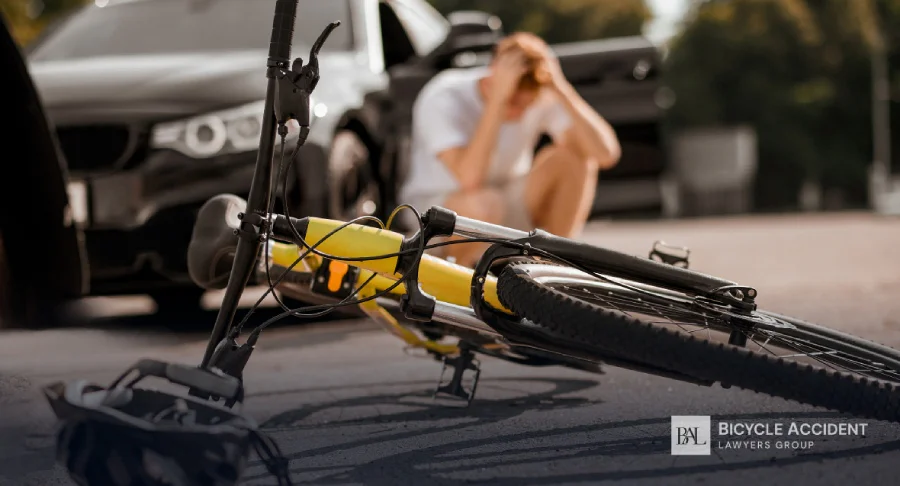

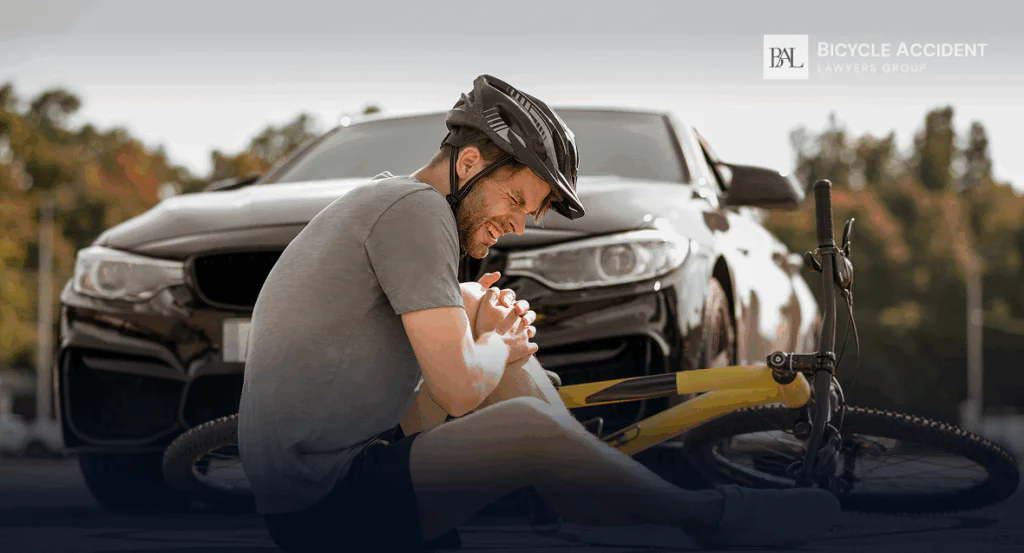
If you hit a cyclist with your car, you could face legal consequences that range from traffic citations to serious criminal charges. However, what happens after the crash depends on the specific circumstances and consequences of the collision.
A bicycle-car accident is any traffic collision that involves a motor vehicle (a car) and a cyclist. In 2024, 1,166 riders lost their lives in traffic accidents across the US, and our bicycle vs. car accident statistics show that most bike crashes are caused by motorists driving under the influence, being distracted, or speeding.
Still, drivers are not automatically at fault. Even though cyclists are vulnerable road users, they can contribute to the crash, and other parties might also be partly responsible. After all, both motor vehicle operators and bicycle riders have rights and responsibilities according to traffic laws. This guide explains what happens if you hit a cyclist with your car and how shared fault in a bicycle accident may affect the outcome.
- Key Takeaways
- What to Do Immediately After Hitting a Cyclist with Your Car
- What Does the Cyclist Have to Do After a Car Accident?
- How Fault Is Determined in Car-Cyclist Accidents
- Legal Consequences for Drivers Who Hit Cyclists
- What Are the Main Types of Damages an Injured Bicyclist Can Seek Compensation For?
- Hit-and-Run: Penalties and What You Must Know
- Cyclist Rights and Traffic Laws
- How Drivers Can Prevent Cyclist Accidents
- How Much Time Do You Have to File a Bicycle Accident Claim?
- How a Bicycle Accident Attorney Can Help
- Contact an Experienced Car Accident Attorney Today!
- Any questions?
- Get a FREE case evaluation today
Key Takeaways
- Stop immediately and don’t leave the accident scene. Hit-and-run crashes can lead to serious criminal charges.
- Call emergency services and exchange contact and insurance details.
- Cyclists can claim medical costs, lost income, and emotional damages. Your auto insurance may cover the cyclist’s damages.
- Fault may be shared under comparative negligence laws.
- Legal claims must be filed within the state’s statute of limitations.
- An attorney can help you protect your rights and maximize compensation.
What to Do Immediately After Hitting a Cyclist with Your Car
A car accident usually has a more serious impact on the bicyclist than on the motorist. That’s why drivers must act both responsibly and legally. Here’s what to do after hitting a cyclist:
- Stop the vehicle instantly. It’s crucial that you stop after hitting a cyclist and pull over safely without obstructing traffic flow. Never leave the scene — doing so constitutes a hit-and-run, a criminal offense that can result in felony charges and jail time.
- Check the cyclist’s condition. Call out to them and ask if they can respond. Assess injuries but avoid moving them if they appear seriously hurt. Spinal or head injuries can worsen with improper handling.
- Report the accident. Calling 911 after a cyclist collision is important, especially if the rider is injured or there is significant property damage. Request medical assistance and police dispatch. Even if injuries seem minor, a police report of the bike accident is essential for insurance claims.
- Exchange information. You should share your contact and insurance information with the cyclist. Ask for the same details in return. If there are witnesses, ask for their contact information, too.
- Document the scene thoroughly. Take photos and videos of vehicle damage, bicycle damage, road conditions, traffic signs, weather conditions, and visible injuries. Note the locations of any security cameras or traffic cameras nearby — this footage may become critical evidence.
- Notify your insurance company. Report the accident promptly, but avoid admitting fault or making detailed statements until you’ve consulted with an attorney. Insurance adjusters may use your words against you to minimize payouts.
While it may feel natural to apologize, your words can be interpreted as an admission of fault and used against you in legal proceedings. Express concern for the cyclist’s well-being without accepting responsibility for the collision until fault is properly determined.
Important: Leaving the scene may lead to criminal charges. Hit-and-run offenses carry severe penalties, including felony prosecution, jail time, license suspension, and civil liability — even if you weren’t initially at fault for the collision. See our section on hit-and-run penalties for complete details.
What Does the Cyclist Have to Do After a Car Accident?
As a bicyclist hurt in a car crash, you should do everything possible to ensure your safety, eliminate the chance of additional harm, and solidify your future compensation claim or personal injury lawsuit. Here’s what you may want to do after getting hit by a car:
- Move away from the street. Staying on the busy street may cause you additional harm, so it’s better to move away from the road. However, if your traumas are too serious, you should stay still and wait for help.
- Seek medical attention. Even if you feel fine and seem to only have a few scrapes and bruises, you should let a doctor inspect you. Some injuries may have hidden symptoms or a delayed effect that only a professional can detect.
- Investigate the scene. You should collect as much physical evidence as possible. Take photos and videos of your injuries, property damage, road conditions, and even the weather. Talk to witnesses, if any. Record their statements and contact information. Report the accident to the police and ask for their report number. Official records serve as proof that can support your claim in the future.
- Call an attorney. A qualified bicycle accident lawyer will evaluate your case and determine the most effective legal strategy to pursue maximum compensation for your losses and damages.
How Fault Is Determined in Car-Cyclist Accidents
While many people assume drivers are automatically at fault in a bike-car crash, this isn’t true. Both drivers and cyclists must follow traffic laws, and whoever violates those laws typically bears responsibility. So, the driver is not always liable. Evidence determines fault allocation: police reports, witness statements, traffic camera footage, physical damage patterns, and sometimes accident reconstruction analysis.
There are different scenarios in which the cyclist is at fault in a car collision:
- Riding against traffic (wrong-way cycling)
- Running red lights or stop signs
- Riding at night without required lights or reflectors
- Failure to yield right-of-way at intersections
- Sudden lane changes without signaling
- Riding while intoxicated or impaired
- Distracted cycling (phone use, wearing headphones in prohibited areas)
- Weaving between parked cars without checking for traffic.
When evidence shows the cyclist violated traffic laws, they may bear significant or even complete fault for the collision.
Comparative Negligence: What Happens When Fault Is Shared
In some states, an accident victim can lose their right to compensation if they are even 1% at fault. This is known as the contributory negligence system, and it is followed only by Alabama, Maryland, North Carolina, and Virginia. Washington, D.C. also has this law, but vulnerable road users like cyclists are exempt from it.
Most states follow comparative negligence in bicycle crashes, which allows fault to be split between parties. There are two types of comparative negligence systems:
- Pure comparative negligence: Allows victims to recover damages even if they are 99% at fault, though their compensation is reduced by their percentage of responsibility. Alaska, California, and New York are among the states that follow this principle.
- Modified comparative negligence: Operates similarly but with a cutoff threshold. You can’t recover damages if you’re 50% at fault (in some states) or 51% at fault (in others). More than 30 states use modified systems, including Colorado, Florida, Georgia, and Massachusetts.
Here’s what this means in practice. If damages total $100,000 and the claimant is found 30% at fault:
- Under pure and modified comparative negligence, they receive $70,000
- Under contributory negligence, they receive $0.
This is why fault determination matters so much — even small percentage differences can impact the final compensation.
Legal Consequences for Drivers Who Hit Cyclists
Bicycle accidents differ from one another on many levels. Depending on the underlying conditions of the collision, you can expect various legal consequences for hitting a cyclist. Note that all these possible penalties vary greatly by state, and you may face different types of separate charges for the same incident. Generally, the more serious the consequences of the collision, the more severe the penalties, especially in fatal bike accidents.
Traffic Citations and Fines
If you broke a traffic law and hit someone on a bike, a traffic citation may be issued. Common traffic violations in bike crashes include:
- Failure to yield the right of way to the rider
- Unsafe lane changes
- Speeding in bike zones
- Running red lights/stop signs.
Penalties can range from minor fines and violation points on the driver’s record to license suspensions and jail time, and repeat offenses or especially careless driving can be qualified as criminal charges. Having a record of traffic violations can also lead to increased insurance premiums.
Civil Lawsuits and Personal Liability
If your negligence (failure to exercise the necessary level of care while driving) caused injuries or property damage to the cyclist, they have the right to file an insurance claim or a civil lawsuit for compensation. These cases are governed as personal injury claims and can be filed regardless of other charges or citations related to the accident.
In the most unfortunate of bicycle accidents, the injured victim may sustain fatal injuries. The surviving family members have the right to file a wrongful death lawsuit, which often results in substantial financial compensation.
Criminal Charges
Vehicle operators may face criminal charges for hitting a biker if they were driving recklessly (for example, racing on the street or behaving aggressively), under the influence, or while impaired by alcohol, caused extremely severe injuries, or committed repeat offenses. The specific penalties depend on state laws, driver behavior, the severity of the victim’s injuries, and any criminal history.
What Are the Main Types of Damages an Injured Bicyclist Can Seek Compensation For?
After sustaining a personal injury in a bicycle vs. car accident, a rider is usually entitled to fair compensation for the suffered losses. The damages a cyclist can claim fall under three main categories:
- Economic: Most bicycle accidents lead to substantial financial expenses. Instead of dealing with those on their own, bicyclists can recover them in the form of monetary damages.
- Non-economic: Another side of any bike incident is a traumatizing experience that does not have visible signs and cannot be calculated in a monetary equivalent. However, a professional bicycle accident lawyer can help you obtain a full settlement of these intangible losses as well.
- Punitive: Although rare, punitive damages are applied to the most devastating of bicycle accidents. The main goal is to punish the extremely reckless driver and prevent such instances in the future.
Economic Damages
Monetary losses can vary widely from one claim to another. Factors such as injury severity, treatment costs, and long-term consequences often shape the value of a case, just as they can influence the average bicycle accident settlement in California. Common examples include:
- Medical costs: Your medical expenses after a cycling accident, whether it is a one-time emergency room visit or a complex surgery and lengthy rehabilitation, can be recovered. A qualified bicycle accident attorney can help you assess past and future costs so that you can claim the maximum settlement.
- Loss of income: The fact that you were forced to miss work because of serious injuries sustained in a crash does not mean that you will lose the expected income. A liable party will have to cover your lost wages in full. Moreover, if the accident diminishes your earning potential, you can claim future lost income as well.
- Property damage: If the accident resulted in damage to your bicycle or other gear, you can obtain compensation for repairs or a complete replacement of your belongings.
Non-Economic Damages
Personal damages in the form of psychological or quality-of-life impact can’t be reflected in a precise medical bill or receipt. Yet, you can still recover the following types of intangible losses, which are often a meaningful part of the average bicycle accident settlement in Pennsylvania and similar injury claims in other states:
- Pain and personal suffering: Serious injuries come with loads of physical pain that no mathematical formula can assess.
- Mental distress: Psychological traumas cause accident victims insurmountable suffering projected through emotional anguish, PTSD, depression, and anxiety.
- Loss of consortium: Often, injured cyclists refuse to interact with their loved ones the way they used to before the accident. Spouses and family members can recover loss of affection or sexual activity in monetary equivalent.
- Loss of joy: The inability to enjoy their favorite hobbies and activities diminishes the victim’s overall quality of life. Thus, it is up for fair compensation.
Wrongful Death Compensation
A fatal incident does not mean that there is no one to recover the damages and losses a negligent driver has caused. Certain family members of the victim, such as spouses, children, or parents, can file a wrongful death claim under state-specific wrongful death statutes. Usually, the claim covers all the monetary and non-monetary damages sustained by the family, including but not limited to the following:
- Funeral costs and related expenses
- Loss of income and financial support that the deceased provided
- Loss of companionship that a spouse, parent, or child provided
- Personal pain and suffering that the family members have to deal with.
Hit-and-Run: Penalties and What You Must Know
A bike crash after which the driver flees the scene without stopping to identify themselves, render aid, or report the collision to authorities is commonly referred to as a hit-and-run bicycle accident. Leaving the scene is illegal in all states and transforms what might have been a simple traffic violation into a serious criminal offense.
The Aaron Cohen Life Protection Act, named after a New York cyclist killed by a hit-and-run driver, has been adopted by multiple states to increase penalties for drivers who flee after injuring or killing vulnerable road users. The law recognizes that leaving an injured cyclist without aid can worsen their injuries or delay life-saving treatment. It imposes harsher sentences specifically for hit-and-run cases involving cyclists and pedestrians.
If you hit a bicyclist and flee the scene, you can face severe and stacking consequences:
- Criminal charges: Since leaving the scene without providing even basic aid to the injured is a serious offense, one can face felony charges. The severity of those will depend on the severity of the damage inflicted.
- Jail time: Felony hit-and-run involving injury typically carries 2–10 years in prison, depending on state law and injury severity. Fatal hit-and-run cases can result in 10–25 years or more.
- Stringent penalties: In some of the most serious bicycle accidents, the at-fault driver can be charged with fines, mandatory community work, driver’s license suspensions, and even jail time.
- Civil accountability: A driver will have to repay the cyclist they injured in a bike accident for all the monetary and non-monetary losses, including but not limited to medical expenses, lost wages, property damage, and emotional suffering.
- Public record: A hit-and-run is a serious offense that will be added to one’s personal record. It may have a permanent effect on your employment options and other personal opportunities.
Hit-and-run charges stack on top of other offenses. If you were also speeding, driving under the influence, or driving recklessly, you’ll face separate charges for each violation. A DUI hit-and-run, for example, combines penalties from both offenses and typically results in maximum sentences.
Staying at the scene, calling 911, and cooperating with authorities is always the legally required — and morally right — choice, regardless of who caused the accident.
What Should You Do If You’ve Already Left the Scene?
If you’ve already left the scene of a bicycle accident, your situation is serious — but taking immediate action can reduce the severity of charges you face. Some states allow drivers to self-report to police within a limited timeframe (typically 24–48 hours) after leaving an accident scene. While self-reporting won’t eliminate criminal charges, it may demonstrate some degree of responsibility and could result in reduced penalties compared to waiting until law enforcement tracks you down.
Contact a lawyer immediately before speaking to the police or making any statements. An attorney can guide you through the reporting process, protect your rights during questioning, and potentially negotiate with prosecutors for reduced charges.
Time matters critically in these cases. The longer you wait, the worse your legal position becomes. Prosecutors view delayed reporting as evidence of consciousness of guilt and are less likely to show leniency.
Cyclist Rights and Traffic Laws
In most states, cyclists’ rights are the same as those of motor vehicle drivers, although some regulations may differ depending on whether a state treats bicycles as vehicles. For example, riders are entitled to use the full lane when necessary for safety.
Throughout the US, cyclists have to follow traffic laws like any other road users. Most jurisdictions require riders to:
- Ride in the direction of traffic
- Obey traffic lights and signs
- Use proper equipment (functioning brakes, lights, reflectors, etc.)
- Signal turns and lane changes
- Yield to pedestrians.
Bicyclists are also subject to DUI regulations in many states, although a DUI penalty on a bike may be different from a standard charge for drivers.
There are also traffic laws aiming to protect cyclists and ensure safe and respectful driver conduct. For example, drivers might have the following obligations towards riders:
- Yield right-of-way when required
- Maintain a safe passing distance (typically 3+ feet)
- Check blind spots before turning
- Never drive in bike lanes
- Be aware of the “dooring” risk when parked.
The specific rules are different for each state. Sometimes, municipalities can also impose local regulations that cyclists must be aware of. To learn more about cycling rules, check out our overview of bicycle laws across the country.
How Drivers Can Prevent Cyclist Accidents
The consequences of a bike-car accident can be serious for both drivers and riders. Take these measures to avoid hitting a cyclist:
- Check blind spots before every turn or merge
- Maintain a safe distance when passing cyclists according to your state’s regulations
- Use the “Dutch Reach” when opening doors to prevent dooring accidents (open your car door with your far hand to naturally turn and check for cyclists)
- Yield at intersections even when you have the right of way
- Eliminate distractions — put your phone away, avoid eating while driving, ask your passengers not to distract you from the road.
How Much Time Do You Have to File a Bicycle Accident Claim?
There is a legal deadline an injured party must meet to recover compensation. Each state has a different time limit for filing a bicycle accident claim, regulated by the statute of limitations.
The statute of limitations for bike crashes usually ranges from one to four years. However, exceptions are possible in wrongful death cases and claims against government entities. It is essential to consult local laws to figure out how much time you have at your disposal to proceed with the case.
How a Bicycle Accident Attorney Can Help
A lawyer specializing in bike crash cases can bring many advantages to your claim, including:
- Thorough investigation of the accident and timely evidence gathering
- Proving who was at fault and to what extent
- Negotiating with insurance and dealing with the related paperwork
- Calculating and pursuing the full compensation for all your possible losses
- Advocating for you in court if needed.
Many riders injured in accidents are worried about lawyer fees. However, law firms like Bicycle Accident Lawyers Group work on a no-win, no-fee basis, meaning there are no upfront fees until the case is resolved. Our attorneys also provide cyclists with a free consultation and case review to help you understand if you have a valid case, how much it might be worth, and what steps to take next.
Contact an Experienced Car Accident Attorney Today!
If you hit a cyclist with your car, it’s important that you show compassion, morality, mutual respect, and readiness to accept legal responsibility for personal actions. However, whether you are a driver or a bicycle rider in a car accident, a well-versed legal advisor is your trustworthy partner to consult in your time of need.
A qualified bicycle accident lawyer will help you assess the situation on all levels, understand your rights and obligations, and build a case to achieve justice.
Contact our team today and book a free consultation that can turn the tables in your favor.

Since his academic days at the UC Berkeley School of Law, Robert Goldwater has remained a committed advocate for victims of other people’s negligence. His tort law background, together with his unquenchable thirst for justice, helped young Robert found a now-successful law firm – Bicycle Accident Lawyers Group, gathering same-minded and promising attorneys from all over the country.
Any questions?
What Is the Penalty for Hitting a Cyclist?
Depending on the type of incident and its severity, the penalty will vary. For instance, dooring accidents may lead to traffic citations and fines, while hit-and-runs can result in criminal charges, license suspension, or even imprisonment. Besides, different jurisdictions may have local laws and regulations that can affect your legal responsibility.
Can You Get Compensation If Someone Hits You in a Car?
Generally speaking, it is possible to recover compensation for your damages in most bicycle accidents with motor vehicles. However, the amount of contribution to the collision plays a pivotal role in the case. Most states in the USA allow the victims to obtain a fair settlement even if they are partially at fault. Yet, some state laws deny the right to reimbursement even if you are found to be 1% to blame.
Can I Sue If I Got Hit by a Car Driver?
In the majority of cases, bicycle accidents are resolved without going to trial. However, if your claim is rejected, denied, or seems to be unfairly minimized, you can go to court and sue the negligent driver or their insurance company.
Who Will Cover My Medical Expenses After a Bicycle Collision with a Motor Vehicle?
Most economic damages, including but not limited to medical costs, are covered by the at-fault party’s insurance policy. If it is unavailable or insufficient, you can file a personal injury claim against the driver or any other involved party. There may be state-controlled regulations and exceptions, so it is always a good idea to speak to a trained legal representative first.