
California bike laws aren’t just a set of rules to abide by. They can become your secret weapon that can make a difference between feeling powerless after a crash and knowing exactly where you stand.
The state regulations do not define bicycles as legal vehicles. They are mostly referred to as human-powered devices. However, in the majority of cases, riders share the same rights and duties as drivers. The better you understand the matter, the easier it will be to fight for accountability and fair compensation after a possible collision.
You should know that our legal team is always ready to stand up for injured cyclists. If you choose us, you will get:
- Free case evaluation
- Contingency-fee-based cooperation
- Rightful reimbursement of your losses
Call us or fill out the form today!
What Traffic Laws Apply to Cyclists in California?
Main traffic laws apply to bike riders in California. It is necessary to stress the point because some people may falsely assume that since bicycles aren’t considered vehicles in the state, you don’t have to follow traffic regulations.
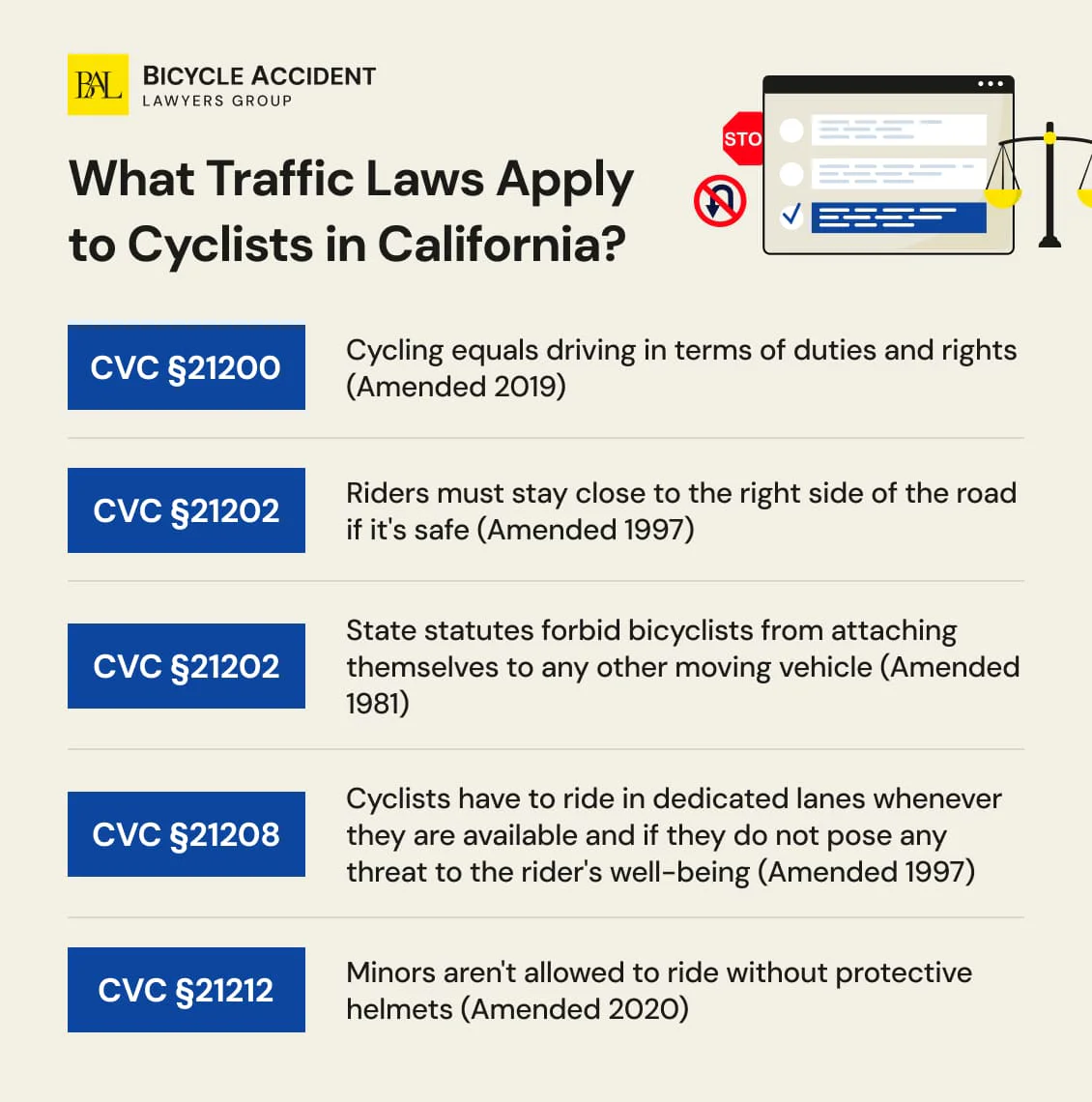
Key bicycle laws in California
- CVC §21200: Cycling equals driving in terms of duties and rights (Amended 2019)
- CVC §21202: Riders must stay close to the right side of the road if it’s safe (Amended 1997)
- CVC §21202: State statutes forbid bicyclists from attaching themselves to any other moving vehicle (Amended 1981)
- CVC §21208: Cyclists have to ride in dedicated lanes whenever they are available and if they do not pose any threat to the rider’s well-being (Amended 1997)
- CVC §21212: Minors aren’t allowed to ride without protective helmets (Amended 2020)
These regulations form a legal base that every bicyclist in California must learn, memorize, and abide by.
What Rights Do Cyclists Have Under California Law?
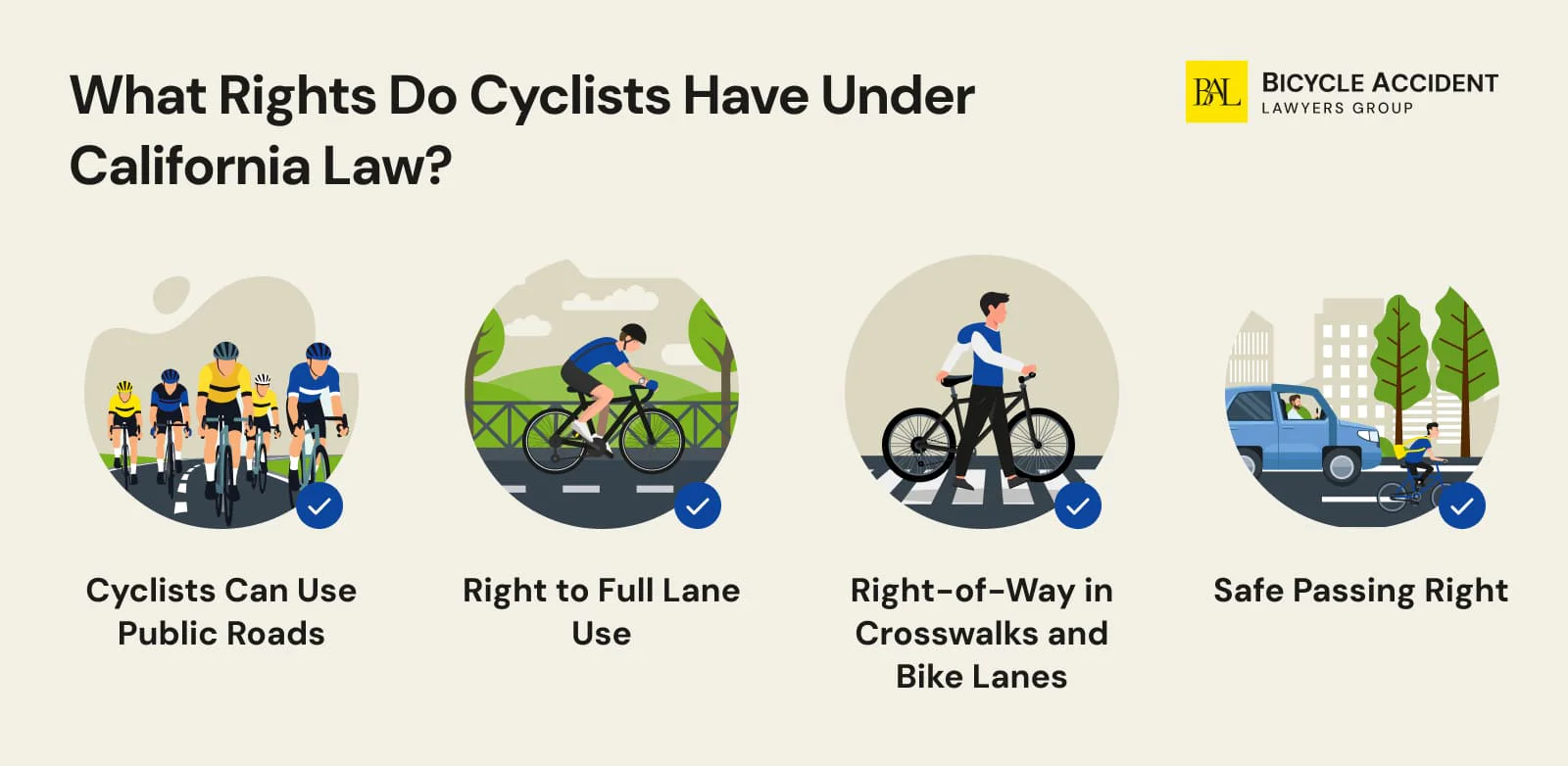
Bicyclists are rightful traffic participants, not guests on the road, in California (§21200). This means that riders can access most roads and trails available to the public. Moreover, they have the right to cycle safely and disobey some laws if the opposite poses palpable risks.
Although it isn’t a state-imposed regulation, adult bicyclists have the right to wear protective helmets (§21212(a)). Moreover, the choice to wear protective gear voluntarily can save you from a life-threatening head injury in the future.
Would you like to learn how these rights play out in real life? We’ve tried to put them into action below.
Cyclists Can Use Public Roads
Bicycle lanes are designed for a reason, and it may be safer to choose dedicated paths over shared lanes, but cyclists have the right to use all public roads when there’s no bike lane in the vicinity (§21200(a)). Almost. We say that because freeways and expressways are off-limits for riders. The state Department of Transportation (DOT) or local authorities have the right to prohibit access to those roads, so you should be on the lookout for signs confirming limited access (§21960(a)).
Whenever you ride on the road, you shouldn’t listen to drivers who are trying to discourage you from riding in a shared lane. You have the legal right to travel with motor vehicles as an equal.
Right to Full Lane Use
California statutes claim that the rider has to cycle on the right side of the road, closer to the edge, especially if they can’t match the speed of other vehicles traveling in the same direction. However, there are exceptions when you can legally take the whole lane.
The first case would be when you’re turning left. The second is when you are about to overtake someone ahead of you. There’s also the third one. If there is any hazard or obstruction on your path, say a pothole or debris, you can move to the center of the lane and take it over (§21202).
Right-of-Way in Crosswalks and Bike Lanes
Right-of-way laws in California are slightly different from those in other states. Firstly, drivers do not have to yield to riders automatically — at least there’s no statute mandating this. Instead, the Department of Motor Vehicles (DMV) advises cyclists to behave like drivers when approaching an intersection. That is, move to the center of the lane, signal the turn, and give way to oncoming traffic. At the same time, both motor vehicle operators and bicyclists owe the right of passage to pedestrians (§21950(a)).
Safe Passing Right
Over 10 years ago, in 2014, the Three Feet for Safety rule came into effect in California. This act defined a legally safe distance between a driver and a bicyclist — three feet. It is believed that the distance is enough to ensure that the rider’s balance and overall safety on the road remain uncompromised.
Some streets and lanes are narrower than others, so there may not be enough space to complete the maneuver. In that case, a driver must slow down and wait until the opportunity presents itself. Should they choose to violate the rule, they will be subject to a $35–$220 fine and other legal consequences, depending on the situation (§21760).
Other Cyclist Rights
You have the right to proper infrastructure, too. California law mandates that local municipalities keep the roads safe in the area. Suppose you hit a pothole, fall off the bike, and break your arm. In that case, you can hold the city accountable for these damages. Some riders mistakenly blame themselves for failing to see a sign or a crack in the pavement. However, it isn’t your liability, and there are always negligent parties to hold accountable (§835).
Cyclists Have the Same Legal Privileges as Motorists in California
Many cyclists in California still don’t realize that the law treats them the same as drivers. What does it mean? In the case of an accident, you can file a corresponding claim and recover the damages inflicted by the collision. Whether these are medical bills, lost wages, or personal pain and suffering, you can obtain them in full, even if you are partially at fault (up to 99%) for the crash.
Although it is your legal right to recover fair compensation for your losses, the liable parties often try to shift blame, and insurance providers try to find ways to decrease your payouts. Luckily, you have the right to contact a lawyer to protect your rights as a cyclist!
What Responsibilities Do Cyclists Have Under California Law?
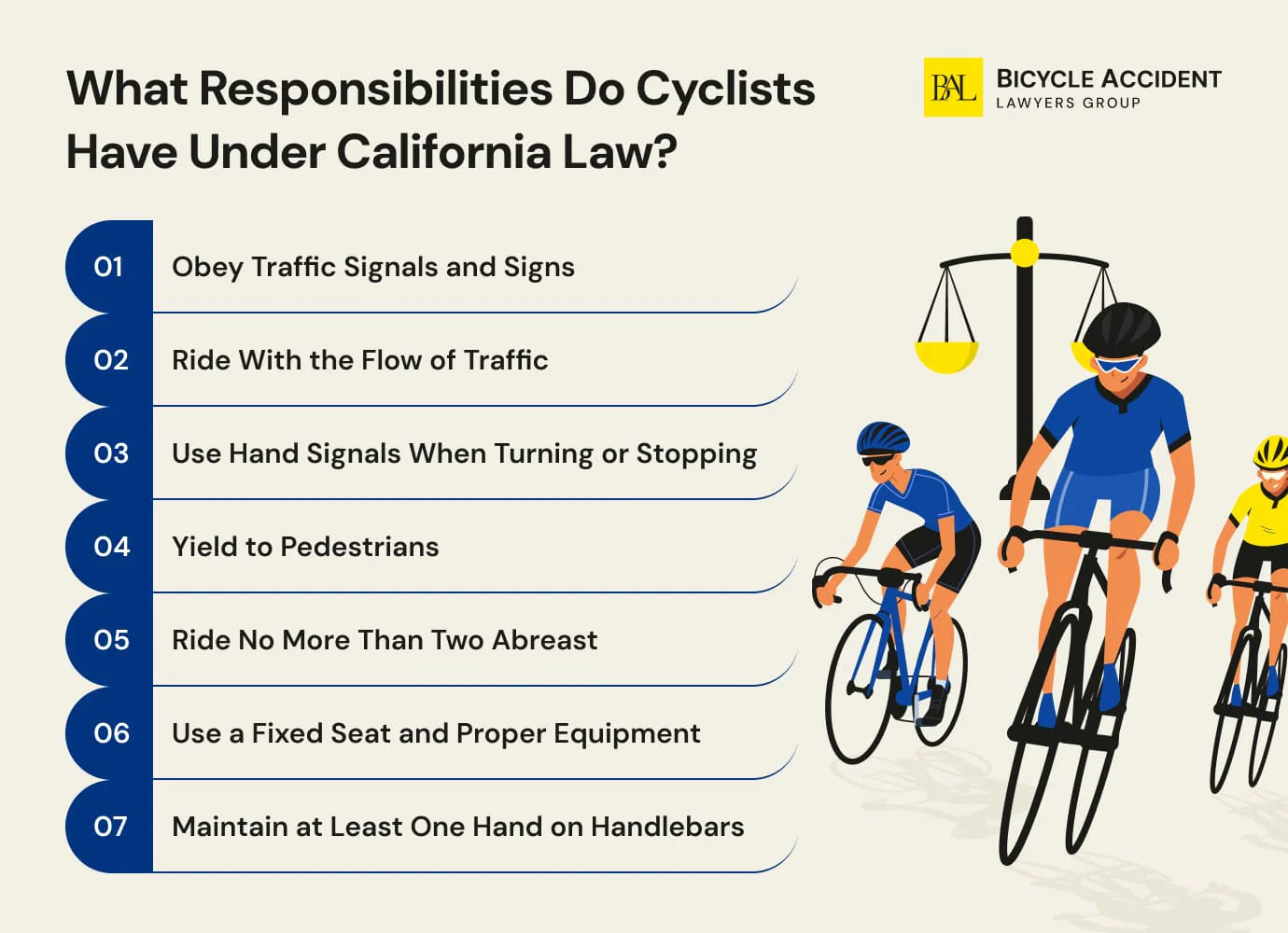
Along with the rights always come responsibilities. In California, bicyclists’ responsibilities primarily mirror those of motor vehicle operators. That is why you have to follow state-approved traffic rules, signal changes of direction, and behave properly.
Responsible cycling isn’t a choice; it is your duty. It is easy to assume that such a duty is restrictive, but in reality it keeps you safe and protects your legal standing should anything go south.
Disclaimer: Use this content for informational purposes, and in case of an accident, contact a qualified California attorney.
Obey Traffic Signals and Signs
Traffic lights, stop signs, and control devices aren’t reserved for car drivers. Riders in California must follow them, too. Running a red light or ignoring a stop sign puts your life at risk, but there are other road users at risk. Moreover, there’s also a legal aspect to such a violation — your negligence will result in decreased claim compensation as well. Those few seconds of waiting matter more than you think!
Ride With the Flow of Traffic
The fact that you are not driving a car does not mean that you can choose the direction to follow depending on your needs and preferences. In fact, it is illegal to cycle against the flow of traffic in California (§21650.1). Such behavior may confuse other vehicle operators and provoke serious collisions. To ensure that local riders bike responsibly, the state statute points out that violators will be subject to fines and citations (§40000.1). As you ride with the flow, you will certainly avoid hefty penalties. Moreover, you will also maintain a stronger legal position in case of an accident.
Use Hand Signals When Turning or Stopping
Your hands are your turn signals — and in California, you’re required to use them (§22111). It’s simple:
- Extend your left arm straight out for a left turn
- Bend the left arm up or extend the right arm straight out for a right turn
- Bend your left arm down to signal a stop
Clear signals tell drivers what you’re doing before you do it, preventing confusion and crashes — a small gesture that can save you big trouble.
Yield to Pedestrians
Pedestrians always come first. That is California law. Yet not all cyclists across the state are familiar with the rule. Moreover, some even assume that a moving vehicle has the right of way because it is easier for a person to stop than to halt a bike. However, it is vulnerability that matters. True, both bicyclists and pedestrians are often referred to as vulnerable road users, as opposed to motor vehicle operators. Nevertheless, pedestrians have the least protection, and a few seconds of patience can prevent a lifetime of regret.
Ride No More Than Two Abreast
In fact, there’s no statewide rule that regulates group riding or single-file cycling per se. However, you shouldn’t discard local ordinances that may impose additional requirements. If you are about to bike through a city with a partner or friend, consult local regulations to avoid unnecessary penalties.
From the rational point of view, it is possible to ride two or more abreast if you are travelling at the speed of the traffic. However, in case you can’t compete with the speed or merely do not want to, riding in a single file would be a wise decision. Also, keep in mind where you are riding. Bike lanes offer more freedom than a shared lane.
Use a Fixed Seat and Proper Equipment
A well-equipped bicycle goes beyond a sturdy frame and functional wheels. California law mandates that every vehicle has operable brakes, a fixed seat, proper lights, and reflectors. Also, it is illegal to carry passengers if your bicycle does not feature an additional seat for them (§21201).
If you think about it, these requirements are quite basic, but something as simple as a loose saddle, faulty brakes, or missing front or rear lights can turn a rider into a hazard on the road.
Maintain at Least One Hand on Handlebars
Can you ride with no hands on the handlebars? Cool, illegal though. The state vehicle code clearly states that all cyclists must keep at least one hand on the handlebars at all times (§21205). It is not a whim to decrease the fun of the ride. It is a practical precaution.
As much as a sudden bump or a slightly stronger breeze is enough to cause a cyclist to lose control of the vehicle and end up on the ground, if not worse. Not to mention that letting go completely means slower reaction time and zero chance to brake fast.
Where Can I Ride My Bike in California?
California laws try to ensure that every road user has equal rights, and sharing the road does not imply fighting over it. Generally speaking, bicycles are allowed almost anywhere cars can drive. The “almost” part means there are a few exceptions. The major exceptions are limited-access roads. Traffic on state freeways and expressways is too dangerous for cyclists, so no bikes are allowed there.
Now, let’s talk positioning. The rule of thumb is to keep to the right side of the lane as long as it is practicable. If you have to make a turn or there’s a pile of glass in front, you can move to the middle and take over the lane.
What about bicycle lanes? Cyclists are required to use a dedicated lane whenever one is in the vicinity (§21208). However, if riding in one puts you at palpable risk, you have the right to continue cycling on the road.
The situation with sidewalks is a little ambiguous. That’s because the state leaves it up to local governments to decide whether cyclists are permitted or forbidden to ride on sidewalks. So, it’s a must to browse through local statutes before you go on a ride in any unfamiliar location.
All in all, the state gives you space and rights to ride freely, but you have to use those opportunities wisely.
What Traffic Laws Apply to Cyclists in California?
Technically speaking, all traffic laws in California apply to bike riders. Surely, a bicycle is not a car, but if you run a red light or ignore a stop sign, the risks are the same as if a negligent driver had done so. Disregard for traffic rules often leads to serious collisions, and in the worst cases, to unnecessary fatalities.
Riding a bicycle is a fun activity, but as long as you’re on the road, you can’t behave the way you like. You must read and react to the signature as well as follow the flow of traffic. On top of that, you have to ensure that other participants can see you and can anticipate your maneuvers. Move to the middle of the lane when making a turn and give a signal to warn others of your intentions. It takes a couple of moments of your time but proves to be lifesaving.
California regulations are exceptionally clear when it comes to distractions. Bicyclists aren’t allowed to cycle with both ears covered with headphones or earbuds. One ear must always be free of all devices so that you can hear and respond to the situation on the road (§27400).
The same is true about biking under the influence — you are not allowed to operate a vehicle impaired by alcohol or drugs, or both. While traditional Driving Under the Influence charges can’t be held against riders, there are special Biking Under the Influence regulations. If you are caught cycling intoxicated, you can expect to pay a fine of $250 (§21200.5).
Required Bicycle Equipment and Safety Gear in California
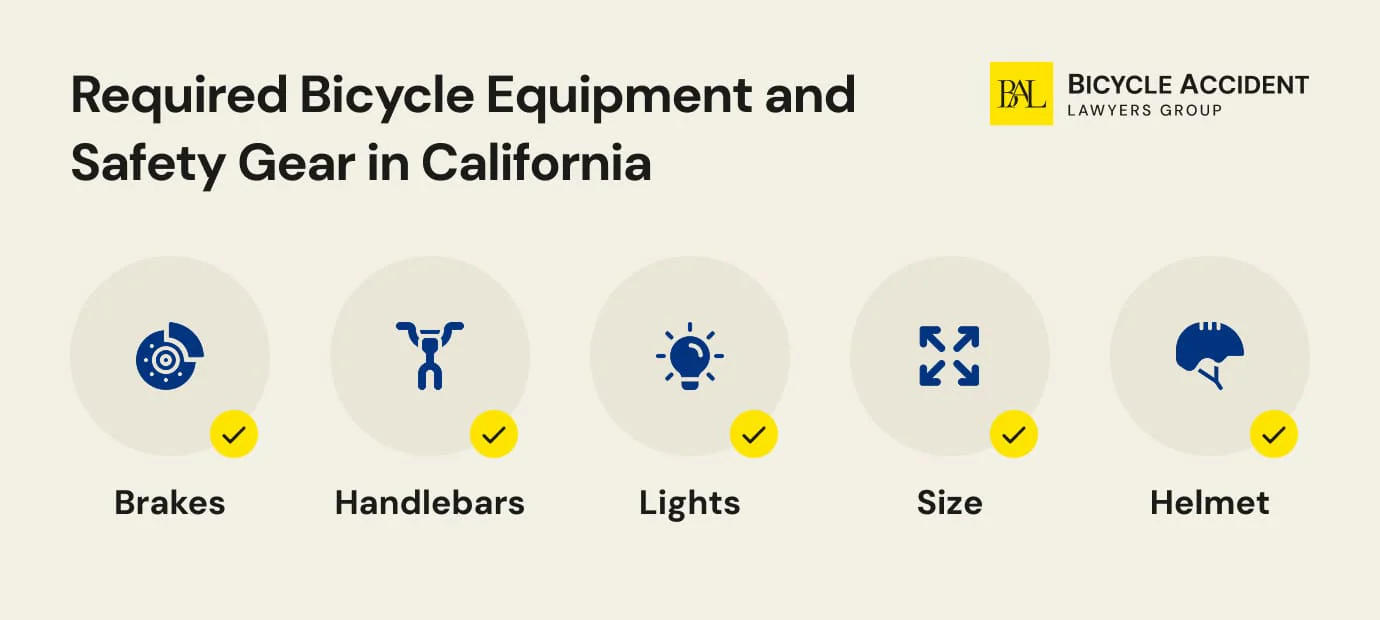
Getting a used bicycle may seem like a smart investment, but only as long as it is fully functional and meets California equipment standards. These are the absolute basics to pedal legally in the state:
- Brakes: Functional brakes may sound a little vague if you are new to the activity. Putting it simply, if your brakes are strong enough to stop one wheel on dry pavement, you’re fine.
- Handlebars: You can’t ride a bike with handlebars as high as above your shoulders, as such a position will affect your ability to control the vehicle. If the bars sit below your shoulders, you can take it out for a ride.
- Lights: You must be visible on the road, especially after dark. A car is equipped with headlights and taillights, so a bicycle must have a front white light and a rear red light or reflector, visible from 300–500 feet.
- Size: There’s no one-size-fits-all bike on the market. You need to pick one that corresponds with your height. Pick the one that allows you to stop with at least one foot on the ground.
- Helmet: California helmet rules may be the strictest in the country. Every rider under 18 years of age must wear a protective helmet. The rule does not apply to adults, though.
You may have noticed that many bicyclists wear bright or reflective clothing while on the road. It isn’t mandatory, but it is a great addition to improve your safety.
What Is Prohibited When Cycling in California?
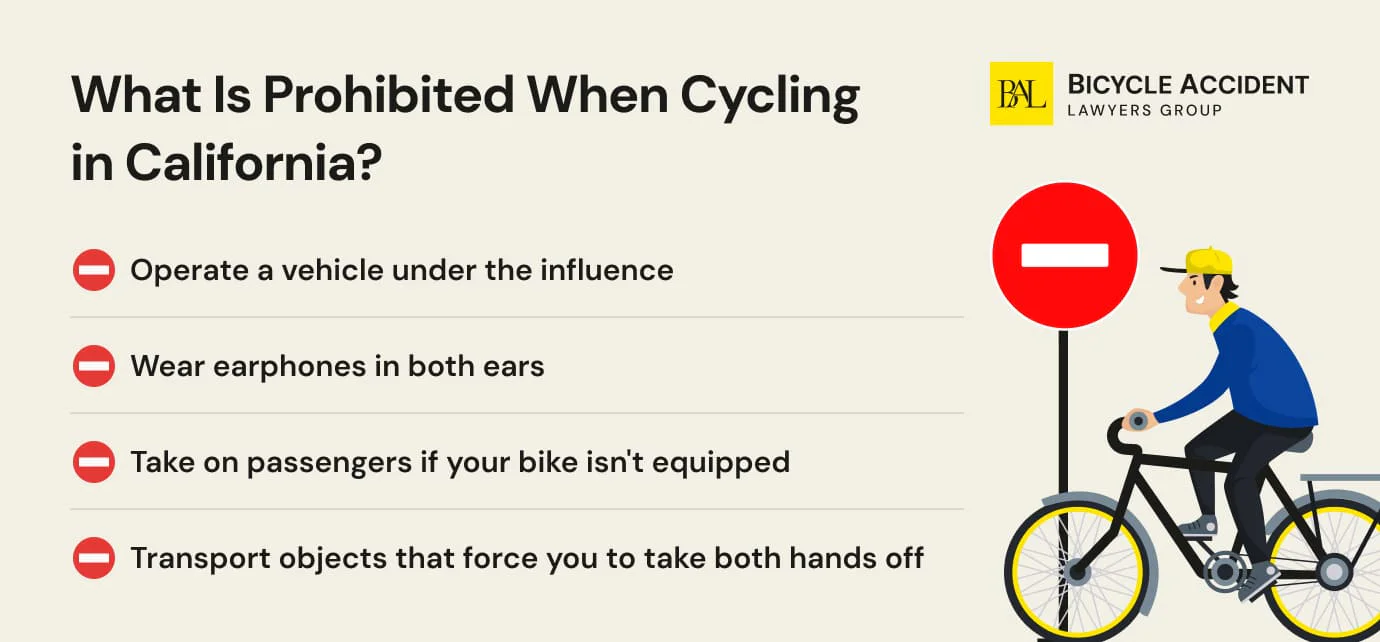
Bike riders in California are granted multiple freedoms and rights. However, there is also a list of ‘don’ts’ that every cyclist has to memorize, not to break the law and stay safe on the road:
- You can’t operate a vehicle under the influence of such substances as drugs or alcohol.
- You can’t wear earphones in both ears, so they cancel out all surrounding noise.
- You can’t take on passengers if your bike isn’t equipped for the purpose.
- You can’t transport objects that force you to take both hands off the handlebars.
All these restrictions aren’t random because local authorities like car drivers more. They have been carefully evaluated and implemented to keep you alert, predictable, and safe.
Can You Get a DUI on a Bicycle in California?
No, you can’t get a DUI in California while riding a bike, per se. Don’t rush to rejoice and head out for a few drinks with friends. Cycling under the influence does not go unpunished in the state. California is one of the few states that has special charges for impaired riders. Sure, you may not lose your license or find yourself in jail after being caught biking intoxicated. However, you will find your bank account $250 lighter, since that is the major penalty for riding under the influence in the state.
Local City-Specific Bicycle Laws in California
In California, local authorities have the power to override statewide regulations (§ 21100(h)). That is why something that is absolutely legal in one area may be out of the question in another. Surely, this sounds confusing and maybe even a little maddening. However, each location has its own traffic patterns, population density, and infrastructure, and existing statutes may be insufficient to ensure the utmost safety in the area. Now, let’s dive a little deeper into these differences to keep you on the safe side when pedaling across major cities in the state.
Los Angeles Bicycle Laws
For the most part, the LA regulations synchronize with major statewide regulations. However, local ordinances have clear requirements when it comes to riding on sidewalks. Generally, the activity is legal, but the riders must cycle cautiously not to collide with pedestrians. If a bicyclist is suspected of purposefully putting others at risk, they will face penalties.
The city of Los Angeles has various educational and infrastructure-improvement plans, programs, and initiatives intact. These include, but are not limited to, Operation Firefly, Bicycling in LA, and free safety classes.
San Francisco Bicycle Laws
The situation in San Francisco is slightly different from that of LA. Local ordinances still closely mimic statewide regulations, but riders over 13 years old are banned from the sidewalks in the city. That is the major exception to memorize if you plan to visit the area on a bike anytime soon.
San Francisco authorities put a lot of thought and effort into promoting such activities as cycling and walking. A 20-year improvement plan, called Active South City, was launched in 2022. It aims to make the active transportation network as inclusive and comfortable as possible. On top of that, various organizations take part in distributing new and reclaimed bikes among those in need in San Francisco.
San Diego Bicycle Laws
Once again, one of the major differences between San Diego and the rest of the state concerns cycling on sidewalks. It is legal to ride on a sidewalk in the city anywhere except for business districts. This means that when in the area, you should be on the lookout for special signs indicating that a certain path is off-limits to riders.
Bike lanes deserve special attention, too. As you already know, California statutes encourage bicyclists to stay within a dedicated lane whenever there is one. In San Diego, there are as many as four types of bicycle facilities, which range from shared paths to cycling tracks. Such versatility aims to improve overall safety and connectivity across the city.
Fresno Bicycle Laws
Fresno authorities continue to put palpable thought and effort into enhancing cycling infrastructure in the city. There aren’t many exceptions to the state’s bicycle laws. However, riders must stay away from biking on sidewalks in business districts and mall streets — it is forbidden.
Among the local initiatives that deserve your attention would be a growing network of Class IV routes and Sharrows. In case you don’t know what these are, Class IV tracks are separated bikeways that have a physical barrier between them and other traffic lanes. Sharrows, or shared lane markings, indicate the areas where riders can safely bike alongside other road users.
Sacramento Bicycle Laws
The city of Sacramento is known for its heavy pedestrian traffic, which is why bicyclists are mostly not allowed to ride on local sidewalks. However, there are places where it is permitted, and a special sign will help you make the right decision.
Other than that, there aren’t major bicycle laws that differ from those imposed by the state. Some interesting and quite effective initiatives from local communities and the city itself help promote rider safety. For instance, Sacramento Area Bicycle Advocates throws Bike Rodeos where they teach kids how to cycle in the city. At the same time, the City of Sacramento offers citizens the opportunity to participate in various educational classes.
California Electric Bicycle Laws
Electric bicycles in California primarily have the same rights as traditional bikes. The state divides these types of vehicles into three main classes (§ 312.5):
- Class 1: Pedal-assist only bike, with a maximum speed of 20 mph.
- Class 2: Throttle-assist vehicle, with a maximum speed of 20 mph.
- Class 3: Pedal-assist bicycle with a speedometer and maximum speed of 28 mph.
Since e-bikes fall under the category of traditional bicycles, you need no license, registration, or insurance to operate them legally in the state. However, there are certain exceptions when it comes to the areas that you can access on this type of vehicle (§ 21207.5).
It is forbidden to ride electric bikes on paths and lanes that do not border a roadway. What does it mean? Well, it means that unless there’s a sign stating otherwise, you can’t ride on off-road trails and potentially protected bike lanes.
Most local ordinances have a more detailed explanation of the use of motorized bicycles in the areas. For instance, in San Diego County, e-bikers of Class 1 and Class 2 are allowed on all trails, while Class 3 vehicles are limited to lanes next to the roadway.
Do I Need a Driver’s License to Ride a Bicycle in California?
No, you do not need a valid driver’s license to ride a bicycle in California, even an electric one. Bicycles aren’t recognized as motorized vehicles under state law, so a cyclist is an independent road user and not a driver.
You don’t need any paperwork or gas to pedal freely across the state. However, freedom comes with responsibilities, and even if you don’t have a license or registration, you must abide by all traffic rules and regulations.
Bike Laws in Other States
Some of the bicycle laws are universal across the country. For example, most cyclists have to follow traffic rules no matter the state they explore. However, different states have an individual approach to such regulations as sidewalk use, helmets, vehicle status, and more.
A three-foot passing law seems like a real savior, but wait until you learn about a four-foot passing law, which has been implemented across Pennsylvania. At the same time, riders over 16 can legally cycle in Georgia without a protective helmet, which is forbidden in California, until the rider reaches the age of 18.
As you can see, some laws differ drastically across the US. A word of advice — don’t be lazy and browse through the major bicycle regulations in the area you are about to conquer!
Car Driver Responsibilities Related to Cyclists
The California authorities recognize the danger that low speeds and close distances pose to vulnerable road users, such as bicyclists. That is why all drivers must not only abide by the existing traffic rules and regulations but also respect the riders that they share the road with.
Motor vehicle operators must give cyclists enough space in the lane; thus, the three-feet passing regulations. On top of that, there’s a ‘dooring law‘, which ensures that motorists and their passengers do not open a car door without checking for an approaching rider (§ 22517). In California, drivers share equal responsibility for keeping cyclists safe.
Most Common Injuries of Cyclists
All crashes hurt differently. Some accidents are more serious than others, and the injured suffer more than a single local trauma. However, considering the nature of bicycle collisions, there are four main groups of traumas that doctors see most often:
- Head injuries: You don’t need to hit your head on something hard to sustain a brain injury. Sometimes, all it takes is a severe jerk to lead to a concussion. Besides, there are far more serious conditions, including but not limited to traumatic brain injuries, skull fractures, and brain hemorrhage.
- Back injuries: The cyclist’s back is the largest part of the body and remains the least protected of all. That is why a serious blow to the back can result in spinal cord injuries, the consequences of which sometimes lead to such permanent damage as paralysis.
- Fractures: There are too many bones that a rider can break in a bike accident. Starting with limbs and going all the way to ribs, collarbones, and skulls. Yes, broken bones heal, but in some cases, the road to proper healing can take months, if not years.
- Road rash: When you are thrown off the bike and slide across the pavement, your skin will be grazed, no matter how many layers of clothing you wear. Surely, that sounds like the mildest of traumas to sustain. However, skin abrasions are prone to infection, which can lead to more serious conditions.
You can’t eliminate the chance of getting injured unless you decide not to ride at all. However, a few simple precautions, like a helmet or gloves, can soften the impact and the outcome of the collision.
Common Bicycle Accident Types in California
What many bicyclists in California don’t know is the fact that many crashes follow similar patterns. So, if you know where and how it can happen, you will be extra vigilant when riding through the potential danger zones.
- Intersection collisions: It isn’t much of a brainer — where there’s a lot of traffic, there’s palpable potential for accidents. Many people rush through intersections, hoping that they’ll manage to get to the other side before the light turns red. Others remain oblivious to the right-of-way rules. No matter the reason that another party can come up with, you should be alert and always assume that they do not see you or that they do not know the rules like you do.
- Rear-end impacts: Bicycles are smaller and less noticeable on the road, especially if it is dark and especially if the vehicle isn’t properly equipped. If the driver spots you a few moments too late, they may not be able to brake in time and ram into you from behind.
- Dooring incidents: Not everyone is equally aware that parked cars pose an actual threat to bicyclists. A door flung open out of nowhere can interfere with the rider’s movement. Ending up on the pavement is a scary option, but flying under the wheels of the upcoming traffic is an even more frightening alternative.
A lot of accidents would never happen if all road users respected one another, remained predictable, and obeyed the law.
California Bike Accident Statistics
California is the fourth most bicycle-friendly state in the national rank from the League of American Bicyclists. The state scored 95% for its rider-oriented infrastructure, 100% for its safety policies, and 86% for its legal support of bicyclists. Also, it is claimed that local authorities have taken every step possible to make the area welcoming to cyclists in 2024.
However, the accident statistics reported across the state remain quite concerning. According to 2024 crash forecasts, California holds the second place on the most dangerous states list. Around 146 people lost their lives on local streets and roads in 2024. One could say it is a 20% improvement compared to 2023, when 177 people died in biking accidents. Yet, in the long run, the data indicate that there are many challenges that the state has to overcome to become safe for all its citizens and visitors.
California Cycling Safety Programs
The Golden State has numerous programs and projects aimed at bicyclists’ safety in the area. Some of them focus on the educational part, while others are more practical and include different infrastructure plans and transportation system enhancements.
For instance, the California Office of Traffic Safety (OTS), together with UC Berkeley’s Safe Transportation Research and Education Center (SafeTREC) and the National Highway Traffic Safety Administration (NHTSA), has launched the Community Pedestrian and Bicycle Safety Training initiative. The main goal of the program is to work with local communities to figure out existing weak points in riders’ safety and eliminate them in the future.
Sources
- 2024 California Code, Operation of Bicycles, Section 21200
- 2024 California Code, Operation of Bicycles, Section 21202
- 2014 California Code, Operation of Bicycles, Section 21203
- 2024 California Code, Operation of Bicycles, Section 21208
- California Code, Vehicle Code – VEH § 21212
- 2024 California Code, Pedestrians’ Rights and Duties, Section 21960
- 2024 California Code, Operation of Bicycles, Section 21202
- California Vehicle Code, Pedestrians’ Rights and Duties, section 21950
- DMV, Bicyclists & Pedestrians
- 2024 California Code, Overtaking and Passing, Section 21760
- Government Code, Dangerous Conditions of Public Property, Section 835
- Comparative & Contributory Negligence Laws: 50-State Survey
- 2024 California Code, Driving on Right Side, Section 21650.1
- 2024 California Code, Violation of Code, Section 40000.1
- 2024 California Code, Turning and Stopping and Turning Signals, Section 22111
- 2024 California Code, Operation of Bicycles, Section 21201
- 2024 California Code, Operation of Bicycles, Section 21205
- California Code, Vehicle Code – VEH § 27400
- California Code, Vehicle Code – VEH § 21200.5
- California Code, Vehicle Code – VEH § 21100
- Metro Launches Free Bike Safety Classes
- LADOT Bicycling in LA
- BikeLA Operation Firefly
- LA SEC. 56.15. BICYCLE RIDING – SIDEWALKS
- San Francisco SEC. 1007. BICYCLE RIDING ON SIDEWALKS
- Active South City
- BIKE IT FORWARD
- South San Francisco’s Bike Program Rolls On
- San Diego Municipal Code: §84.09 Bicycle Riding Restricted
- The City of San Diego Lanes and Routes
- City of Fresno Bicycle Facilities
- Sacramento, 10.76.010 Riding bicycles on sidewalks
- SABA Bike Rodeos
- City of Sacramento Urban Biking and Scooting 101 Class
- 2024 California Code, WORDS AND PHRASES DEFINED, Section 312.5
- 2024 California Code, Operation of Bicycles, Section 21207.5
- SANDIEGOCOUNTY.GOV Electric Bike Fact Sheet
- 2024 California Code, Stopping, Standing, and Parking, Section 22517
- State Ranking and Report Cards, California
- Community Pedestrian & Bicycle Safety Training Program

Since his academic days at the UC Berkeley School of Law, Robert Goldwater has remained a committed advocate for victims of other people’s negligence. His tort law background, together with his unquenchable thirst for justice, helped young Robert found a now-successful law firm – Bicycle Accident Lawyers Group, gathering same-minded and promising attorneys from all over the country.