
California gives every cyclist the same legal rights and duties as any motorist on public roads, and on January 1, 2026 it rewrote the equipment standard every rider is measured against. AB 544 made a rear reflector required at all hours instead of only after dark, AB 875 let officers impound a Class 3 e-bike ridden by anyone under 16, and uncertified e-bike batteries became illegal to sell.
Each requirement matters for a second reason after a bicycle accident: every one is something an adjuster will use to argue your injury was partly your own fault. A guide to California bicycle laws is about what your injury claim is worth. A bicycle accident attorney can review the facts and explain how these California bicycle laws apply. Call 866-966-5240 or visit our website for a free consultation.
- California Bike Laws at a Glance
- What Changed for California Cyclists in 2026
- Is a Bicycle a Vehicle in California?
- Where You Must Ride on The Road
- California Bike Lane Regulations
- Can You Ride on The Sidewalk in California?
- Where Bicycles Are Not Allowed
- Stop Signs, Signals, And The Walk Signal
- Required Bicycle Equipment in California
- California Bicycle Helmet Law
- California E-bike Laws And Categories
- How Motorists Must Pass You, And The Dooring Provision
- What California Cyclists May Not Do
- How a Broken Rule Changes What You Recover
- California Bicycle Accident Filing Deadlines
- What To Do After a Bicycle Accident in California
- Get a FREE case evaluation today
California Bike Laws at a Glance
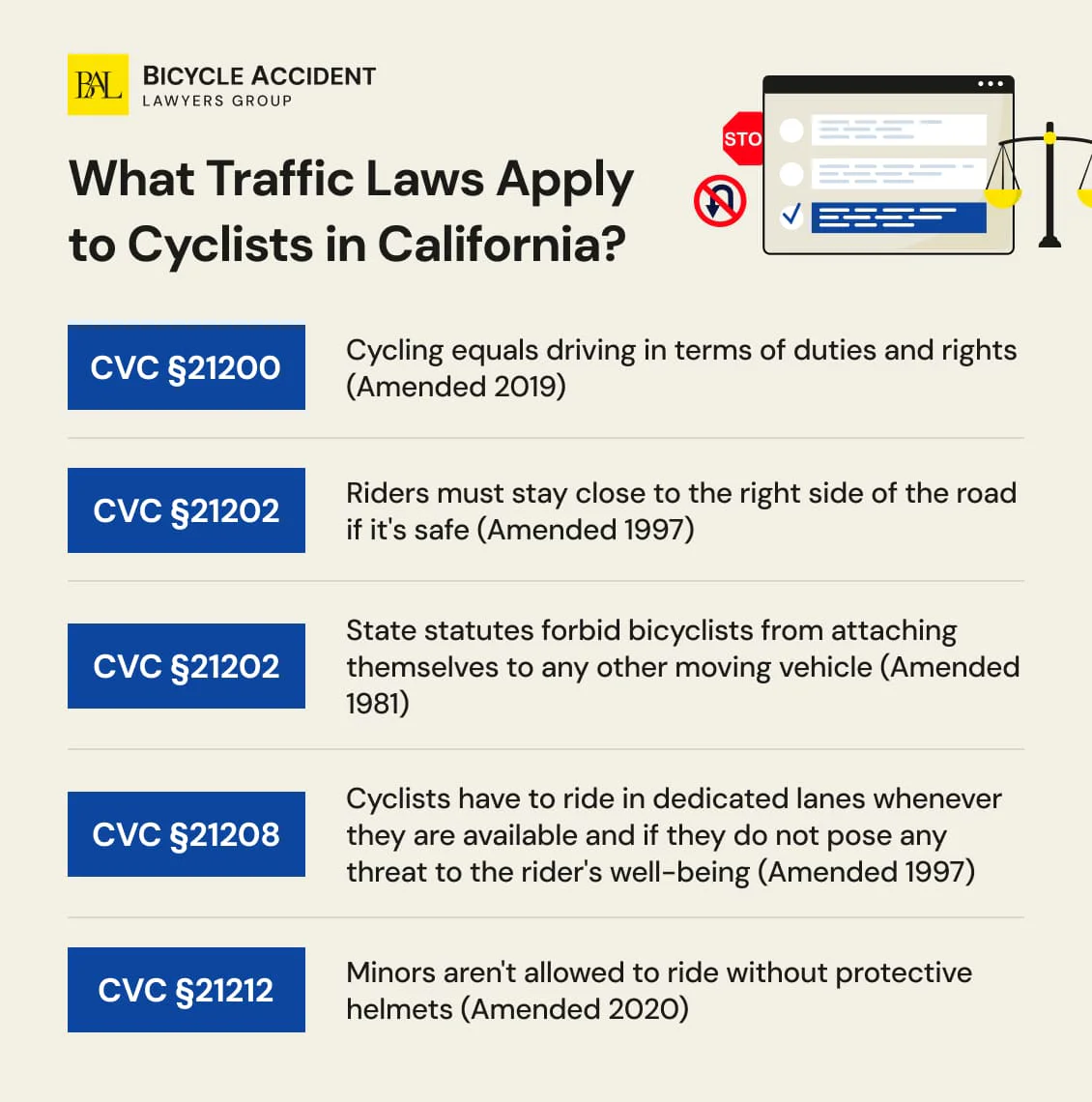
- Legal status: all the rights and duties of a motorist (CVC 21200). A bicycle is not a “vehicle.”
- Where to ride: as close as practicable to the right when slower than traffic, with four wide exemptions (CVC 21202).
- Bike lanes: use one when slower than traffic, with four exemptions (CVC 21208).
- Sidewalks: no statewide restriction. Your city ordinances decide where bicycles are allowed (CVC 21206).
- Equipment: a stopping mechanism, shoulder-height handlebars, a white light visible from the front during darkness, and since January 1, 2026 a rear visibility device at all hours (CVC 21201).
- Helmets: bicyclists must wear a helmet when younger than 18, and on a Class 3 e-bike regardless of the operator’s age (CVC 21212, CVC 21213).
- Passing: motorists owe three feet of distance, or a lane change when one is available (CVC 21760).
- Deadlines: two years to file an injury claim against a private party. Six months against a city or Caltrans.
- Fault: pure comparative negligence. A violation cuts your recovery. It never ends.
What Changed for California Cyclists in 2026
Four changes landed on January 1, 2026, three reaching ordinary bike riders rather than manufacturers.
AB 544: Rear Visibility at All Hours
Stats. 2025, Ch. 36 amended CVC 21201. A rear red reflector, or a solid or flashing red light with a built-in reflector visible from 500 feet, is now required at all hours. A daytime cyclist without one is out of compliance, the sort of detail a carrier saves for the fault discussion months later.
AB 875: Impound Power
CVC 22651.08, added to the Vehicle Code, lets an officer remove a Class 3 e-bike operated by anyone younger than 16. The same power reaches an electric vehicle with fewer than four wheels that exceeds 20 miles per hour when the cyclist has no licence. The agency holds it for at least 48 hours and may require proof of a safety course.
SB 1271: Battery Certification
From January 1, 2026, e-bikes and lithium-ion batteries sold or leased in California must carry UL 2849 or EN 15194 certification. Rental fleets have until January 1, 2028. If an uncertified battery starts a fire after that date, certification becomes a product liability argument.
AB 382: School Zone Speed Limits
AB 382 dropped school zone speed limits from 25 to 20 miles per hour, changing what speeding means on streets where child cyclists are most exposed.
Is a Bicycle a Vehicle in California?
A bicycle is not a vehicle in California, yet CVC 21200 gives every person riding one the same rights and duties as a motorist. CVC 231 defines a bicycle as a human-powered device, so statutes for motor vehicles stop at the cyclist. The DUI statute, CVC 23152, is the clearest example: it cannot touch you while cycling.
You inherit the whole traffic code. Bicyclists must stop at signals, signal turns, and yield where a motorist would yield. The same code that gives you the road is the code an adjuster reads back when pricing your claim.
Where You Must Ride on The Road
CVC 21202 asks one thing: ride as close as practicable to the right-hand curb when slower than traffic. Its four exemptions are broad enough that taking the full lane is usually lawful, and riding at the speed of traffic means the statute does not apply at all.
The four exemptions are wider than most drivers assume:
- Overtaking and passing another bicycle or motor vehicle going the same direction.
- Preparing for a left turn, at an intersection or driveway.
- Avoiding conditions, including objects, vehicles, pedestrians, animals, surface hazards, and substandard width lanes.
- Approaching a place where a right turn is authorized.
The hazard-avoidance carve-out does most of the work: a substandard width lane is one too narrow for a cycle and a car to safely share the road side by side, and most California lanes qualify. Bicyclists may ride in the full lane. On a one-way highway with two or more lanes, CVC 21202(b) lets you ride at the left instead.
CVC 21650 and CVC 21650.1 carry no comparable allowance. They put bicyclists with traffic rather than against it, and wrong-way riding hands the other side a fault theory you cannot answer. A wrong-way cyclist gives the carrier strong fault evidence.
California Bike Lane Regulations
CVC 21208 requires a bicyclist to use bike lanes when riding slower than traffic, with four carve-outs. The mandatory-use provision may not reach a protected bikeway at all, and that is the distinction insurers get wrong.
The Four Carve-Outs
- Overtaking and passing
- Preparing for a left turn
- Leaving to avoid debris or other hazardous conditions
- Approaching a place where a right turn is authorized
Protected Bikeways
CVC 21208 reaches a bicycle lane under CVC 21207. Streets and Highways Code 890.4 makes a Category II bikeway and a Category IV separated bikeway distinct classes, and a Category IV sits behind posts, a barrier, or parked cars. CalBike reads mandatory use as not reaching one, but no court has decided, and insurers call leaving any striped facility negligence.
Motorists in Bike Lanes
Motorists may not use your lane. CVC 21209 keeps motor vehicles out of designated bike lanes except:
- Where parking is permitted
- Where the operator is entering or leaving the roadway
- Where a left turn is being prepared within 200 feet of an intersection
Parking outside those exceptions violates CVC 21209, and CVC 21211 separately bars leaving an object that obstructs a cycling path or crosswalks.
When a motorist forces a bicyclist out of a bicycle lane and an accident follows, the exemption you relied on becomes the fact that decides how fault gets split. Write it down that day, because the detail fades long before the claim file closes.
Can You Ride on The Sidewalk in California?
CVC 21206 hands the pavement question to your city, and the answer changes street by street because there is no statewide law. Riding on sidewalks is legal in Los Angeles, barred for bicyclists 13 and older in San Francisco, and barred in business districts in San Diego and Long Beach.
- Los Angeles: permits it, subject to due regard for pedestrians.
- San Francisco: prohibits it for bicyclists 13 and older (Transportation Code sec. 7.2.12).
- San Diego: prohibits it in business districts.
- Long Beach and Fresno: prohibit it in business districts.
- Sacramento: restricts it, with signed exceptions.
Check the local ordinances for the city you ride in. When a cyclist gets hit where city ordinances bar cycling, the carrier will argue the violation makes you partly at fault. A bicycle accident attorney can challenge that argument.
Where Bicycles Are Not Allowed
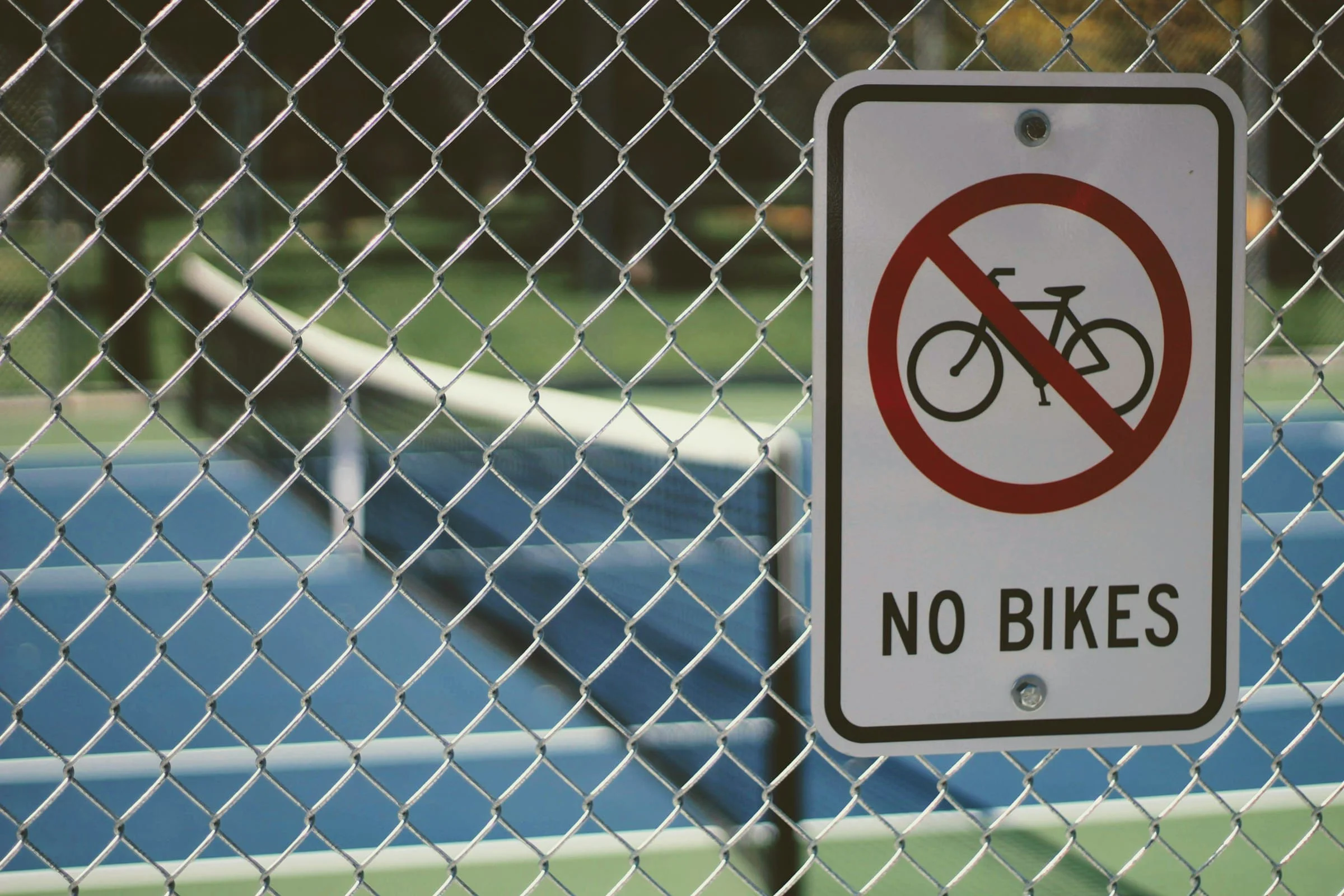
Freeways, expressways, and toll crossings are closed to bicycles wherever Caltrans or a local authority has posted a sign (CVC 21960, CVC 23330). Rural interstate shoulders are often open to bicyclists while urban stretches are posted closed. E-bikes carry a second restriction: CVC 21207.5 keeps them off equestrian, hiking, and recreational trails unless the local land manager allows them.
Stop Signs, Signals, And The Walk Signal
You stop at every signal and stop sign, because Governor Newsom vetoed the safety stop in 2021. The Idaho stop has no California equivalent, but CVC 21456 does let you cross an intersection on a pedestrian walk signal.
A cyclist facing that signal crosses in that direction, yielding to anyone already lawfully in the intersection. At a leading pedestrian interval, that translates to a head start of several seconds.
CVC 22111 asks for an arm signal on turns and stops, and CVC 21950 puts pedestrians ahead of you at all crosswalks. Bike riders who ignore these obligations face fault arguments in any collision that follows.
Required Bicycle Equipment in California
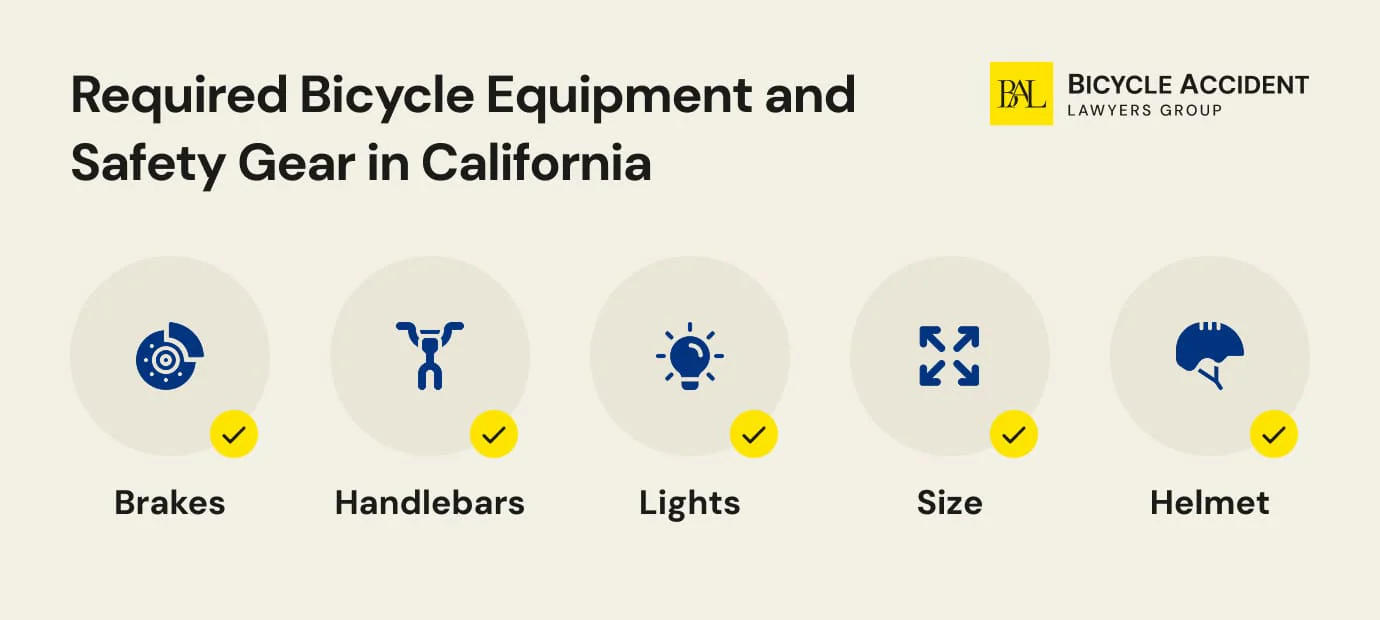
CVC 21201 lists the equipment all bicycles on California roads must carry. AB 544 expanded the list on January 1, 2026. Missing equipment is one of the first things an insurance adjuster attacks after a bicycle accident.
- Brakes: one brake that causes a wheel skid on dry level clean pavement (subdivision (a)).
- Handlebars: not raised above shoulder level at the grips (subdivision (b)).
- Frame size: small enough to stop, foot down, and start again safely (subdivision (c)).
- Front lamp: white, visible 300 feet ahead and from the sides, required during darkness. A body-worn lamp counts (subdivision (e)).
- Rear reflective device: red, visible 500 feet, and since January 1, 2026 required at all hours rather than only during darkness.
- Pedal reflectors: white or yellow reflector on each pedal, visible 200 feet.
- Side reflectors: white or yellow on the front half, white or red on the rear half, visible 200 feet.
CVC 21201 requires no bells on bicycles. Photograph your lights and any reflective device before anything gets replaced.
California Bicycle Helmet Law
California does not require adults to wear head protection on an ordinary cycle. The duty falls on bicyclists younger than 18 (CVC 21212) and, on a Category 3 e-bike, on every operator and passenger regardless of years (CVC 21213). CVC 21213 also bars anyone younger than 16 from operating a Category 3, and a youth violation carries a $25 fine with parents jointly liable.
California has no statute making non-use of helmets inadmissible, so a carrier may argue your head injury would have been smaller with one. An attorney experienced in bicycle accident cases can counter medical evidence and accident reconstruction.
California E-bike Laws And Categories
CVC 312.5 sorts e-bikes by how the motor helps and where it stops. The ceiling for all three classes is 750 watts, and the widely repeated statewide under-12 provision does not exist.
- Class 1. Pedal assist only, cutting out at 20 miles per hour.
- Class 2. A throttle that can propel the cycle alone, cutting out at 20 miles per hour.
- Class 3. Pedal assist to 28 miles per hour, with a speedometer, no riders younger than 16, and head protection on every operator and passenger. Since January 1, 2026, an officer who finds a rider younger than 16 on a Class 3 may impound the cycle for at least 48 hours (CVC 22651.08).
Labelling. Every e-bike carries a permanent label showing class number, top assisted speed, and motor wattage — the first thing anyone checks after a collision.
No class needs a licence, registration, or insurance. The statewide minimum of 12 years old that circulates widely does not exist. AB 2234 created a San Diego County pilot running until January 1, 2029, allowing local authorities to bar cyclists younger than 12 from Class 1 and Class 2 bikes. It is a local option, not a statewide law. AB 1774 bans aftermarket kits that raise an e-bike’s speed or wattage.
How Motorists Must Pass You, And The Dooring Provision
When passing a cyclist, a motorist must leave three feet of distance or change lanes entirely, slowing when neither is possible. AB 1909 (Stats. 2022, Ch. 343) added the lane-change duty effective January 1, 2023.
A violation carries a $35 fine, rising to $220 with bodily injury (CVC 21760), but the citation matters more as proof of breach than as a penalty. CVC 22517 bars opening a car door on the traffic side unless it is reasonably safe, and liability lands on whoever opened the door, not on bicyclists who had no room to stop. When a dooring accident causes injuries, the at-fault party’s liability policy sets the starting point.
What California Cyclists May Not Do
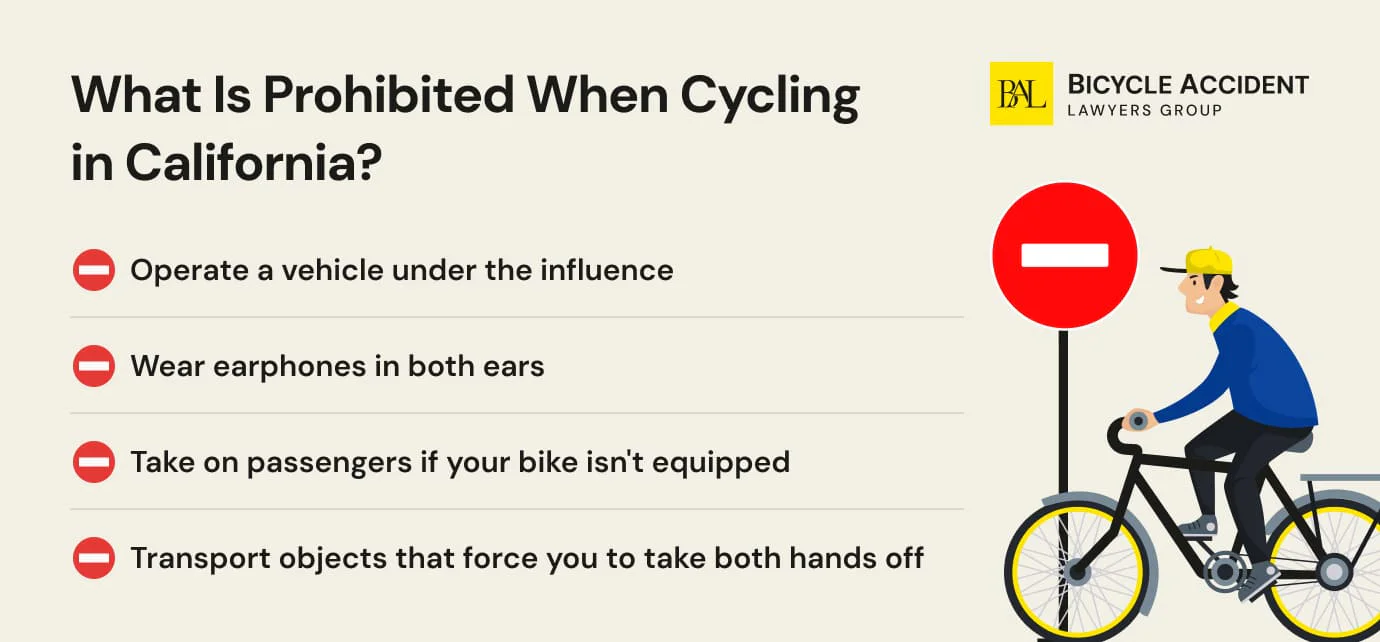
California bars covering both ears, hitching a ride on a moving motor vehicle, carrying anything that takes at least one hand off the bars, and riding under the influence.
- Headphones. Bars covering both ears. One ear is lawful; hearing aids are exempt.
- Hitching (CVC 21203). Bars attach themselves or the cycle to moving vehicles.
- Carrying articles (CVC 21205). Bars anything that prevents keeping at least one hand on the handlebars.
- Seats and passengers (CVC 21204). Requires a permanent regular seat, a second seat for passengers, and a retaining seat for any passenger four years old or under or 40 pounds or less.
- Riding under the influence. Covers alcohol or drugs, fine up to $250. Alcohol impairment is not a DUI under CVC 23152, but CVC 13202.5 reaches licence suspension for bike riders from 13 to 20 years old.
How a Broken Rule Changes What You Recover
California is a pure comparative negligence state, which means a cyclist found 90 percent at fault in a bicycle accident still recovers the remaining 10 percent. Li v. Yellow Cab Co. (1975) 13 Cal.3d 804 ended the old all-or-nothing contributory negligence bar. No percentage threshold wipes out your claim, and that single feature is worth more to an injured cyclist than every requirement above it.
Every requirement above becomes a percentage argument: no head protection, no rear visibility device, outside the bike lane, further from the curb than they think practicable. Each is a bid to move a number, not a defence that ends the case. The insurance company assigns a fault percentage that directly reduces what it pays for your injuries and medical bills.
A violation reduces recovery only so far as it actually contributed to the accident. Riding without lights at noon in full sun contributed nothing. The carve-outs in CVC 21202 and CVC 21208 are part of the statute, not excuses bolted onto it.
SB 1107, the Protect California Drivers Act, raised minimum liability insurance limits from January 1, 2025 to $30,000 per person, $60,000 per accident, and $15,000 for property damage. The old insurance coverage floor was $15,000, $30,000, and $5,000.
A serious bicycle injury exhausts $30,000 of coverage. Uninsured and underinsured motorist coverage on your own auto insurance policy often separates a partial recovery from a real one, even though you were on a cycle and not in the car your insurance policy covers. Talk to an attorney about whether your coverage is adequate. For information, call 866-966-5240 or visit our website.
Fault in California moves a number rather than closing a door. No adjuster will volunteer that.
California Bicycle Accident Filing Deadlines
You have two years to sue a private party under CCP 335.1, but only six months to present a written claim under Government Code 911.2 when a road defect puts a city, a county, or Caltrans on the hook.
- Two years, private defendant. CCP 335.1 gives two years from the date of injury to sue a driver, an employer, a manufacturer, or any other private party.
- Six months, public entity. If a pothole, a defective bike lane design, a missing sign, or a bad roadway surface contributed to your accident, the defendant is a city, county, or Caltrans. Government Code 911.2 sets six months for a written injury claim, one year for other causes of action. Miss that window and the public entity claim is barred.
- Where that liability comes from. Government Code 835 makes a public entity liable for a dangerous condition of its property — the route for every road-defect accident claim.
- Minors. A child’s two-year deadline pauses until they turn 18, but the six-month government clock does not. Government Code 911.4 allows a late-claim application within one year of accrual, and 911.6(b)(2) says the board shall grant it where the injured person was a minor for the whole six months. Miss that outer limit and the route closes.
When both a private party and a public entity may be responsible for an accident, the six-month clock governs your whole case. Treat any accident involving the road surface as a six-month file from day one.
What To Do After a Bicycle Accident in California
Evidence that sets your fault percentage disappears within hours.
- Call the police and get an accident report. It is the first document an adjuster reads.
- Photograph everything before it moves. Vehicle position, your bike, the road, lane markings, lights.
- Get witness names and numbers. They leave and are almost never found.
- Get medical care the same day. A gap is a carrier’s proof your injuries were not serious.
- Keep the cycle, helmet, and clothing. Replaced equipment cannot be recreated.
- Skip the recorded statement. An early guess about your injuries becomes the ceiling.
- Report the accident to your insurance company. Uninsured motorist insurance coverage applies to bicycle accidents, and your policy may cover treatment even when another party is at fault in the accident.
- Note which CVC 21202 exemption you relied on while it is fresh. “I moved left to get around a parked car” is a statutory exemption; “I moved left” alone is an admission. Bicyclists may ride outside the designated lane under any of these carve-outs, and documenting the reason protects your accident claim.
An experienced attorney can guide you through the insurance process. For information about your legal options after an accident, visit our website or call for a free consultation.

Robert Goldwater is a cyclist representing cyclists. He has practiced personal injury and wrongful death law for more than 20 years, graduating with Honors from Arizona State University Law School, and has helped recover over $1 billion for clients, including injured cyclists.
If you’re a cyclist who has been in an accident, call today for a free initial consult about your legal claim. We’re here to help with your legal questions. Contact our law firm for coast-to-coast bike accident and personal injury representation.