


In New York City, bicycles and e-bikes are legally treated as vehicles and must follow the same traffic regulations as a motor vehicle driver on the road (VTL 1231). That includes obeying signals, making proper turns, riding with traffic, yielding to pedestrians, and using usable bike lanes unless blocked or unsafe. These provisions apply in the same manner to all who ride, just as they apply to motorists.
NYC cycling regulations come from three overlapping systems: the NY Vehicle and Traffic Law (VTL), the Rules of the City of New York (RCNY), and the NYC Administrative Code. Violating these regulations can establish fault in a collision and affects your safety and legal rights.
- Key Bicycle Laws in NYC
- Required Bicycle Equipment (VTL 1236)
- NYC Helmet Requirements (VTL 1238)
- Commercial Cycling Rules (AC 10-157)
- E-Bike Laws in NYC
- Where You Can and Cannot Ride in NYC
- NYC Bicycle Enforcement: What Changed in 2025-2026
- NYC Bicycle Accident Statistics (2023-2025)
- What Happens After a Bicycle Accident in NYC?
- How Can You Stay Safe Cycling in NYC?
- New York Bike Laws: Key Takeaways
- Injured After a Cycling Accident in NYC?
- Get a FREE case evaluation today
Key Bicycle Laws in NYC
NYC traffic laws apply to all road users, including bicyclists (RCNY 4-02(a)). Like motor vehicles, bicycles are subject to the same signal, speed, and right-of-way provisions.
Signals and Stop Signs
Obey all traffic signals, stop signs, and pavement markings (VTL 1231). Running a red light is negligence per se.
Riding Direction
Ride with traffic. Riding against traffic (“salmoning”) is prohibited (VTL 1234) and commonly ticketed.
Are Bike Lanes Mandatory in NYC?
Cyclists must ride in usable bicycle lanes when available, unless blocked or unsafe (RCNY 4-12(p)). NYC is one of the few municipalities that enforces this mandatory use requirement. Municipalities in Arizona, Texas, California, and Illinois do not require bicyclists to use a bike lane. This covers both protected paths (physical barrier) and unprotected ones (paint only).
On a one-way street at least 40 feet wide, bicyclists may ride on either portion (RCNY 4-12(p)(3)).
No operator may stop or park in a bicycle lane (RCNY 4-08(e)(9)) unless it’s an emergency or an instruction from law enforcement.
Can You Ride a Bicycle on the Sidewalk in NYC?
Riding on a sidewalk is illegal, with a first-offense fine of $100 (AC 19-176). Endangering a pedestrian on the sidewalk is a misdemeanor ($100 to $300), and police can confiscate the bicycle. Children under 12 are permitted on sidewalks unless sign allows otherwise, provided their wheels are less than 26 inches in diameter.
Yielding to Pedestrians
Always yield the right of way to pedestrians at crosswalks and intersections. Motor vehicle operators also owe the right of way to cyclists. When a driver or bicyclist fails to yield and it leads to a collision, they can be held at fault for the resulting personal injury.
Hand Signals
Signal clearly before turning or stopping. Extend your left arm straight out to signal a left turn. For a right turn extend your right hand horizontally, or raise your left hand or arm upward. When stopping, extend your left arm downward at full arm extension.
Earphones
Only one earphone attached to a radio tape player or other audio device is permitted while riding (VTL 375 24-a). New York State is one of only 7 states with headphone restrictions for those riding. Police can stop a person solely for wearing two earphones (primary offense). Fines reach $150, and wearing illegal headphones at the time of a collision can trigger negligence per se.
Group Riding
No person shall ride more than two abreast on any roadway; bicyclists should travel in single file, keeping as close to the right hand curb as practicable (VTL 1234). On a designated shoulder bicycle riders may ride two or more abreast when sufficient shoulder width is available.
Expressways and Bridges
Riding is prohibited on expressways, highways, interstate routes bridges unless a posted sign permits it (VTL 1229-a). Bicyclists should check local signs and shoulder markings before entering these types of roadways.
How Close Can Cars Pass Cyclists in New York?
Motorists must pass bicyclists on the left at a safe distance (VTL 1122). New York State has no defined minimum passing gap, complicating fault claims compared to places with minimum-distance statutes.
VTL 1146 requires all motorists to exercise due care to avoid colliding with cyclists and pedestrians. When a driver passes too closely and causes a collision, the driver is liable for the resulting personal injury.
When Can a Bicyclist Ride in the Center of the Lane?
When the roadway is too narrow for a bicyclist and another vehicle traveling in the same direction to share safely, a bicyclist may legally ride in the center, returning to the right side when the road widens.
Is Dooring a Cyclist Illegal in NYC?
Yes. VTL 1214 requires motor vehicle operators and their passengers to check the path before opening any door in a manner that endangers approaching persons. Around 1,700 bicyclists are injured in dooring crashes each year in NYC. Together with VTL 1146 (duty of care), these statutes create a potential personal injury negligence claim when a motorist doors a rider. NYC has completed over 65 miles of protected bicycle lane infrastructure to separate riders from door zones.
Dooring by NYC Taxi Cabs
Operators must park parallel to the curb, at least 12 inches away (RCNY 4-11(c)), and no taxi occupant may exit facing oncoming traffic without checking for approaching persons on the roadway (RCNY 4-12(c)).
Passing on the Right
Overtaking another vehicle on the right is generally forbidden (VTL 1123), except when the vehicle in front signals a left turn or sufficient space exists. Cyclists must watch for opening doors, hidden obstacles, and persons stepping into the street.
Required Bicycle Equipment (VTL 1236)
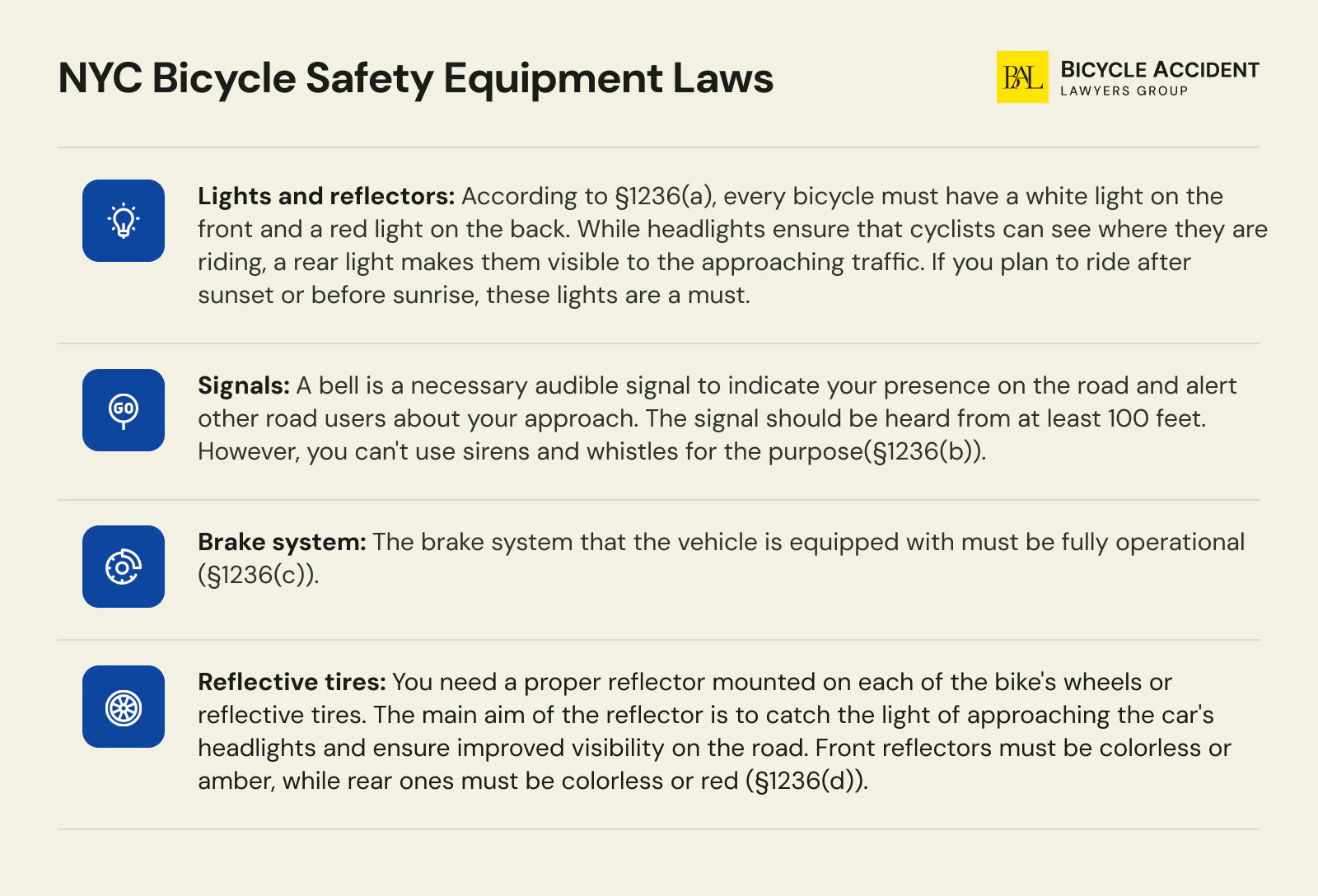
All bicycles ridden in New York must meet these equipment requirements under the vehicle and traffic law. Violations of these vehicle laws affect fault.
- Lights: A white front headlight visible from 500 feet, a red taillight visible from 300 feet, and a side light visible from 200 feet. Required from half hour after sunset to half hour before sunrise.
- Reflectors: Front (colorless or amber) and rear (colorless or red) mounted reflectors on each wheel. Reflective tires may be used as substitutes.
- Bell or horn: Every bike must carry an audible warning device that can be heard from 100 feet away. Sirens and whistles are prohibited. NYC is one of few municipalities with this mandate. Arizona, Texas, California, and Illinois do not.
- Brakes: Fully operational, capable of stopping within 25 feet on a dry level surface at 10 mph (VTL 1236(c)). Must be able to make the braked wheel skid on dry, level pavement.
NYC Helmet Requirements (VTL 1238)
Requirements depend on age and riding type:
- Children ages 5 to 13: Must wear a CPSC-approved helmet, whether riding or as a passenger.
- A child ages 1 to 4: Must wear an approved helmet and ride in a properly affixed child carrier.
- Infants under 12 months: Cannot ride on a bicycle in any capacity.
- E-bike operators under 18: Are required to use approved head protection.
- Commercial delivery operators: Are required to use protective headgear at all times (AC 10-157).
- Adults: Not legally required to wear a helmet in NYC. An insurer generally cannot use the absence of one to reduce an adult bicyclist’s claim, though helmets reduce serious cranial injuries by up to 60%.
Parents or guardians who fail to comply face a $50 fine.
Commercial Cycling Rules (AC 10-157)
Businesses that use bicycles for commercial purposes face additional requirements: ANSI or Snell-approved helmets, operator identification on both the bicycle and the person operating it, a log book with employee names, IDs, and daily trips, and annual reports filed with the Police Department for record-keeping purposes. Working operators must also meet all VTL 1236 equipment requirements. These rules apply to the growing number of delivery persons on platforms like DoorDash and Uber Eats.
E-Bike Laws in NYC
An estimated 300,000 e-bike operators use NYC streets daily, and related crashes are a growing share of bicycle accidents in the city. New York State recognizes three classes of e-bikes (VTL 102-c) with additional NYC restrictions.
NYC E-Bike Classes
- Class 1 (Pedal-assist): Motor assists only when pedaling. Top speed of 20 mph. Permitted on streets, bicycle lanes, and multi-use paths.
- Class 2 (Throttle-assist): Throttle can propel it without pedaling, up to 20 mph. Permitted on streets and in a designated bicycle lane or path.
- Class 3 (Speed pedal-assist): Motor assists up to 25 mph. Permitted on streets but may be restricted from multi-use paths and greenways. Class 3 electric bicycles are legal only in NYC and prohibited everywhere else in New York State.
Electric bicycles must ride on roads with posted speed limits of 30 mph or less and are prohibited from sidewalks. Models exceeding class limits on city roadways (Sur-Ron, Talaria, etc.) are illegal.
NYC E-Bike Speed Limit: 15 MPH
As of October 24, 2025, all e-bikes, e-scooters, and pedal-assist commercial bicycles are capped at 15 mph on NYC streets (34 RCNY 4-06), overriding state limits of 20-25 mph. Fines start at $100, with the number of violations determining impoundment. Exceeding this limit at the time of a collision establishes fault against the rider.
How Old Do You Have to Be to Ride an E-Bike in NYC?
Persons must be at least 16 years old to operate any electric bicycle in NYC. Operators under the age of 18 must also wear approved head protection (VTL 1238). A visible class label must be displayed.
Can You Get a DUI on a Bicycle or E-Bike in NYC?
VTL 1192 (DWI) applies only to motor vehicles, so regular bicycles are exempt. Electric bicycles fall under VTL 1242-A, the state’s dedicated e-bike DUI statute. This type of DUI is a traffic infraction, not a misdemeanor, with its own BAC thresholds. Riding a bicycle under the influence at the time of a collision affects fault and the value of any damage claim. Read our full guide to DUI on a bicycle in NYC.
Where You Can and Cannot Ride in NYC
- Sidewalks. Sidewalk riding is prohibited in NYC, with fines starting at $100 and possible confiscation. See the sidewalk section above.
- Parks. Cycling is permitted in city parks only in places designated for that purpose. If no dedicated path exists, you must dismount (RCNY 4-07(c)(3)). Persons may push bikes on city beaches but cannot ride.
- Seat and Pedal Rules. No one shall ride a bicycle without keeping at least one hand on the handlebars and both feet on the pedals (VTL 1232). No rider may carry two or more passengers on a single-seat bicycle.
NYC Bicycle Enforcement: What Changed in 2025-2026
Under the Adams administration (April 2025 to March 2026), NYPD upgraded six offense categories to criminal summonses — roughly 40 per day, totaling about 20,000 in 11 months. Most were dismissed at arraignment.
As of March 27, 2026, minor violations result in civil tickets, the same process that applies to other motorists and drivers. If you receive a ticket in NYC today, it’s resolved in place by a fine, not a court appearance.
NYC Bicycle Accident Statistics (2023-2025)
In the first half of 2023, 18 bicyclists were killed, the deadliest start to a year since Vision Zero began. Two years later, only 1 traditional bicycle fatality occurred in the first half of 2025, part of a record-low 87 total traffic deaths citywide. By Q3 2025, bicycle fatalities had risen to 3 out of 159 total deaths, still down 18% from 2024.
Approximately 4,000 to 5,000 cyclists are injured annually in NYC crashes. Q1 2025 injuries dropped to 7,936 from 9,599 the prior year, suggesting genuine safety improvement.
What Happens After a Bicycle Accident in NYC?
New York follows a pure comparative negligence system (CPLR 1411). A person can recover damages even if found 99% at fault. Compensation is reduced by fault percentage — more favorable than Pennsylvania, Georgia, or Illinois, where exceeding a fault threshold eliminates recovery entirely. Every traffic violation reduces but does not eliminate a claim in your case. If you’ve been in a crash in NYC, understanding your settlement options, filing deadlines, and whether you need an attorney are the next steps. Most cycling attorneys work on contingency.
How Can You Stay Safe Cycling in NYC?
Beyond legal requirements, these practices reduce your risk on the road:
- Yield to pedestrians at every crosswalk and intersection.
- Ride at least 3 to 4 feet from parked cars, especially outside the protected bicycle lane network. Watch for passenger movement and motorists making turns.
- Check over your shoulder and take the lane if the roadway is too narrow to share safely.
- Wear visible clothing and reflective gear at night.
- Inspect brakes, tires, and all safety equipment before each ride. Additional safety information is available from the NYC DOT.
New York Bike Laws: Key Takeaways
NYC cycling laws come from three levels (VTL, RCNY, and the NYC Administrative Code). To protect yourself:
- Know the regulations that affect fault in a crash: lane use, equipment, direction of travel, headphone restrictions, and right of way.
- Keep your equipment legal. NYPD enforces light and reflector requirements at checkpoints.
- If you’re injured in a bicycle accident, New York law allows you to recover damages even if you share some fault.
For the full guide, check out the NYC DOT Bike Rules page for updated safety information and cycling information.
Injured After a Cycling Accident in NYC?
If you’ve been injured in a crash, contact our NYC cycling accident attorneys for a free consultation.

Robert Goldwater is a cyclist representing cyclists. He has practiced personal injury and wrongful death law for more than 20 years, graduating with Honors from Arizona State University Law School, and has helped recover over $1 billion for clients, including injured cyclists.