
Call Now - Open 24/7
888-521-6377
Call
Latest update
Reading
5 min

New York City Bicycle Laws and Cyclists’ Legal Rights

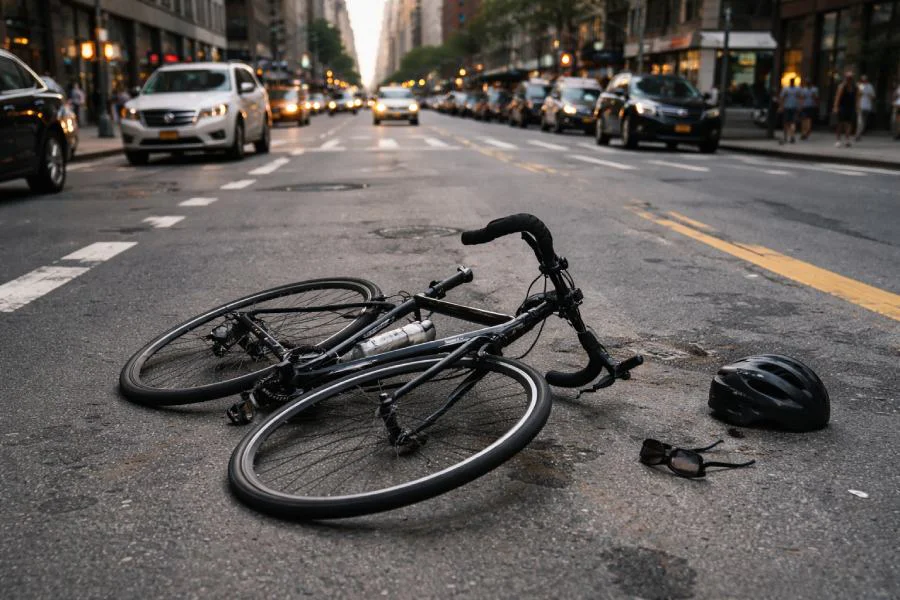
Damaged bicycle lying on New York street after accident, helmet nearby, blurred traffic and buildings.

Break a bicycle rule in New York City and your fault share goes up. Since 26 May 2026, CPLR 1411(b) bars your recovery outright where that share exceeds the motor vehicle driver’s, so a broken rule that used to trim a settlement can now end one.

The city capped e-bikes and pedal-assist commercial bicycles at 15 mph on 24 October 2025. Each rule below comes with what breaking it may do to your recovery.

Key Takeaways

  • New York City stacks three rule layers on you: state VTL, city RCNY, and the Administrative Code.
  • You must use a usable bike lane unless it is blocked or unsafe, under RCNY 4-12(p).
  • Sidewalk riding costs you $100 on a first offense and can cost you the bike.
  • You need no helmet as an adult in NYC, but children five to thirteen must wear one.
  • Your bike needs a white headlight visible 500 feet and a red taillight visible 300 feet.
  • Police can stop you solely for wearing two earphones, and fines reach $150 under VTL 375.
  • Since October 2025 your e-bike is capped at 15 mph on NYC streets, with fines from $100.
  • You must be sixteen to operate any e-bike in NYC, and Class 3 is city-only.
  • Since March 2026 a minor NYC cycling violation gets you a civil ticket, not a criminal summons.
  • You can recover damages even at 99% fault, though your award shrinks by your fault share.

Which Bicycle Laws Actually Apply to You

Three layers govern you in New York City. Only VTL Article 34 extends statewide, because the city adds its own Administrative Code and DOT traffic regulations in 34 RCNY on top, and each layer can add rules the layer below never had.

  • State law covers every road in New York. According to VTL Article 34, equipment, headgear, road position and e-bike standards are set at the state level, and they bind cyclists in Buffalo and Brooklyn alike.
  • The Administrative Code applies only in the city. It creates offenses the rest of the state never sees, and sidewalk cycling is the one most cyclists meet.
  • The DOT traffic regulations in 34 RCNY change most often. DOT writes them and can amend them without Albany, which is how the 15 mph e-bike limit arrived.

The layer matters more than the rule. E-bikes picked up a 15 mph cap in October 2025, and the summons for a red light changed twice between 2025 and 2026, stranding rules many riders had memorised.

Who Must Wear a Bicycle Helmet in New York?

Operators and passengers under fourteen must wear approved protective headgear, adults on a pedal bicycle are exempt, and two groups need helmets at any age.

  • Persons under fourteen must wear one. According to VTL 1238(5), the statute requires a helmet meeting the Commissioner’s standards, which typically track CPSC, Snell and ASTM.
  • Passengers aged one to four need a carrier seat. No person operating a bicycle may carry them without a properly affixed child carrier (VTL 1238(2)), and none may allow a passenger under one year to ride at all.
  • Two groups need one regardless. Subdivision 5-c of VTL 1238 reaches class three e-bike riders, and Administrative Code 10-157 reaches commercial delivery bicyclists, binding the business as well as the person cycling.

The ticket for a child normally goes to the parent present (VTL 1238(8)). Helmet use still matters after crashes in a way the statute never mentions, because the question arrives whatever your age.

New York E-Bike Classes and Speed Limits

According to VTL 102-c, the state caps the motor at 750 watts and splits e-bikes into three types, with the operating limits set out in VTL 1242.

What the statute counts as an e-bike: No more than 36 inches wide, with operable pedals, two wheels and an electric assist motor under 750 watts.

  • Class one is pedal assist only. There is no throttle, and the motor stops assisting at 20 mph.
  • Class two adds a throttle to the same cap. It propels the bicycle without pedaling and also cuts out at 20 mph.
  • Class three runs on a throttle to 25 mph. That authorisation reaches only cities of a million or more, which means New York City.

Every class carries a minimum age requirement of sixteen years. VTL 1242(2) sets it.

E-bikes may be ridden on any roadway posted at 30 mph or less (VTL 1242(8)). VTL 1242(3) also lets a municipality set the time, place and manner of e-bike operation by local law, and it may restrict how persons use bike lanes built for pedal bicycles.

NYC’s 15 mph E-Bike Speed Limit

New York City DOT amended 34 RCNY 4-01 and 4-06 to cap e-bikes, e-scooters and pedal-assist commercial bicycles at 15 mph citywide, effective 24 October 2025. The cap runs below the motor vehicle speed limit on the same street, although it doesn’t reach an ordinary pedal bicycle at all.

  1. Where the city found authority to act. The state provision lets municipalities regulate the time, place and manner of e-bike operation, and that same provision keeps an e-bike off the sidewalk unless a local law allows it back.
  2. The objection that could unwind the 34 RCNY amendment. The rulemaking drew 849 online public comments, and some argued that VTL 1642(26) bars the city from going below 20 mph except by local law. However, a DOT regulation under 34 RCNY is not a Council local law, and that gap grounds any future challenge.
  3. The city can move it again. The amendment lands in the agency traffic rules of 34 RCNY rather than state statute, so it needs no trip back to Albany.

New York’s One-Earphone Rule for Cyclists

According to VTL 375(24-a), you may wear exactly one earbud while cycling. The statute names bicycles alongside motor vehicles, so it applies on any public road in New York.

One earphone is legal and two earphones is a violation everywhere in the state, and the rule reaches any audio device with more than one earphone attached, whether you ride a bicycle or drive a car.

Enforcement is rare on the street, but the earphones question surfaces later: if both were in, expect the argument that you never heard the vehicle behind you. That argument goes straight to your fault share, and it may cut what you recover for your injuries.

Where You Must Ride on New York Roads

According to VTL 1234, you ride in a usable bicycle lane or near the right-hand edge. However, its exceptions are broad enough that moving further left is often legal.

  • Your default position is right, or in the lane. Persons cycling ride in the direction of traffic in usable bike lanes, and otherwise near the right curb or edge, or on a usable right-hand shoulder.
  • You may move left to avoid conditions on the right. VTL Section 1234 names fixed or moving objects, parked vehicles, obstructions and other pavement hazards, a lane too narrow to share, and preparing for a left turn.
  • Two abreast on the roadway, more off it. VTL 1234(b) caps bicyclists at two abreast on the pavement and single file when vehicles overtake, although on a shoulder or path you may ride more abreast.
  • Entering a roadway from a driveway or curb, VTL 1234(c) says you must stop and yield to movement on that roadway.

Required Lamps, Reflectors, Horn and Brakes on Every Bicycle

nyc-bicycle-safety-equipment-laws

According to VTL 1236, you may not operate a bicycle unless it is equipped with front and rear lamps, reflective material and a brake. Lamps and reflective equipment are required from half an hour after sunset to half an hour before sunrise.

  • Lamps front, rear and to the side. A front lamp that emits white light visible 500 feet ahead, a red rear lamp visible 300 feet behind, and one visible 200 feet from each side.
  • Reflective tires or spoke-mounted material on each wheel. VTL 1236(d) asks for spoke-mounted reflective material or reflective tires, colorless or amber in front and colorless or red at the rear.
  • An audible warning device that carries. A bell or horn audible 100 feet away; sirens and whistles are barred.
  • Brakes that will skid the wheel. The brake must enable the operator to skid the wheels on dry, level, clean pavement (VTL 1236(c)), and a brakeless fixed-gear bike fails it.

You may have read that a bicycle must stop within 25 feet at 10 mph. That number appears nowhere in VTL 1236.

Can You Ride a Bicycle on NYC Sidewalks?

No. Riding on a sidewalk is banned in New York City for anyone older than twelve, and that rule comes from the city rather than from Albany.

  1. Sidewalks are a local question. The VTL never mentions them, so whether you can ride on one depends on your municipality.
  2. The city rule turns on the cyclist’s age. Children twelve and under may ride on a sidewalk, and the code prohibits every older person from doing so, on pain of a summons.
  3. Outside the city the answer sits in a village or town code. Localities often prohibit bicycle riding in places where pedestrians walk, although some ordinances let children ride there.

If someone tells you the practice is illegal statewide, ask which street. That answer is in a village code, not in the VTL.

Where Bicycles Are Banned in New York

According to VTL 1229-a, bicycles are barred from expressway and interstate routes. State law says nothing about them, so the same ride can be lawful in one town and a fineable offense in the city.

Expressways and Interstates

VTL Section 1229-a bars bicycles from state expressway and interstate route highways, entrances and exits included, and Highway Law 316 carries the same bar. However, the ban lifts where a lane or section of that highway is provided for bicycle use. Authorities over other controlled-access highways may prohibit bicycles too, so a highway that is not an interstate can still be closed to you.

Parks and Greenways

Parks and greenways set their own regulations for cyclists, pedestrians and animals, and a posted sign generally controls where you may ride and in which direction.

Cyclists Have the Same Rights and Duties as Drivers

According to VTL 1231, the statute grants every bicyclist on a New York roadway the same rights as persons in cars and imposes every obligation of a vehicle operator. The exceptions are limited to provisions that by their nature cannot apply to a bicycle.

  • Signals, signs and markings bind you. Red lights, stop signs, turn restrictions and the obligation to yield bind you as they bind motorists and other persons operating vehicles on the roadway.
  • The rule follows you off the roadway too. VTL 1230(b) covers persons riding bicycles on any highway, on private roadways open to public traffic, and on paths set aside for cycling.
  • Keep at least one hand on the handlebars. VTL 1235 bars carrying a package, bundle or article that prevents the operator keeping one hand on the bars.

VTL 1230(a) bars a parent or guardian from knowingly permitting a child to violate traffic laws, so the duty can reach past the person riding. The obligation motorists owe you sits in the same part of the code, which cyclists rarely hear.

What Drivers Legally Owe Cyclists in New York

Drivers owe you a safe pass, due attention on the roadway, and a safety check before exiting a vehicle.

  • A safe pass, with no distance fixed by statute. According to VTL 1122-a, a person overtaking a bicycle must pass at a safe distance. Other states set three feet; New York left the gap to the facts, so lane width, speed and the point of impact carry the proof.
  • Due care toward pedestrians, bicyclists and anyone else on the roadway. VTL 1146 requires every person operating a vehicle to exercise due care to avoid colliding with any bicyclist, pedestrian or domestic animal, and the same standard protects pedestrians and animals crossing at marked and unmarked places.
  • A check before the door opens. VTL 1214 bars opening a door into the path of moving vehicles, and it binds the passenger as well as the person driving.

A driver’s breach of any of the three may still shift the fault share back toward the vehicle.

After bicycle crashes, the law puts duties on the cyclist too: stop, give your name, address and insurance information, and report to the Police Department, which the city requirements of 34 RCNY require. Where someone is killed or seriously injured, you must also file form MV-104C with the DMV yourself.

  • Stop at the scene and identify yourself. According to 34 RCNY 4-12(h), the 34 RCNY requirements apply to any accident causing death, personal injury or property damage. Those are a driver’s obligations, applied to you, and the report goes to the Police Department rather than only to the other party.
  • Hand your information to the injured person first. The leaving-the-scene provisions cover any person eighteen or older. However, if nobody can take it, report to a police officer or the nearest police station.
  • File the DMV report the driver will not file. VTL 605(b) puts that obligation on the person cycling, and it applies where a person is killed or suffers serious physical harm. You file form MV-104C with the DMV within ten days, or MV-104A where a motor vehicle was involved.
  • Know which provision turns a crash into a crime. VTL 1240 covers leaving the scene after physical harm; VTL 1241 is the first-degree offense, where the harm is serious.

The paperwork is not bureaucracy: the police accident report and the MV-104C are usually what an insurer reads before it reads information from you.

What Does a Bicycle Ticket Cost in NYC?

A bicycle violation is a traffic infraction with a penalty attached and no points on a driver licence. Although the penalties stay financial, which summons you get decides whether you pay by mail or appear in criminal court.

  • Headgear and child carrier fines are capped at $50. A court must waive the fine on proof you bought the equipment first (VTL 1238(4), 1238(6)).
  • Leaving the scene is its own offense. Causing physical harm to any person and leaving without giving your information to a police officer violates VTL 1240; serious physical harm makes it a class B misdemeanor under VTL 1241, and for purposes of the Penal Law it is prosecuted accordingly.
  • No points transfer to your driver licence. Penalties for pedestrian and bicycle violations stay financial, for purposes of your driving record, although the underlying conduct may still affect a civil claim.

The summons type changed twice in New York City. In 2025 the NYPD began issuing criminal court summonses for low-level offences such as red lights and sidewalk riding, although the policy was reversed effective 27 March 2026.

Transportation Alternatives found in 2024 city summons data that 92% of criminal summonses for reckless bicycle operation went to New Yorkers of colour.

Does Breaking a Bicycle Law End Your Claim?

Breaking a bicycle regulation reduces a claim in proportion to your fault, and since May 2026 it can end one outright where your share is greater than the person driving. An even split is not greater, so a 50/50 case still recovers half of what it would have.

The May 2026 Fault Change

According to CPLR 1411(a), culpable conduct still “shall not bar recovery”, and damages are instead “diminished in the proportion” your conduct bears to the harm. However, subdivision (b), added by Part EE of Chapter 58 of the Laws of 2026, changes that in one class of case. In an action “subject to article fifty-one of the insurance law”, the claimant’s conduct “shall bar recovery” where it is greater than the defendant’s, which takes in a claim against a driver. CPLR 1411(b) applies by filing date, so an older crash commenced on or after May 26, 2026 falls under it.

Burden of Proof and Exceptions

  1. The driver has to prove your share. CPLR 1412 makes culpable conduct an affirmative defense, so the burden usually sits with whoever asserts it rather than with you.
  2. Headgear use is shielded by statute. According to VTL 1238(7), a failure to comply “shall not constitute contributory negligence” and shall not “diminish or reduce the damages recoverable”. VTL 1238(9) protects you the same way against any local ordinance.
  3. A violation is evidence, not a verdict. A statutory breach can support negligence per se, although it must still have caused the crash. A missing warning signal has nothing to do with a vehicle turning left across the bike lane.
  4. Some violations carry heavier weight than others. Riding the wrong way, riding without lights after dark, or running the signal you were struck at plausibly contributed to the crash.

A traffic ticket is only one piece of evidence in the apportionment of fault. Your rights under the traffic laws do not vanish because you broke a rule in the VTL or 34 RCNY, but your recovery can shrink to nothing when your share is the larger one.

Talk to a New York City Bicycle Accident Lawyer

You now know which rules apply, which layer imposed them, and what a violation does to your claim. The question is whether the other side is using one of those rules against you.

A contested fault split, a denied no-fault claim, or personal harm that crosses the serious-injury threshold are the moments worth a call. Municipal liability claims for crashes involving cars, pedestrians or cyclists add a 90-day notice deadline that does not wait for you to heal first.

Bicycle accident cases are handled on a contingency fee. The consultation is free. Tell us what happened and we will tell you what your claim is worth.

Get a FREE case evaluation today

If you were injured in a bicycle accident, call today for a free consultation. Tell us what happened and we will tell you what your claim is worth.

Call us now at:
888-521-6377