

Call Now - Open 24/7
888-521-6377
Latest update
Reading
20 min

Can You Ride a Bicycle on a Sidewalk?

Can You Bicycle on a Sidewalk in US

Are bikes allowed on sidewalks? As of 2026, sidewalk cycling is legal in many areas but is often discouraged due to safety risks and is regulated by local ordinances. According to the League of American Bicyclists Sidewalk Riding Laws Table, most states either explicitly permit sidewalk riding or remain silent, deferring to local ordinance. Only a handful of states prohibit it at the state level.

This guide covers how each state views the matter, the safety risks involved, and how to protect yourself legally and physically when riding.

Key Takeaways

  • As of 2026, most U.S. states either permit sidewalk cycling or defer to local ordinance. Only a handful prohibit it statewide.
  • Local laws vary significantly: ordinances can override state laws. Always check your city or county’s municipal code before riding.
  • Sidewalk riding is commonly prohibited in business districts and commercial areas. Look for posted signs indicating restrictions.
  • Drivers may not expect fast-moving bikes at driveways and intersections, creating collision risks. Pedestrian conflicts and uneven surfaces add further hazards.
  • Pedestrians always have the right of way on sidewalks. Use a bell or verbal warning when passing pedestrians.
  • When sidewalk cycling is legal, ride at a walking pace (under 10 mph), yield to pedestrians, give an audible signal, and travel in the same direction as adjacent traffic.
  • Many jurisdictions make exceptions for children, with age cutoffs typically under 12 or under 18.
  • Violations can result in fines of $50 to $500 depending on jurisdiction.
  • When in doubt, dismount and walk your bicycle. This is always legal and always safe.

Why Is Sidewalk Riding Dangerous?

Although riding on a sidewalk may feel safer than sharing the road with motor vehicles, research shows the opposite. A meta-analysis cited in the NHTSA Impact Analysis of Bicycle Safety Laws found that sidewalk bicycling is associated with 1.8 to 16 times more collisions than riding on the road.

According to the latest NHTSA Traffic Safety Facts, 1,166 pedalcyclists were killed in U.S. traffic crashes in 2023, a 4% increase from 2022, with 49,989 injured (see latest bicycle accident statistics). Approximately 81% of these fatalities occurred in urban areas, where sidewalk cycling is most common.

Pedestrian Conflicts

The core problem with sidewalk cycling is the speed differential. A typical cyclist travels at 10-15 mph while pedestrians walk at 3-4 mph, creating collision risks in crowded areas, near building entrances, and around blind corners. Children, elderly individuals, and people with mobility impairments are at particularly high risk because they may not react quickly to an approaching bicycle.

Reduced Visibility at Driveways and Intersections

Motorists turning into or out of driveways, parking lots, and cross streets do not expect fast-moving traffic on sidewalks. These car-versus-bicycle collisions at turning points are among the most dangerous scenarios for sidewalk riders. Drivers scan at pedestrian speed, so a cyclist traveling two to four times faster can enter their path before they can react. NHTSA 2023 data shows 28% of pedalcyclist fatalities occurred at intersections and 62% at non-intersection locations, including driveways and mid-block crossings.

Uneven Surfaces and Obstacles

Sidewalks are designed for foot traffic, not wheeled vehicles. Cracked pavement, raised tree roots, utility covers, curb cuts, and surface grade changes all pose hazards that can lead to road defect accidents. At higher speeds, these obstacles can cause loss of control and falls that would be less likely at walking pace.

Wrong-Way Riding Risk

Cyclists on sidewalks often ride against the flow of adjacent vehicle traffic, making them less visible at intersections and driveways. Drivers turning right typically look left for oncoming road traffic, not right for a cyclist approaching from behind.

Universal Safety Guidelines for Sidewalk Cycling

When local laws permit sidewalk riding, follow these guidelines to reduce collision risk:

  • Ride at a walking pace (under 10 mph): The single most effective way to reduce collision severity.
  • Always yield to pedestrians: Pedestrians have absolute right of way on sidewalks. Slow down or stop when approaching, especially from behind.
  • Give an audible signal before overtaking: Use a bell, horn, or your voice to announce your presence from a safe distance.
  • Travel in the same direction as adjacent traffic: This makes you visible to motorists at driveways and intersections.
  • Exercise extreme caution at driveways and intersections: Slow to near-walking speed, check for turning vehicles, and make eye contact with drivers.
  • Dismount in crowded areas: If a sidewalk is congested, dismount and walk your bike.
  • Use bike lanes when available: If a dedicated bike lane or shared-use path exists, use it instead of the sidewalk.
  • Obey crosswalk signals: When crossing at an intersection, follow pedestrian signals rather than vehicle traffic signals.

When Sidewalk Riding May Be Acceptable

Even in jurisdictions that discourage sidewalk cycling, certain conditions may make it the safest available option:

  • No bike lane or shared-use path exists: States and cities like Delaware and Albuquerque explicitly allow sidewalk riding when no dedicated cycling infrastructure is available.
  • Road conditions are dangerous: High-speed traffic with no shoulder, heavy truck traffic, poor road surfaces, or active construction may make the roadway unsafe.
  • Temporary hazards: Road flooding, debris, or accident scenes may force a cyclist onto the sidewalk.
  • The cyclist is a child: Many jurisdictions that otherwise ban sidewalk cycling make exceptions for children, with age thresholds typically ranging from 10 to 16.

A landmark Reynolds et al. study in Environmental Health Perspectives found that on-road marked bike lanes reduce injury rates by approximately 50% compared to unmodified roads, while sidewalks and multi-use trails pose the highest crash risk for cyclists.

Children and Age-Based Sidewalk Cycling Exceptions

Many states and cities that prohibit or restrict sidewalk cycling make exceptions for children, who lack the experience and size to safely share the road with motor vehicles.

Age thresholds vary by jurisdiction: under 10 (Ithaca, NY), under 12 (Georgia, Indianapolis, Charleston, Cincinnati), under 13 (various California municipalities), under 14 (Elmira, NY), under 15 (New Orleans), and under 16 (New Hampshire). Parents should verify their local municipal code for specific requirements.

Research cited by the FHWA found that children riding more than 5 kilometers on the sidewalk had 3.1 times higher injury odds, increasing the risk of traumatic brain injuries and other serious harm even where children are legally permitted.

Definition of a Sidewalk

A sidewalk is a paved pathway running parallel to a roadway, separated from vehicle traffic, and designed primarily for pedestrian use. Some sidewalks are designated as shared-use paths that explicitly permit both pedestrian and bicycle traffic, typically marked with signage. The distinction matters for cyclists because riding on a shared-use path is generally legal even in jurisdictions that ban sidewalk cycling.

Can You Be Fined for Sidewalk Riding?

Yes. Cyclists are classified as lawful road users in most states and are subject to the same traffic laws as motor vehicle drivers. In New York City, a sidewalk cycling violation can carry a fine of up to $100, 20 days of imprisonment, or both.

Even in jurisdictions where sidewalk cycling is legal, a cyclist can still be cited for reckless riding, failure to yield to pedestrians, or unsafe speed. If you are involved in an accident while riding, knowing what to do after a bicycle accident can protect your rights.

State-by-State Sidewalk Cycling Laws

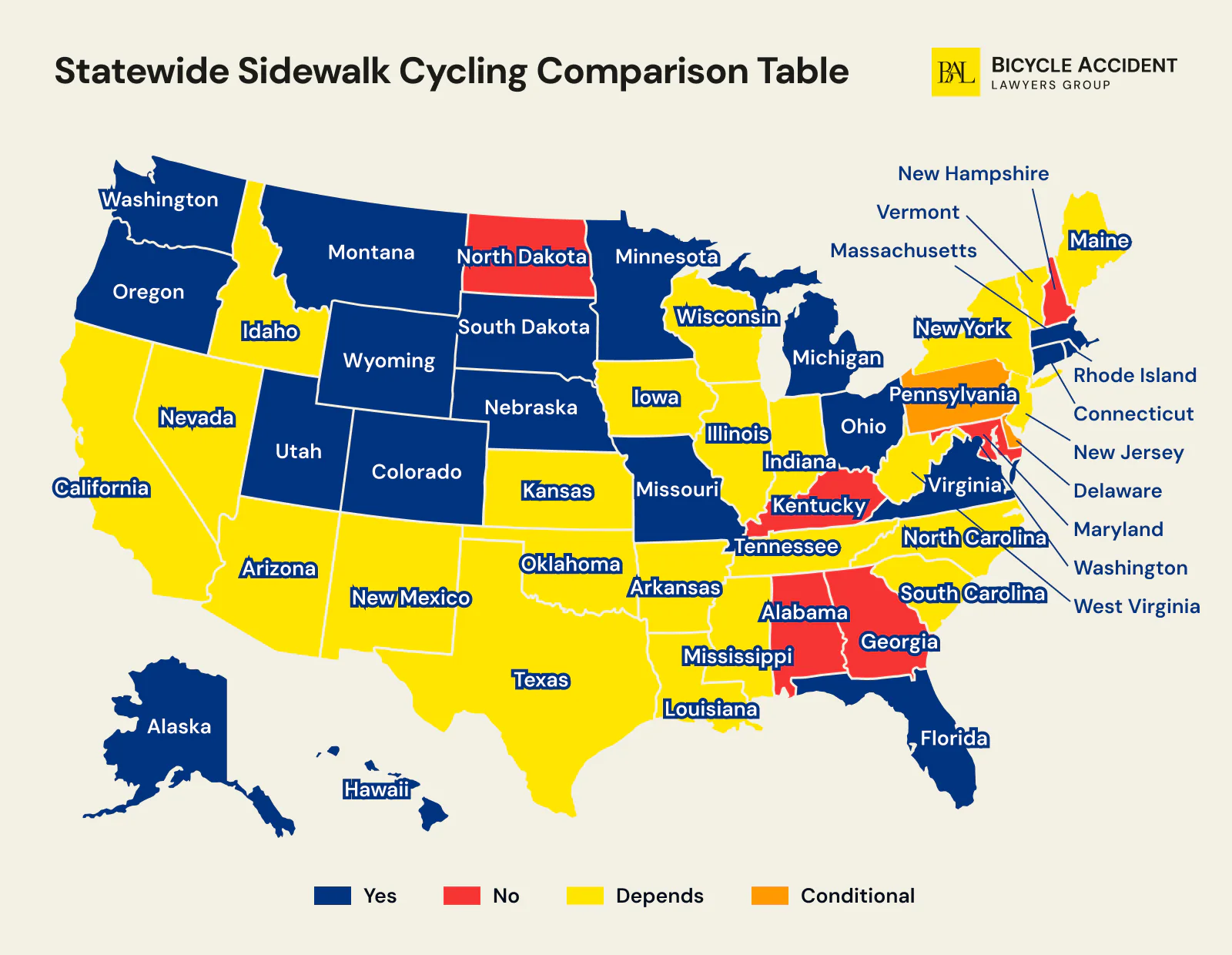
Can you ride a bicycle on a sidewalk in US by state

Below is a breakdown of sidewalk cycling laws across all 50 states and Washington, DC. Because local ordinances can override state-level rules, always verify your city or county’s municipal code before riding.

Alabama

According to NHTSA safety guidance, cyclists should avoid sidewalk riding because motorists do not expect moving traffic on sidewalks, especially when backing out of driveways or turning. Alabama reflects this principle: bikes are considered vehicles under state law, and riding bicycles on sidewalks is banned statewide.

Alaska

You can bike on a sidewalk in Alaska under three conditions: ride carefully to avoid collisions, yield the right of way to pedestrians, and give an audible signal before overtaking.

Arizona

Arizona has no strict statewide regulations for sidewalk riding and allows local governments to set their own rules. As of January 2026, municipalities like Glendale have begun enacting stricter Arizona e-bike laws that affect sidewalk access. Consult local ordinances before riding.

Arkansas

Arkansas doesn’t prohibit sidewalk cycling statewide but doesn’t recommend it either. According to the Arkansas Department of Transportation, several cities prohibit sidewalk cycling via local ordinance, including Little Rock, North Little Rock, Hot Springs, Maumelle, Fayetteville, and Fort Smith.

California

California lets each municipality decide. In Los Angeles, cyclists may use sidewalks as long as they give audible signals and yield to pedestrians. Local laws in Carlsbad, Escondido, and Vista ban bike riders from sidewalks.

  • Santa Monica and LA County: Santa Monica prohibits sidewalk cycling entirely. An additional 32 cities within Los Angeles County have enacted similar bans, particularly in business districts.
  • Business district restrictions: Even in California cities that permit sidewalk riding, business districts are frequently excluded. Signage may not always be posted, so riders should know local boundaries.
  • Children’s exceptions: Some California municipalities allow children under 13 to ride on sidewalks even where adult cycling is prohibited.

Colorado

Bikes, electric bicycles, and other human-powered vehicles are allowed on Colorado sidewalks. Riders must dismount in designated Dismount Zones, obey traffic control devices, and yield to pedestrians.

Connecticut

Sidewalk cycling is generally permitted in Connecticut. Cyclists must alert pedestrians from a safe distance and follow crosswalk signals at intersections.

Delaware

Delaware allows sidewalk cycling under three conditions: no bike lane is available in the vicinity, the area is not a business district, and no signs or devices prohibit the activity.

Washington, DC

Cyclists may ride on sidewalks anywhere in the District of Columbia except the Central Business District. Specially designated bicycle sidewalks in the area are exempt from this restriction.

Florida

Although Florida classifies bicycles as vehicles, sidewalk cycling is generally permitted except in areas restricted by local ordinance. Pedestrians have the right of way. Florida’s bicyclist fatality rate is notably high at 6.3% of all traffic deaths, making cautious riding essential.

Georgia

Under O.C.G.A. 40-6-294, Georgia prohibits any person over age 12 from riding a vehicle on a sidewalk, making it one of the few states with an explicit age-based sidewalk prohibition.

Hawaii

Sidewalk cycling is legal in Hawaii outside of business districts. Cyclists must maintain a speed of no more than 10 mph.

Idaho

Sidewalk cycling is permitted in Idaho unless a local ordinance prohibits it. Cyclists have the same rights as pedestrians but must yield the right of way and announce their presence.

Illinois

Illinois forbids vehicles on sidewalks except human-powered ones, including bicycles. Local rules vary: in Chicago, sidewalk cycling is prohibited unless on a designated bike path or traveling to the nearest bike station.

Indiana

Indiana delegates sidewalk cycling rules to local governments. In Indianapolis, only children under 12 may ride on sidewalks; adult riders are prohibited.

Iowa

Local ordinances control sidewalk cycling in Iowa. In Cedar Rapids, cycling is banned on sidewalks within the central business district and wherever “No sidewalk riding” signs are posted.

Kansas

Kansas has no state-level rule. In Wichita, riding is permitted unless posted signs indicate otherwise. Cyclists must yield to pedestrians.

Kentucky

Under 601 KAR 14:020 Section 8, Kentucky explicitly permits bicycles on sidewalks unless prohibited by local ordinance, and cyclists have the rights and duties of pedestrians. In Louisville, no bicyclists older than 11 are allowed on sidewalks.

Louisiana

Louisiana state law neither permits nor prohibits sidewalk cycling. In New Orleans, only cyclists under 15 may ride on sidewalks.

Maine

Maine has no state law addressing sidewalk cycling. Local ordinances apply exclusively, so check municipal codes before riding.

Maryland

Maryland state law prohibits sidewalk cycling, though local exceptions exist. In Montgomery County, sidewalk riding is permitted except within the City of Gaithersburg, where it is banned.

Massachusetts

Sidewalk cycling is legal statewide in Massachusetts. Signs indicate restricted areas. Cyclists must yield to pedestrians, and Boston encourages using designated bike lanes where available.

Michigan

Michigan allows sidewalk cycling as long as riders warn pedestrians and yield the right of way. Local ordinances may impose additional restrictions.

Minnesota

Sidewalk cycling is permitted in Minnesota but not recommended due to the speed differential between cyclists and pedestrians. Under Minn. Stat. 169.222 subd. 4, sidewalk riding is prohibited in business districts unless locally permitted, and riders must give an audible signal when passing pedestrians.

Mississippi

Mississippi has no statewide rule. In Jackson and Gulfport, sidewalk cycling is allowed outside business districts. Starkville and Hattiesburg prohibit it entirely.

Missouri

Missouri permits sidewalk cycling outside business districts for regular bicycles. E-bikes are banned from sidewalks statewide. The state recommends riding in the same direction as vehicle traffic.

Montana

Montana allows bike riders on public pathways such as sidewalks. Local restrictions may apply, like in Billings, which prohibits cycling in business districts.

Nebraska

In Nebraska, it is legal to ride on crosswalks and sidewalks. Cyclists have the same rights and duties as pedestrians and owe a duty of care to those on foot.

Nevada

Nevada has no specific state law on sidewalk cycling. Local governments regulate the practice, and certain Las Vegas streets are off-limits to cyclists.

New Hampshire

New Hampshire classifies bicycles as vehicles, prohibiting sidewalk cycling statewide. Children under 16 are exempt.

New Jersey

New Jersey statutes do not prohibit sidewalk cycling, but most densely populated areas ban the practice, with exceptions for small children under parental supervision.

New Mexico

New Mexico delegates sidewalk cycling rules to local authorities. The Albuquerque City Code prohibits sidewalk riding when a dedicated bike lane is available.

New York

While New York state has no uniform rule, local municipalities do. In New York City, only children 12 and under may ride on sidewalks. Elmira limits it to children under 14, and Ithaca to those 10 and under.

New York City has invested heavily in cycling infrastructure to reduce sidewalk riding. According to NYC DOT data, the 9th Avenue protected bike lane led to a 56% reduction in injuries to all street users and an 84% reduction in sidewalk riding.

North Carolina

North Carolina has no statewide rule. In Raleigh, sidewalk cycling is permitted as long as riders comply with traffic regulations.

North Dakota

North Dakota classifies cyclists as vehicle operators and prohibits sidewalk riding statewide. No local laws can override this.

Ohio

Sidewalk cycling is legal statewide in Ohio, though local municipalities can alter the rules. In Cincinnati, primarily those 15 and under may use sidewalks. Joint sidewalks with signage permitting both cyclists and pedestrians exist in some areas.

Oklahoma

Oklahoma has no statewide rule. In Oklahoma City, riders are banned from business districts but may use sidewalks elsewhere.

Oregon

Bike laws in Oregon permit riders on the sidewalk under specific conditions:

  • Notify pedestrians with an audible signal.
  • Ride at a walking speed.
  • Operate the vehicle with caution.

Pennsylvania

Pennsylvania allows sidewalk cycling outside business districts. Cyclists must adhere to traffic laws and yield to pedestrians. Local jurisdictions may impose stricter rules.

Rhode Island

Rhode Island deems sidewalk cycling legal. State law grants bicyclists the same rights and duties as pedestrians. Noncompliance may affect your compensation if you get into an accident. You can use an online bike accident compensation tool to estimate your claim’s worth.

South Carolina

South Carolina has no statewide regulation. In Charleston, only children aged 12 and under may ride on sidewalks.

South Dakota

Sidewalk cycling is legal throughout South Dakota. Pedestrians hold absolute right of way.

Tennessee

Tennessee has no specific statewide regulation. Local jurisdictions may have location-specific requirements, so consult local ordinances.

Texas

Texas does not prohibit sidewalk cycling at the state level, but large cities and counties regulate the practice. Business districts and city centers are commonly restricted.

Utah

Utah allows sidewalk cycling as long as it does not obstruct pedestrian traffic. Certain zones are off-limits, typically marked by signage requiring riders to dismount.

Vermont

E-bikes are banned from Vermont sidewalks as motorized vehicles. Regular bicycles are not directly prohibited by state law, but local regulations may apply.

Virginia

Virginia permits sidewalk cycling statewide with local exceptions. In Virginia Beach, riding is prohibited at the Oceanfront. In Norfolk, sidewalk cycling is banned where dedicated bicycle paths exist nearby.

Washington

Washington state law permits sidewalk cycling. Riders have the same rights and duties as pedestrians on the sidewalk and acquire motor vehicle operator obligations upon leaving.

West Virginia

In Parkersburg, sidewalk riding is banned in business districts, and only children under 12 may ride on sidewalks elsewhere. Other West Virginia jurisdictions set their own rules.

Wisconsin

Wisconsin generally prohibits sidewalk cycling for anyone past the learning stage. Individual communities may pass local ordinances to override the ban.

Wyoming

Human-powered vehicles are permitted on sidewalks in Wyoming. In Jackson, sidewalk cycling is prohibited within a two-block radius of the Town Square.

Recent Legislative Updates (2024-2026)

Sidewalk cycling laws continue to evolve across the United States:

  • Glendale, Arizona (January 9, 2026): A new ordinance requires helmets for all e-bike riders under 18 within city limits and sets minimum operating ages: 14 for Class 1 and 2 e-bikes, and 16 for Class 3 e-bikes.
  • California (2023): The state reaffirmed its delegation of e-bike sidewalk regulation to local municipalities.
  • New York City (2024): NYC DOT expanded its bicycle infrastructure budget to reduce reliance on sidewalk cycling, though the sidewalk prohibition for adults remains unchanged.

Because sidewalk cycling rules change quickly, always verify current regulations with your local municipal code before riding.

Statewide Sidewalk Cycling Comparison Table

State

Allowed?

Key notes

Alabama

No

Bicycles classified as vehicles; sidewalk riding prohibited statewide.

Alaska

Yes

Cyclists must yield to pedestrians and give an audible signal before overtaking.

Arizona

Depends

Local ordinances determine regulations; no statewide rule.

Arkansas

Depends

Local ordinances apply. Banned in Hot Springs, Little Rock, and Maumelle.

California

Depends

Each municipality decides. Banned in Santa Monica and 32 LA County cities. Legal in parts of LA with audible signal and pedestrian yield requirements.

Colorado

Yes

Cyclists must obey Dismount Zones, yield to pedestrians, and follow traffic control devices.

Connecticut

Yes

Cyclists must alert pedestrians from a safe distance and follow crosswalk signals.

Delaware

Conditional

Allowed only when no bike lane is available, outside business districts, and no signs prohibit it.

Washington, DC

Yes

Allowed everywhere except the Central Business District.

Florida

Yes

Pedestrians have the right of way. State has a high cyclist fatality rate (6.3% of traffic deaths).

Georgia

No

Bicycles are vehicles under state law. Exception: children 12 and under.

Hawaii

Yes

Legal outside business districts; speed limit of 10 mph on sidewalks.

Idaho

Depends

Local ordinances may prohibit. Cyclists must yield to pedestrians.

Illinois

Depends

Local authorities set rules. In Chicago, only designated bike paths or routes to bike stations.

Indiana

Depends

Local governments decide. In Indianapolis, only children under 12.

Iowa

Depends

Local municipalities set terms. In Cedar Rapids, banned in the central business district.

Kansas

Depends

Local laws apply. In Wichita, allowed unless posted signs indicate otherwise.

Kentucky

No

Sidewalk riding prohibited. In Louisville, no cyclists older than 11 on sidewalks.

Louisiana

Depends

State law is silent; local municipalities regulate. In New Orleans, only cyclists under 15.

Maine

Depends

No state law; local ordinances apply exclusively.

Maryland

No

State law prohibits sidewalk cycling, though local exceptions exist.

Massachusetts

Yes

Legal statewide; signs indicate restricted areas.

Michigan

Yes

Cyclists must warn pedestrians and yield right of way.

Minnesota

Yes

Allowed but not recommended due to safety concerns.

Mississippi

Depends

Local rules apply. Allowed in Jackson and Gulfport outside business districts. Banned in Starkville and Hattiesburg.

Missouri

Yes

Allowed outside business districts for regular bicycles. E-bikes banned from sidewalks.

Montana

Yes

Allowed on public pathways. Local restrictions may apply (e.g., Billings business districts).

Nebraska

Yes

Legal on crosswalks and sidewalks. Cyclists have pedestrian rights and duties.

Nevada

Depends

No specific state law. Certain Las Vegas streets off-limits.

New Hampshire

No

Bicycles are vehicles. Exception: children under 16.

New Jersey

Depends

No statewide prohibition, but most densely populated areas ban it except for supervised children.

New Mexico

Depends

Local authorities decide. In Albuquerque, banned when a dedicated bike lane is available.

New York

Depends

Rules vary by municipality. NYC: only children 12 and under. Elmira: under 14. Ithaca: under 10.

North Carolina

Depends

Local ordinances define rules. In Raleigh, allowed with compliance to traffic regulations.

North Dakota

No

Cyclists classified as vehicles; not permitted on sidewalks.

Ohio

Yes

Legal statewide, but local municipalities can alter rules. In Cincinnati, mainly those 15 and under.

Oklahoma

Depends

Local authorities decide. In Oklahoma City, banned in business districts.

Oregon

Yes

Allowed with conditions: audible signal, walking speed, cautious operation.

Pennsylvania

Conditional

Allowed outside business districts. Local jurisdictions can overrule.

Rhode Island

Yes

Legal; cyclists have the same rights and duties as pedestrians.

South Carolina

Depends

No statewide regulation. In Charleston, only children 12 and under.

South Dakota

Yes

Legal statewide. Pedestrians hold absolute right of way.

Tennessee

Depends

No specific statewide regulation.

Texas

Depends

Not prohibited statewide, but large cities regulate. Business districts and city centers often restricted.

Utah

Yes

Legal as long as it does not obstruct foot traffic.

Vermont

Depends

E-bikes banned. Regular bicycles subject to local regulations.

Virginia

Yes

Legal statewide with local exceptions. Virginia Beach: banned at Oceanfront. Norfolk: banned near bike paths.

Washington

Yes

Legal; cyclists have pedestrian rights and duties.

West Virginia

Depends

Local jurisdictions regulate. In Parkersburg, banned in business districts.

Wisconsin

Depends

Generally forbidden past the learning stage, but local ordinances can override.

Wyoming

Yes

Legal for human-powered vehicles. In Jackson, prohibited within two blocks of Town Square.

How to Handle a Sidewalk Cycling Citation

What to do if you get ticket for bicycling on sidewalk

Receiving a citation for sidewalk cycling can be confusing given the patchwork of laws. Here is how to respond:

  • Read the citation carefully: Note the specific ordinance cited, the date, location, and the fine amount.
  • Look up your local municipal code: Verify whether the ordinance applies to your location, whether age exceptions exist, and whether the area is classified as a business district or restricted zone.
  • Document the circumstances: If you believe the citation was issued in error, gather photographs of the location, signage, and any witnesses.
  • Understand the penalty: Sidewalk cycling fines in major U.S. cities typically range from $50 to $500. In some jurisdictions, such as Summit, New Jersey, e-bike violations can result in fines up to $500 with possible device confiscation. In rare cases, such as New York City, penalties can also include short-term imprisonment.
  • Decide whether to contest or pay: If the citation appears valid, paying is typically the simplest resolution. If you believe it was issued in error, you may contest it in traffic court.
  • Consult a bicycle accident attorney if needed: If the citation arose from a collision or if your legal rights were violated, our bicycle accident lawyers often offer free initial consultations. You can also review our bicycle accident claim guide for a detailed walkthrough of the process.

When in Doubt: Dismount and Walk

If you are unsure whether your current location permits sidewalk cycling, dismount and walk your bicycle. Walking a bike on the sidewalk is universally legal, eliminates collision risk with pedestrians, and avoids any possibility of a citation. This is especially advisable in unfamiliar cities, business districts, and areas with heavy pedestrian traffic.

Conclusion

As of 2026, bicycle laws across the country remain as varied as the states themselves, and the landscape continues to evolve as cities respond to new mobility trends like e-bikes. Whether sidewalk cycling is legal in your area depends on state law, local ordinances, and sometimes the specific block you are riding on. Check your local municipal code, follow the universal safety guidelines, use dedicated bike lanes when available, and dismount when you are unsure.

If you have questions about cycling laws in your jurisdiction or have been involved in an e-bike accident or bicycle crash, contact Bicycle Accident Lawyers Group for guidance specific to your situation.

Get a FREE case evaluation today

If you’re a cyclist who has been in an accident, call today for a free initial consult about your legal claim. We’re here to help and offer coast-to-coast representation.

Call us now at:
888-521-6377

Start Your Free Consultation

Supply a few simple details about your injury and our team will take it from there.

First Name
Start Your Free Consultation
Last Name
Start Your Free Consultation
E-mail
Start Your Free Consultation
Phone
Start Your Free Consultation
Which state did the accident occur in? Which state did the accident occur in?
  • Which state did the accident occur in?
  • Alabama
  • Alaska
  • Arizona
  • Arkansas
  • California
  • Colorado
  • Connecticut
  • Delaware
  • Florida
  • Georgia
  • Hawaii
  • Idaho
  • Illinois
  • Indiana
  • Iowa
  • Kansas
  • Kentucky
  • Louisiana
  • Maine
  • Maryland
  • Massachusetts
  • Michigan
  • Minnesota
  • Mississippi
  • Missouri
  • Montana
  • Nebraska
  • Nevada
  • New Hampshire
  • New Jersey
  • New Mexico
  • New York
  • North Carolina
  • North Dakota
  • Ohio
  • Oklahoma
  • Oregon
  • Pennsylvania
  • Rhode Island
  • South Carolina
  • South Dakota
  • Tennessee
  • Texas
  • Utah
  • Vermont
  • Virginia
  • Washington
  • West Virginia
  • Wisconsin
  • Wyoming
What was the date of the accident?
Message
Start Your Free Consultation

We will do our best to reach you as soon as possible.

For urgent queries please call
888-521-6377
Start Your Free Evaluation