


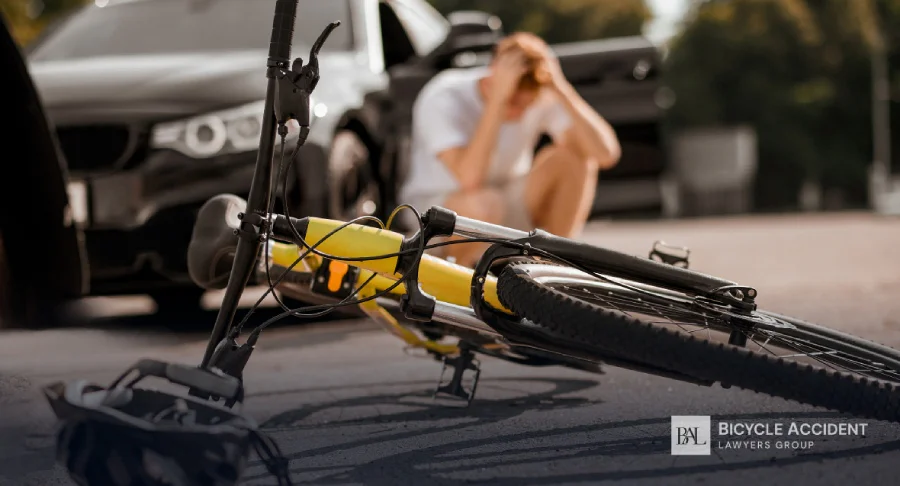
When a car hits your bike in New York, the motorist is not automatically at fault. Responsibility goes to whoever broke a traffic rule or failed to take reasonable care, and it can be split between cyclists and drivers. No-fault insurance can pay your medical bills no matter who caused the collision.
For personal injury lawsuits filed on or after May 26, 2026, a 2026 statute may bar your claim if you are more at fault than the parties you sue.
- Is the Driver Always at Fault in a New York Bicycle Accident?
- Which Driver Mistakes Lead to Fault in a New York Bike Crash?
- When Is a Cyclist at Fault in a New York Bike Crash?
- Does No-Fault Insurance Cover a Bicycle Accident in New York?
- Can You Claim Pain and Suffering After a New York Bike Accident?
- What If You’re Partly at Fault in a New York Bike Crash?
- How Long Do You Have to Sue After a New York Bicycle Accident?
- Who Else Can Be Liable for a Bicycle Accident in New York?
- How Do You Prove Fault in a New York Bicycle Accident?
- Need Help Proving Fault After a Bicycle Accident in New York?
- Get a FREE case evaluation today
Is the Driver Always at Fault in a New York Bicycle Accident?
New York’s Vehicle and Traffic Law (VTL) gives bicyclists a driver’s rights and duties while cycling, except for the bicycle-specific regulations and any driver’s duty that cannot apply to a bicycle. Every driver must also take reasonable care not to hit you or any other cyclist or rider. Who hit whom doesn’t decide fault on its own, so a motorist can be at fault even if your bike hit the car.
Which Driver Mistakes Lead to Fault in a New York Bike Crash?
- Dooring. A motorist swings a car door into your path. A door on the traffic side may open only when it is reasonably safe, a rule that binds passengers too.
- Right hook. The driver passes the rider, then turns right across your lane. A turn is allowed only when it can be made with reasonable safety.
- Left cross. An oncoming driver turns left into your path without yielding to a bicycle or vehicle already in the intersection or close enough to be an immediate hazard.
When a driver or other party breaks state traffic laws like these without an excuse, courts treat it as carelessness in itself (negligence per se). Breaking a city rule is only evidence of carelessness, and breaking a broad duty such as reasonable care may count only as ordinary carelessness. Either way, you must show the violation caused the accident.
When Is a Cyclist at Fault in a New York Bike Crash?
Traffic laws bind bicyclists and riders too, so you can be partly at fault.
- Red light. Stop at a steady red signal.
- Wrong-way riding. Ride with traffic.
- Lane position. Keep to a usable bike lane on your street where one exists or, without a bike lane, ride near the right-hand edge, except to prepare for a left turn or avoid unsafe conditions.
- No lights. From half an hour after sunset to half an hour before sunrise, use a white front light and a red or amber rear light.
- Sidewalk. New York City bans sidewalk riding unless a sign allows it, though a child’s solid-tire sidewalk bike doesn’t count.
A violation matters only if it helped cause the accident.
Does No-Fault Insurance Cover a Bicycle Accident in New York?
No-fault insurance covers your bike accident, up to $50,000 in total.
- What it pays. Your medical bills and treatment costs, 80 percent of lost wages up to $2,000 a month for three years, and up to $25 a day of other necessary expenses for a year.
- Who pays. If the car that hit you is insured, its insurance company pays, even if you caused the accident or have your own auto policy.
- If the car was uninsured. Your own auto insurance company or a relative’s pays, if either of you has a policy. If neither has one, file a claim with the Motor Vehicle Accident Indemnification Corporation (MVAIC) within 180 days of the accident, or within 90 days after a hit-and-run, which also requires a police report within 24 hours.
- Deadline. Give the no-fault insurance company written notification of the accident within 30 days.
Can You Claim Pain and Suffering After a New York Bike Accident?
You can sue the driver for pain and suffering (non-economic loss) only if the driver was at least partly liable and your injuries meet the serious-injury threshold. For lawsuits filed on or after May 26, 2026, being kept from a person’s usual activities for 90 of the first 180 days after the accident no longer counts as a serious injury (injuries such as disfigurement or fracture still qualify). Losses above the $50,000 no-fault limit, such as extra medical expenses or lost wages, need proof of liability but not a serious injury claim.
What If You’re Partly at Fault in a New York Bike Crash?
A stricter limit applies to personal injury lawsuits covered by the no-fault law and filed on or after May 26, 2026. In those lawsuits, you recover nothing for your injuries if you bear more responsibility than everyone you sue put together. If you and the driver are each 50 percent at fault, the limit does not apply and you still recover half your damages.
What counts is the date you file the lawsuit, not the date of the accident. Lawsuits filed before May 26, 2026, keep the old standards.
How Long Do You Have to Sue After a New York Bicycle Accident?
You generally have three years from the accident to sue the driver, whether over your injuries or your damaged bicycle. To sue a city, county, town or village, first serve a notice of claim within 90 days. Then file the lawsuit within one year and 90 days. A case over a state highway or state vehicle has its own 90-day deadline in the Court of Claims. You file the claim within 90 days, or serve a notice of intention in that time and then file within two years.
Who Else Can Be Liable for a Bicycle Accident in New York?
An employer, the automobile’s owner or a government body can also be liable.
- Employer. An employer can be liable for an employee’s driving on city streets.
- Car owner. The owner is liable for anyone driving the automobile with permission, though a rental company has no liability just for owning it.
- Government. A city, county, town, village or the State can be liable for a roadway defect or a collision with a government vehicle. A roadway defect usually needs prior written notification to a city, county, town or village. You don’t need that filing if the government created the defect by its own negligent act or used the spot for its own special benefit.
How Do You Prove Fault in a New York Bicycle Accident?
Fault is decided from the evidence, and the police report is only one piece of it. Doorbell and dashcam video can show the accident itself, but ask nearby homes and shops to preserve footage as soon as possible, collect witness contact information and photos, and preserve your bicycle for the claims process.
What NYC Crash Reports Show
BALG analyzed 12,558 NYPD-reported crashes between one motor vehicle and one bicyclist in New York City from 2023 to 2025. Officers recorded the motorist as turning left or right in 29 percent of those crashes, a group that includes right hooks and left crosses. They named a contributing factor for the cyclist about as often as for the motor vehicle (55 and 56 percent, respectively). These are officers’ entries in individual cases, not findings of legal liability.
Need Help Proving Fault After a Bicycle Accident in New York?
At BALG, our bicycle accident lawyers handle the claims process on a contingency fee basis, so you pay no attorney’s fee unless we recover compensation through a settlement or verdict for you. Call (888) 521-6377 or contact BALG for a free consultation.

Robert Goldwater is a cyclist representing cyclists. He has practiced personal injury and wrongful death law for more than 20 years, graduating with Honors from Arizona State University Law School, and has helped recover over $1 billion for clients, including injured cyclists.