

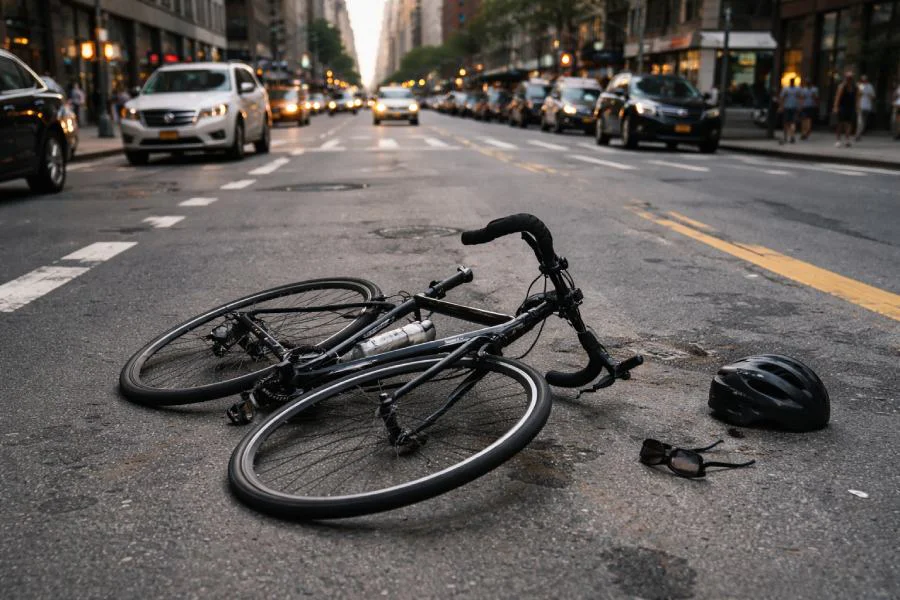
A New York City bicycle accident claim runs on two tracks, and you need to open both. No-fault pays up to $50,000 no matter who caused the accident. A liability case against the at-fault motorist covers everything no-fault doesn’t, including compensation for pain and suffering. Written notice is due within 30 days. Since May 26, 2026, being more than 50 percent responsible can end your case outright.
No-fault comes from the insurer of the vehicle that hit you, and you have three years to bring the liability action against the motorist. New York changed two of those rules on May 26, 2026, covered below. A bicycle accident lawyer at our law firm, Bicycle Accident Lawyers Group (BALG), opens both tracks the week a cyclist calls our phone number, because the earliest deadline is 30 days out.
- What should you do first after a bike accident in NYC?
- Which insurance company pays first after a bike accident in New York?
- What does no-fault pay after a bike accident in New York?
- What are the no-fault deadlines after a bike accident in New York?
- What Changed for New York Bicycle Claims in May 2026
- When can you sue the driver for pain and suffering?
- How does shared fault affect a bike accident claim in New York?
- Does not wearing a helmet reduce your claim in New York?
- What are the deadlines to file a bike accident lawsuit in New York?
- How much is a bike accident claim worth in New York?
- Do you need a lawyer for a bike accident claim in NYC?
- Get a FREE case evaluation today
What should you do first after a bike accident in NYC?
Get medical attention the same day even if you feel fine, since late care is the first thing insurance companies question. Whether the incident happened on streets in Manhattan, a road in the Bronx, or anywhere else in New York, these first steps protect your rights. Two pieces of what to do after a bicycle accident belong here.
How do you get the police report for an NYC bike crash?
Call 911 for any accident with injuries, since an officer at the scene is what produces the report your case depends on. Use 311 only afterward, to follow up on an existing report. The report records the motorist’s details, the witnesses, and the officer’s account. If a detail is wrong, ask the reporting officer’s precinct to correct it within days, before the report is filed with the DMV. Get the report number and the officers’ badge numbers.
A report that names a witness is worth more to us than one that assigns liability, because the officers record what each side says rather than deciding who caused it.
Request the full report from the precinct of occurrence by email or in person, or through the NYPD Collision Report Retrieval Portal. After 30 days, ask the New York State DMV instead.
What evidence should you keep after a bicycle accident?
Photograph where you ended up, the damage to bike and gear, your injuries, skid marks, and cameras. Take the motorist’s name, insurance information, policy number, and plate. Keep every medical record, a repair estimate, and your receipts — this evidence strengthens your bicycle accident claim.
A gap in treatment costs our clients more than any other hole in that file, because a stretch with no appointments lets the insurer argue you had already recovered.
Which insurance company pays first after a bike accident in New York?
The insurer of the vehicle that hit you pays first. Section 5103(a)(1) requires every auto policy to pay first-party benefits to the people that vehicle injures, excluding those riding in another car or on a motorcycle. You are covered whether or not anyone in your home owns a car.
The most common early mistake we see is riders opening the no-fault filing with their own auto insurer. The 30-day clock keeps running while that paperwork sits with a company that owes nothing.
Which policy pays your no-fault benefits?
- The insurer of the vehicle that hit you, once identified and insured.
- A car policy in your household, yours or a resident relative’s, if that car was uninsured or fled.
- Motor Vehicle Accident Indemnification Corporation (MVAIC), only when no household policy exists.
The motorist’s liability insurer is separate from whichever of the three pays your no-fault benefits, and it pays nothing until your injuries clear the serious injury threshold.
What if the driver fled or had no insurance?
MVAIC runs on its own clocks, confirmed against MVAIC’s own rules and Insurance Law § 5208. You must report the incident to police within 24 hours, then file a Notice of Intention to Make Claim within 90 days for a hit-and-run, or 180 days if the driver was identified but uninsured. You must be a New York resident with no other auto insurance available.
What if you hit another rider, a pedestrian, or a pothole?
A collision with another rider or a pedestrian is ordinary negligence, with no serious injury threshold, no no-fault, and the 2026 comparative-negligence bar does not apply. A crash on a road defect is a pothole claim against the City or other municipalities, with a 90-day Notice of Claim. Municipalities are typically liable only if they had prior written notice of specific road hazards, and that requirement ends more of these claims than any other single fact.
What does no-fault pay after a bike accident in New York?
No-fault pays up to $50,000 without anyone proving who was responsible. Section 5102(a) makes that one combined pool, so medical costs, lost wages, and travel to appointments all draw it down together. Lost earnings are capped at 80 percent of what you were making, $2,000 a month, for three years. Other out-of-pocket expenses top out at twenty-five dollars a day for one year.
Does no-fault cover damage to your bike?
Damage to the bike sits outside the $50,000 pool, as a separate action against the motorist’s insurer. You do not need a serious injury to bring it. The first property offer we see on a bicycle lands well under what the rider paid, since insurance companies depreciate it like a motor vehicle with no standard price guide. Ask for replacement value backed by your receipt and a comparable model’s price.
What are the no-fault deadlines after a bike accident in New York?
A no-fault filing carries three deadlines under 11 NYCRR 65-1.1, and missing any of them is the most common reason benefits get denied.
- Notice of the accident, 30 days. Written notice must reach the insurer within 30 days. The insurer then sends form NF-2, with its own return clock. In a hit-and-run, notice goes to a household car policy or MVAIC instead.
- Proof of medical expenses, 45 days. Each bill is due within 45 days of the care it covers, so the clock restarts with every appointment.
- Proof of lost earnings, 90 days. Proof of missed earnings is due within 90 days.
Late paperwork is not always fatal if you send written proof of a clear and reasonable justification, but the insurer decides whether that proof qualifies, so treat every deadline above as firm.
The denial that reaches us most often is not a late notice at all, but a missing proof from a provider who billed a health insurer.
We calendar all three deadlines as soon as a client is retained, and ask providers to bill no-fault directly, so the 45-day deadline becomes the provider’s responsibility, not yours.
What Changed for New York Bicycle Claims in May 2026
Three changes took effect on May 26, 2026 (Part EE of Chapter 58 of the Laws of 2026), applying to any action filed on or after that date, including 2025 accidents not yet filed. Circular Letter No. 3 confirms it.
- The 90/180-day serious injury category was deleted, so a temporary but disabling injury no longer clears the threshold on its own.
- Your share of responsibility can now bar recovery entirely, eliminating any compensation. New CPLR 1411(b) bars recovery once your share is greater than the motorist’s.
- Liability is decided before injury, under amended Section 5104(a).
Cyclists hit by vehicles have been covered by no-fault for decades, and that is settled. What is new and untested is whether the 2026 bar in CPLR 1411(b) reaches cyclists. Attorneys with experience in bicycle accidents at BALG read it as reaching them, since Section 5102(j) counts anyone entitled to no-fault benefits as a covered person, which puts riders inside Article 51. No court has applied it to a cyclist yet, so ask a personal injury lawyer how it lands on your accident.
A new $100,000 cap on non-economic damages (Section 5104(d)) reaches only people who were driving at the time, not riders.
When can you sue the driver for pain and suffering?
No-fault pays your bills but never pays compensation for pain and suffering. Reaching that compensation means proving a serious injury as Section 5102(d) of the Insurance Law defines it, and eight categories now qualify.
- Death.
- Dismemberment.
- Significant disfigurement.
- A fracture.
- Loss of a fetus.
- Permanent loss of use of a body organ, member, function, or system.
- Permanent consequential limitation of use of a body organ or member.
- Significant limitation of use of a body function or system.
A documented fracture qualifies on its own. A head injury qualifies only with proof of a lasting or significant limitation of a body function or system, which takes medical documentation and consistent treatment over time. A soft-tissue strain that resolves within weeks does not qualify. If the rider was killed, the estate’s representative can bring a wrongful death action against the motorist’s insurer. Because liability is now settled first, we collect that evidence in the first few weeks, while witnesses are still reachable.
How does shared fault affect a bike accident claim in New York?
Under Section 1411(a) of the CPLR, New York applies pure comparative negligence to most injury cases, cutting your compensation by your share of responsibility. New CPLR 1411(b) applies to motor vehicle cases under Article 51 and bars compensation once your share is greater than the motorist’s. Because cyclists receive no-fault benefits, they very likely sit inside Article 51, so the bar very likely applies when suing a motorist.
At 50 percent you still collect half your compensation. At 51 percent you collect nothing. One percentage point decides everything, and that is exactly why an insurer will push to raise your share.
Wrongful death actions are not covered by the new bar. The family’s case still runs under pure comparative negligence, where shared responsibility reduces compensation but never eliminates it.
Cyclists and bicyclists carry the same duties as drivers, so insurers commonly argue negligence for running a red light, a stop sign, riding against traffic, or an unsignaled lane change. New York’s DWI laws apply to motor vehicles, not bicycles, so you generally can’t be charged with DWI on a bike, and drinking does not cut off your no-fault benefits. But an insurer can still argue that drinking made you careless, and any traffic ticket becomes a document they build on.
Does not wearing a helmet reduce your claim in New York?
Helmets cannot be held against the riders the law covers. New York requires helmets only for riders under fourteen and Class 3 e-bike riders, so an adult on a standard bicycle has no helmet requirement. Section 1238(7) says failing to wear one “shall not constitute contributory negligence or assumption of risk” and cannot “diminish or reduce the damages recoverable.” If an adjuster brings up your helmet, the law is on your side.
In addition, New York does not require helmets for Class 1 or Class 2 e-bike riders, though helmet use remains strongly recommended for every rider and pedestrian on city roads. On streets across Manhattan and the Bronx, bicycle accidents involving head injuries show better results for riders wearing helmets, but insurers cannot use the absence of a helmet to reduce your compensation. The bottom line: helmets protect you physically, and New York law protects your rights.
What are the deadlines to file a bike accident lawsuit in New York?
Missing a filing deadline usually ends the right it protects.
| Filing | Deadline | When it applies |
| No-fault notice | 30 days | Any crash covered by no-fault |
| MVAIC police report | 24 hours | Driver fled |
| MVAIC Notice of Intention | 90 or 180 days | No household auto policy |
| Notice of Claim | 90 days | Accidents involving municipalities or road defects |
| Lawsuit against a driver | 3 years | Damages beyond no-fault |
| Wrongful death lawsuit | 2 years | Cyclist killed in the crash |
| Suit against the City | 1 year, 90 days | NYC or NYC Transit claims |
Different rules apply to injured children, since deadlines can be paused until a minor turns 18. Ask a personal injury lawyer before assuming a child’s rights have expired.
How much is a bike accident claim worth in New York?
Economic damages cover medical expenses, lost wages, reduced earning capacity, and property damages. Non-economic damages (physical suffering, emotional distress, loss of enjoyment of life) sit outside no-fault, reachable only once your injuries clear the serious injury threshold. Our breakdown of NYC settlements shows how the numbers come together.
New York only requires drivers to carry $25,000 of bodily-injury coverage per person, confirmed against DFS’s own rules, and serious injuries can cost far more. Supplementary uninsured/underinsured motorist (SUM/UIM) coverage on your own household auto policy, if one exists, is the next place to look once the motorist’s policy is exhausted. For a rider with serious injuries and a motorist carrying the state minimum, SUM coverage may be the only realistic path to full compensation.
The results of your case depend on how badly you were hurt, how clearly the motorist was responsible, how complete your documentation is, and your share of responsibility. New York’s anti-subrogation statute (GOL § 5-335) generally bars health insurers from asserting a lien against a personal injury settlement, but it carves out no-fault benefits under Article 51. If your $50,000 pool runs out, the no-fault insurer’s unpaid balance can attach to a later settlement, so raise it with a lawyer before your matter resolves.
Do you need a lawyer for a bike accident claim in NYC?
Not every NYC bike accident needs a personal injury lawyer. Skip one if your injuries healed within a few weeks, the motorist clearly caused the accident, your losses are under $10,000 (the Small Claims Part hears those in court), and no-fault is paying without pushback.
Call a bicycle accident attorney for a case review if your injuries may meet the serious injury threshold, the insurer is denying benefits or pushing an early offer, more than one party is involved, or the driver is blaming you, since the 2026 rule puts everything at stake. An adjuster may ask for a recorded statement, medical authorizations, or an independent exam by a physician the insurer picks. Do not sign a release until your doctor knows how you will end up.
The personal injury lawyer team at Bicycle Accident Lawyers Group, a New York City law firm with experience handling bicycle accident cases across all five boroughs, works on contingency, so there is no fee unless it recovers. Our fee structure explains how the process works. Call our phone number for a free case review and consultation, and a bicycle accident attorney on our staff will answer your questions, go through your police report, injuries, and deadlines before you decide on representation. Call today, and our team will walk you through the next steps to protect your case.

Robert Goldwater is a cyclist representing cyclists. He has practiced personal injury and wrongful death law for more than 20 years, graduating with Honors from Arizona State University Law School, and has helped recover over $1 billion for clients, including injured cyclists.