

In general, riding a bicycle on a corridor, especially an expressway, is not permitted in the United States due to safety and speed-related concerns. Although bicycles are usually allowed on public roads, exceptions apply to controlled-access highways where signage explicitly prohibits them. For example, in Massachusetts, bicycles may traverse all public roads except limited access or express state corridors where they are specifically banned by posted signs.
The legality varies by state, road type, and local ordinance, so riders must check the rules before choosing a route. According to the Federal Highway Administration (FHWA), there are no federal laws that prohibit two-wheeler use on the interstate highway system or other expressways. Each state sets its own rules. Before riding on any corridor, check your state’s Department of Transportation (DOT) website for current restrictions and permitted routes.
Key Takeaways
- Some jurisdictions allow bikes on highways, while others forbid the activity altogether or issue local regulations that control the matter.
- Rural segments of the interstate highway system often permit cycling because no alternative exists. Urban sections typically restrict bikes due to high volume and speed.
- Highways pose real risks to riders because of high-speed traffic, wind gusts, road debris, and narrow shoulders.
- Riders must exercise caution and abide by existing traffic law to stay safe and protected on a corridor.
- Illegal use of controlled corridors can lead to fines, citations, removal, and other legal implications.
- If you are involved in a cycling accident on a corridor, a bicycle accident attorney can help establish the other party’s liability and pursue compensation for your injuries.
Highway Cycling Rules on US Roads
A local municipality may be given the right to impose individual rules and regulations when it comes to biking on a corridor in the region. However, there are also general bike laws to abide by. The following apply specifically to corridor riding:
- Bicycles are considered legal vehicles, so riders have the same rights as car drivers. They must follow the same rules, stop at traffic lights, give right of way, and abide by posted signs.
- On highways with shoulders, ride on the shoulder rather than the travel lane. If no shoulder exists, ride as far right as safely practicable. In jurisdictions that allow full-lane use, take the lane only when traveling at normal speed.
- In 42 states, impeding traffic laws apply only to motor vehicle operators, not people on bikes. Pedaling at a slower speed than surrounding vehicles on a corridor is not a violation in most jurisdictions, as long as you are following the rules above.
- Bike riders should maintain a single-file formation on a corridor. If single-file riding is impossible or unsafe, alterations may be permitted by local ordinance.
- A rider must use hand signals when making a shift, turn, stop, or any change in direction. Signaling is especially critical on highways where vehicles approach at high speed.
- A bike must be equipped with a sound braking system, state-approved front and rear lights, and reflectors. Proper lighting is essential on shoulders where visibility is reduced during early morning and evening hours.
- Riding predictably increases your chances of arriving safely. Avoid sudden moves and alert other participants about your intentions in advance.
What Is a Highway According to Federal Laws of America?
All public roads in the USA fall under the category of a corridor. However, you cannot refer to every expressway as a corridor, as not all highways are expressways. A corridor, an expressway, and an interstate are different types. Depending on the subcategory, specific rules and regulations may apply. Bicycles are classified as non-motorized vehicles in most states. This classification determines whether riders are permitted on access highways, since many jurisdictions restrict these to motorized flow only.
In practice, the rural vs. urban distinction matters most. Rural segments of interstate highways often permit cycling because no alternative route exists and shoulders tend to be wider. Urban areas typically prohibit bicycles due to high volume, high speed, and limited space. NHTSA data from 2023 reflects this pattern: 81% of the 1,166 cyclist fatalities that year occurred in crowded zones, while only 18% occurred in rural zones.
Highways (State and Federal Routes)
As previously mentioned, we collectively refer to all public roads as highways. Whether you are on a rural road, a city street, a US route, or a federal corridor, you can still be biking on a corridor. This category includes numbered US routes (such as US 50 or US 101), state corridors, county roads, and city streets. A corridor may differ in size, the types of vehicles it allows, and the number of lanes.
However, the main outstanding feature that best describes this type of paved road in the USA is the presence of intersections, stoplights, adjacent streets, and by-road properties. This surface may have varying speed limits, which makes it suitable for activities such as cycling.
Freeways
A freeway is also a corridor but with a high speed limit and controlled access highway entry. You can only enter one through an on-ramp. Freeways have no intersections or stop signs, and you cannot reach any property directly from them. Multiple strips run in both directions, and freeways are toll-free. However, bikes are generally forbidden on freeways. Prohibition postings are most commonly placed at entry ramps. If you see a no-bicycles marker at a ramp entrance, that corridor is off-limits.
Interstates
An interstate is a federally funded part of the highway network and often connects major cities across the country. Most interstates are free to use, but there are toll corridors available as well. Interstate routes are specifically designed for long-distance travel and heavy traffic. That is why lanes and shoulders on interstates are usually wider than on other surface categories.
Some states allow bicycles on interstate shoulders in rural areas where the shoulder is wide enough to accommodate cyclists safely and no alternative route exists. This is most common in western jurisdictions such as Nevada, Arizona, and Oregon, where long distances between towns leave riders with no alternative. Western states allow bicycles in these cases because the corridor system offers no other option. Currently, 5 jurisdictions permit two-wheelers on all interstate shoulders (Idaho, Montana, North Dakota, South Dakota, and Wyoming), 9 permit cycling on selected portions, and 34 prohibit bicycles from all interstates. In congested areas, interstates are almost always off-limits.
One of the easiest ways to spot a cross-state corridor is to look for one- or two-digit numbers. Even numbers go east and west, while odd numbers go north and south. Vulnerable participants such as bicyclists are not allowed on these unless state law says otherwise.
Can You Legally Ride a Bicycle on the Highway? State-by-State Overview
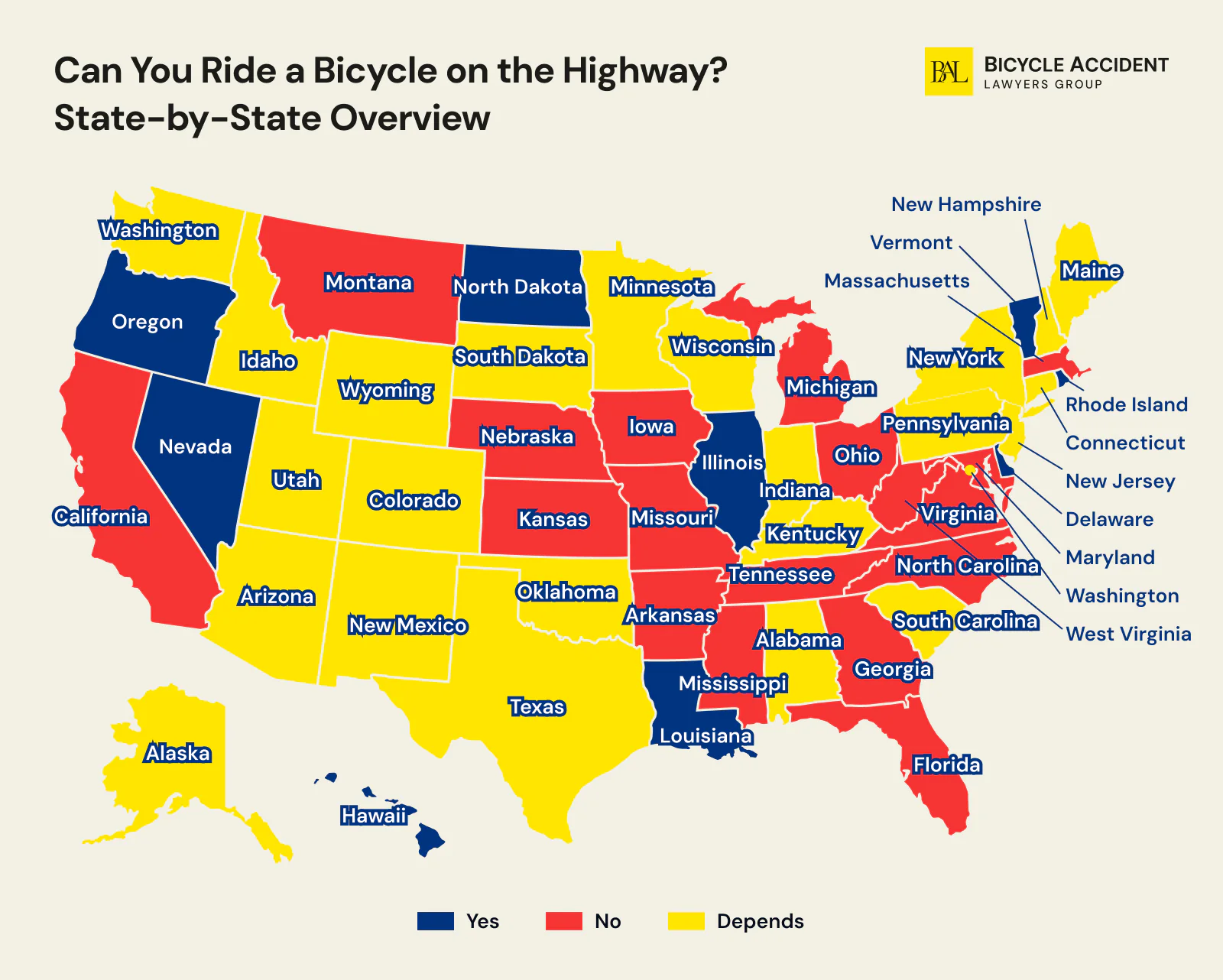
An expressway or a cross-state corridor sometimes seems like a lucrative shortcut that can save you the hassle of making a multiple-mile detour on your journey. Besides, cycling on an expressway in the USA is not always illegal. So, should you seize the opportunity or strategize a longer yet safer journey? There is only one way to figure it out: consult state laws!
Alabama
Alabama treats two-wheelers as full-on automobiles, which are forbidden on sidewalks but allowed on public thoroughfares. Rules do not explicitly restrict riding on expressways or federal corridors, but local governments may impose additional ordinances. Keep an eye out for posted markers when you bike in Alabama.
Alaska
Every rider in Alaska has the same rights as other motorists. They can pedal in a bike lane or pedal on the far right side of the stretch or on a margin if it is safe to navigate. There are stretches, such as Airport Way, the Johansen Expressway, and the Steese Expressway, which restrict riders, so you should always check postings or local municipalities for more information.
Arizona
In Arizona, two-wheelers may be ridden on corridors as long as riders comply with existing ordinances. It is possible to navigate through the state using federal corridors if it is not explicitly forbidden by the local government. Keep in mind that interstate highways are exceptionally dangerous for riders since they pose a high chance of a deadly collision with a car.
Arkansas
Unlike other jurisdictions, Arkansas does not view two-wheelers as lawful automobiles, but they are allowed on all public thoroughfares. Moreover, riders possess the same rights and duties as other motorists. However, in Arkansas, riders are forbidden from any expressway.
California
Generally speaking, if you are moving as fast as the surrounding automobiles, you are allowed to use any stretch in California. Even if you cannot match that speed, you can use most public stretches, except for those that feature prohibiting postings. Also, a rider using a regular bike or an electric bicycle is banned from expressways, toll bridges, and limited-entry corridors.
Colorado
According to Colorado Statutes, riders are rightful participants, which grants them use of public thoroughfares on the condition that they comply with local ordinances. However, state provisions entitle local municipalities to change existing norms in order to improve safety in the area.
Connecticut
Riders in Connecticut can use most thoroughfares in the state, including sidewalks. However, depending on the type chosen, the cyclist follows the rules of either a pedestrian or a motorist. There are limited entry corridors that riders are not allowed on unless there is a designated path available.
Delaware
Delaware stresses the fact that local thoroughfares are not designed exclusively for car operators. Riders are permitted in the state, too. However, they must be well-versed in local traffic laws since they can bear full responsibility for an initiated accident.
Florida
Most public stretches in Florida are accessible for riders. However, they must not obstruct the flow of cars. At the same time, two-wheelers are banned from any limited entry or federal corridor facility.
Georgia
Georgia views two-wheelers as automobiles, which makes it legal for riders to use roadways. It is allowed to use the roadway if no bike lane is available. In other cases, riders should pedal on a designated path. At the same time, they are barred from using any controlled expressway or federal corridor.
Hawaii
Hawaii does not prohibit riding on a corridor. However, there are a few conditions to comply with. Riders must use equipped bike lane room when available. You can exit the strip to overtake others or steer clear of hazardous conditions. When sharing the surface, riders have to maintain a single file.
Idaho
Since riders are entitled to the same rights and duties as the rest of the motorists, they are allowed to use local corridors. There is no provision forbidding the use of federal corridor corridors as such, but most local ordinances set limits on high-speed corridors.
Illinois
General traffic statutes apply to riders on corridors in Illinois. As lawful participants, they can take a full lane when traveling at normal speed. In other situations, they have to stick to the right-hand side as close to the curb as practicable.
Indiana
Riders in Indiana can bike on most corridors in the state on the condition that they comply with local ordinances. However, it is advised to use dedicated bike lane room to navigate the area and stay as safe and protected as possible. If you are unsure whether you can legally pedal on a particular stretch, you can always reach the Indiana Department of Transportation and inquire about the matter.
Iowa
In Iowa, bikes are not defined as automobiles since they are human-powered, but cyclists are allowed on most stretches within the state. The exceptions are federal corridors, corridors with a defined speed limit, and local streets that prohibit the activity.
Kansas
Cyclists are allowed to use public surfaces in Kansas if there is no marked bike lane in the area. While on a highway, they must abide by all posted notices to avoid creating dangerous situations. Non-motorized automobiles, such as two-wheelers, are not generally permitted on a federal corridor unless local ordinances overrule the prohibition.
Kentucky
There are no local statutes that either permit or prohibit bicyclists from using entry corridors or federal corridors in Kentucky. However, there are some precise requirements when riding on public stretches. Riders must use a designated margin when available. They can also take an entire strip if it is exclusively marked for this category of user.
Louisiana
You can pedal a bike on a highway in Louisiana as long as it is adequately equipped and fully functional. Moreover, riders must remain on the far right side unless they are in an area where two or more marked strips heading in the same direction. In that situation, riders may utilize the left-hand curb, especially before making a left turn.
Maine
In Maine, riders have the freedom to pedal anywhere they choose, provided they comply with the current ordinances. Riders are not required to use a dedicated strip even if there is one adjacent to the path they use. However, local governments may restrict them from using divided stretches.
Maryland
Two-wheelers are referred to as automobiles in Maryland, meaning that their operators have to comply with all the statutes of other motorists. Unlike other jurisdictions, Maryland restricts riding on a list of specific corridors and segments.
Massachusetts
Riders in Massachusetts are subject to all state-approved as well as local rules. Aside from the obligations, they have the right to use most public stretches across the state. However, any federal corridor is usually off-limits. A dedicated posting will notify a rider about it.
Michigan
You can pedal a bike on both sidewalks and surfaces in Michigan. When on the stretch, riders acquire the rights of motor automobile operators. When using the sidewalk, they must abide by the same rules that pedestrians do. You cannot bike on an freeway in Michigan.
Minnesota
Cyclists are allowed on most state and trunk corridors in Minnesota. However, they may be banned from controlled expressways if there is a corresponding entrance posting. The high speeds preserved on a major federal corridor pose a danger to such vulnerable participants as riders.
Mississippi
According to Mississippi statutes, riders share the same rights and obligations as car operators. This means that they can bike across major corridors. Yet, the provision forbids biking on any federal corridor or controlled facility.
Missouri
Missouri provisions forbid motor automobile operators from acting in any way that may put riders who share such a roadway with them in any danger. At the same time, riders may use most corridors across the state, except for federal corridors.
Montana
Montana goes further than most in supporting pedaling on corridors. Not only are riders allowed on local corridors, but the state has compiled a dedicated guide that any cyclist can use to navigate the area safely. Keep in mind that biking on any federal corridor is prohibited.
Nebraska
For the most part, riders are allowed on any public stretch except for major expressways and federal corridors in Nebraska. However, if there is an equipped designated strip in the vicinity, riders cannot ignore it and continue; they should always pick a dedicated path over a shared one. Expressways are off-limits to riders.
Nevada
Unlike most jurisdictions, Nevada permits bikes on federal corridors. Due to the rural nature of the state, riders are not offered many alternatives. It is important to remember that most have postings that require riders to exit at one point or another.
New Hampshire
Human-powered automobiles are considered legal participants, meaning that riders have the same rules and obligations as the rest of motorists. Local ordinances may restrict certain stretches, so it is best to check for those in advance.
New Jersey
New Jersey does not ban biking on sidewalks, but many towns have local rules restricting it in certain stretches, usually with postings. Sidewalks are meant for pedestrians, and biking on them can lead to conflicts or crashes, similar to riding against the flow. Only very young children under adult supervision should use sidewalks.
New Mexico
Aside from local corridors, riders can use certain portions of entry corridors, primarily in rural areas, since recent accident statistics show that these locations are less prone to serious incidents than urban stretches. A federal corridor that allows biking will be equipped with a special margin assigned to riders. Other expressways that restrict pedaling will feature posted notices.
New York
Statutes and local ordinances may differ across New York State. Generally, riders are allowed on most public stretches, but certain bridges, expressways, and access corridors may forbid the activity. If general rules do not apply to an area, a posting will proclaim it. Keep in mind, if you have been involved in an incident while biking, consulting a trained New York bicycle accident lawyer will help you understand your legal options.
North Carolina
Non-motorized traffic is not allowed on major interstates and other fully controlled corridors in North Carolina, even though bikes are considered automobiles in the area. You can pedal a two-wheeler on any other public stretch as long as you comply with local ordinances.
North Dakota
North Dakota has a couple of unique rules applicable to riders. First of all, riders are not allowed to use sidewalks to navigate the state. Secondly, they are permitted to use interstate highways for riding.
Ohio
Although cyclists share the same rights and have access to the same areas as motor vehicles, one can’t generally ride a bicycle on a highway. There are certain exceptions, though. A rider may occupy a portion of an expressway when directed by a police officer. Also, it is possible to pedal next to one where there are dedicated designated strip options available.
Oklahoma
Bike riding on highways in Oklahoma is generally permitted because riders are considered rightful participants. There is no direct provision that allows or restricts use of interstate corridors or expressways, so they must consult local ordinances to stay on the safe side.
Oregon
Riders have a legal right to traverse across Oregon’s streets and highways. Moreover, they can even use local interstate highways and expressways. Yet, there are a few sections that riders cannot use. For instance, I-84 from I-5 (MP 0) to 122nd Street (MP 10.25) Eastbound and Sandy Blvd (MP 15.14) Westbound in Portland, or I-5 from Barnet Road (South Medford) Interchange, MP 27.58 to the Crater Lake corridor (North Medford) Interchange, MP 30.29 in Medford.
Pennsylvania
Upon first glance at the general provisions, riders can use any street or corridor in Pennsylvania. While that is primarily true, riders are not allowed to be on expressways unless granted a special permit from the Pennsylvania Department of Transportation.
Rhode Island
Local authorities have put a lot of effort into improving bicyclists safety. There are over 60 miles of paved designated strip space available. Apart from that, riders can use most public stretches for transportation across the state since they are entitled to the same legal rights as car drivers.
South Carolina
Two-wheeler regulations in South Carolina aim to protect riders as well as other individuals on the road. That is why riders can use highways to navigate across the state, but only on the condition that there are no designated strip alternatives in the vicinity or that they are unsafe to use. As for expressways, bicycles are not permitted on controlled corridors unless there are dedicated options available.
South Dakota
South Dakota permits riders to pedal with the flow. This means that riders can use all surfaces available except for those that expressly prohibit the activity. However, while navigating high-speed alternatives, riders must exercise increased caution.
Tennessee
Bicycles are considered automobiles in Tennessee, which means that all legal regulations that govern the operation of cars are applicable to them. Bicycles may be used on most stretches except those restricted by local authorities. Primarily, the rule applies to cross-state corridors and limited access stretches.
Texas
Texas is a key state for understanding cycling regulations. Riders can explore most stretches, including highways, across Texas. There are a few toll roads and expressways in the Texas network inaccessible to bicycle traffic, such as Sam Rayburn Tollway and US 75.
However, keep in mind that the Texas Transportation Commission has the right to impose restrictions on alternative routes, and the Texas Department of Transportation (TxDOT) enforces them. The Texas Transportation Commission works with the Texas Department of Transportation TxDOT to manage restricting bicycle use on certain stretches.
You should always keep an eye for official traffic-control devices marking the areas. Texas riders can also use e-bikes on most public stretches within city limits where traditional two-wheelers are allowed. If you need help with a Texas cycling matter or have been injured on a Texas road, contact us for a free matter review.
Texas laws, enforced by the Texas Department of Transportation, are among the most detailed in the country. Texas remains one of the most important jurisdictions for bicycle safety pointers and planning.
Utah
Riders are permitted on most major surfaces in Utah. Some parts of interstates are not available, but alternative paths are typically accessible. E-bikes follow the same rules as standard bicycles in the state.
Vermont
Like in most situations, you can ride a bicycle across major corridors in Vermont. In fact, it is allowed to cycle on the margin of a partially controlled route as long as there are safe connections with public stretches.
Virginia
Planning a biking journey in Virginia seems effortless since riders are permitted almost anywhere in the state. You can ride on or off the pavement in Virginia, choosing the paths that suit your needs and expertise. However, riders are banned from all interstates for safety reasons.
Washington
Washington laws are quite straightforward when it comes to bicycle use on major state corridors as well as freeways. Riders can ride on highways as long as they abide by existing rules and ordinances. Noncompliance with traffic laws may lead to a ticket. Some portions of controlled-entry alternatives may be closed. Besides, there is a precise map outlining permanently restricted stretches for riders.
West Virginia
West Virginia bike regulations are pretty similar to those of other jurisdictions. Riders are allowed to use public stretches as well as sidewalks to navigate across the state. Depending on where a rider pedals, they have to abide by the general guidelines that either motorists or pedestrians follow. At the same time, it is prohibited to ride on a high-speed corridor.
Wisconsin
Wisconsin allows riders on all the paths available for motor vehicles, except for a few controlled-entry stretches. High-speed alternatives are often equipped with wider margins that riders can use to enhance their safety. However, high-speed riders can change lanes and take a full strip.
Wyoming
Bike regulations in Wyoming do not specifically address highway riding. Since riders are subject to the same rules and responsibilities as motor automobile drivers, riders can generally use high-speed corridors. However, checking local ordinances and seeking alternative routes is advised for safety.
Safety Tips for Bike Riding on Highways

Can you pedal a bicycle on a highway without putting yourself at risk? Probably not. But there are a few practical safety tips that can boost your protection on a busy road, no matter the part of the country you are cycling through:
- Plan your journey in advance. Look up available alternatives before you pedal. Some may be faster, and some may be safer. Check your state’s DOT website for restricted corridors and permitted shoulders. We suggest you pick the safest option available.
- Protect yourself with proper gear. Most jurisdictions do not require adult riders to wear helmets. However, quality safety gear will not rule out every chance of getting into an accident, but it will decrease the seriousness of your injuries if you happen to hurt your head in the process.
- Choose the proper road position. Most state regulations require riders to stick to the far right side, but it does not mean that you should ride as close to the curb as possible. Position yourself closer to the center of the shoulder so that you remain visible to the approaching traffic. In some situations, taking the whole lane is a good choice.
- Watch for highway-specific hazards. Shoulders present dangers that normal stretches do not. High-speed cars create strong wind gusts that can destabilize a two-wheeler. Margins accumulate debris such as glass, gravel, and tire fragments. Narrow space leaves little room to maneuver if an automobile drifts. Scan the road ahead constantly and be prepared to react.
- Understand the actual risk. Crash data suggests cycling incidents are statistically rare. An Arizona DOT study found fewer than 1 bicycle-motor vehicle collision per year on the state’s controlled highways over an 11-year period. However, when crashes do occur, the consequences can be severe. In 2017, a pickup truck struck a group of riders on a 4-foot shoulder in Michigan, killing 5 and injuring 4. The NTSB investigation led to national safety tips and recommendations for margin riding.
- Scan the surroundings. You should be ultra-vigilant about where you ride. Inspect the road ahead for any potential hazards or obstacles so that you can react on time. Try to monitor other individuals at the same time. Be vigilant for vehicles exiting their driveways, opening doors, potholes, and other potentially hazardous actions.
- Know your legal rights. Even the most law-abiding and careful riders may suffer from other people’s negligence. If you are involved in a highway cycling accident, a trained bicycle accident attorney can guide you toward fair compensation for your injuries and losses. Contact us for a free case review to discuss your situation.