
Whether you can cycle on the highway depends on the road and the state, because federal law leaves interstates and freeways to each state. In everyday conversation, the highway covers everything from a two-lane state route to an interstate entered from an on-ramp, where traffic moves at freeway speed.
A route can begin as an ordinary road and become a limited-access freeway. Past that point, the rules for your bicycle can change, which a notice at the entrance may show. If a driver hits you, where and how you cycled can become evidence in the dispute over fault.
What States Allow Bicycles on Interstates?
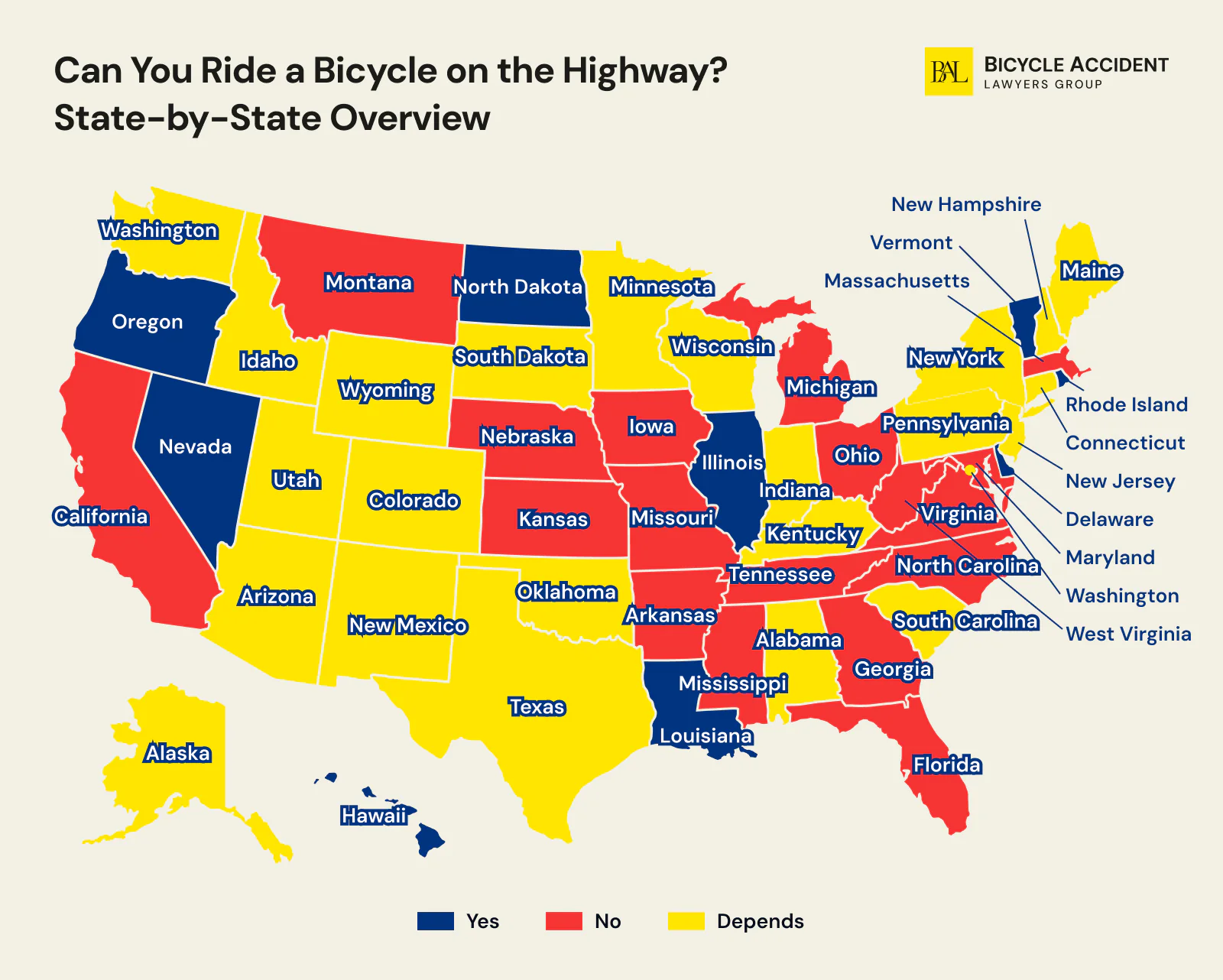
Some states allow bicycles on interstate shoulders in rural areas where the shoulder is wide enough and no alternative route exists. Western states allow bicycles because the highway system offers no other option. Currently, 11 states allow bicycles on interstate shoulders by default (Alaska, Arizona, Colorado, Idaho, Montana, Nevada, New Mexico, Oregon, Utah, Washington, and Wyoming), 3 permit cycling on selected rural portions (California, Nebraska, and South Dakota), and 36 prohibit bicycles from all interstates. In congested areas, interstates are off-limits. Interstate access rules last verified against state DOT policies and statutes in November 2026. Laws change — confirm with your state DOT before planning a route.
Bicycle Highway Laws in All 50 States
|
State |
Highway cycling |
Interstate/expressway access |
Key notes |
|
Alabama |
Allowed on public roads |
No explicit restriction; local ordinances may apply |
Bicycles classified as vehicles; forbidden on sidewalks |
|
Alaska |
Allowed; cycle in designated paths or far right side |
Allowed; specific stretches restricted (Airport Way, Johansen Expressway, Steese Expressway) |
Same rights as motorists |
|
Arizona |
Allowed with local ordinance compliance |
Possible where not explicitly forbidden; serious risks |
Check local postings |
|
Arkansas |
Allowed on all public roads |
Forbidden on all expressways |
Bicycles not classified as vehicles; same rights as motorists |
|
California |
Allowed on most public roads |
Banned from expressways, toll bridges, and limited-access highways |
Must match traffic speed or stay right; includes electric bicycle ban on expressways |
|
Colorado |
Allowed if compliant with local ordinances |
Local municipalities may restrict |
Per Colorado Statutes |
|
Connecticut |
Allowed on most roads, including sidewalks |
Limited-access highways off-limits unless designated bike path exists |
— |
|
Delaware |
Allowed on local roads |
Not specified |
Cyclists bear full responsibility for accidents |
|
Florida |
Most public roads accessible |
Banned from any limited access or interstate highway |
— |
|
Georgia |
Allowed on roadways if no designated path exists |
Barred from controlled expressways and interstates |
Bicycles classified as vehicles |
|
Hawaii |
Allowed |
Prohibited on all interstate highways (H-1, H-2, H-3, H-201) |
Must use bike paths when available; cycle single file |
|
Idaho |
Allowed on local highways |
Allowed on rural interstate shoulders; urban segments (Boise, Coeur d’Alene) may be signed prohibited |
Same rights as motorists |
|
Illinois |
Allowed under general traffic statutes |
Not specified |
Full lane at normal speed; otherwise rightmost position |
|
Indiana |
Allowed with local ordinance compliance |
Not specified |
Use dedicated cycling paths when available |
|
Iowa |
Allowed on most roads |
Banned from interstates |
Bikes not classified as vehicles |
|
Kansas |
Allowed if no marked cycling path exists |
Not permitted on interstates |
— |
|
Kentucky |
Allowed on public roads |
No statutes explicitly permit or prohibit cycling on interstate highways |
Must use designated shoulders when available |
|
Louisiana |
Allowed if bike is properly equipped |
Not specified |
Stay rightmost side unless multiple lanes in same direction |
|
Maine |
Allowed on any road |
Local governments may restrict divided highways |
Not required to use a designated path |
|
Maryland |
Allowed; must comply with all traffic laws |
Restricted on specific highways and segments |
Bicycles classified as vehicles |
|
Massachusetts |
Most public roads accessible |
Interstates off-limits |
Posted notices indicate restricted areas |
|
Michigan |
Allowed on roads and sidewalks |
Banned from freeways |
Rights of motor vehicle operators on roads |
|
Minnesota |
Allowed on most state and trunk highways |
May be banned from controlled expressways if posted |
— |
|
Mississippi |
Allowed on most roads |
Forbidden on all interstates and controlled facilities |
Same rights as car operators |
|
Missouri |
Allowed on most highways |
Banned from interstates |
Motorists prohibited from endangering cyclists on roadways |
|
Montana |
Allowed on local highways; state provides cycling guide |
Allowed on rural interstate shoulders; urban segments and tunnels may be signed prohibited |
— |
|
Nebraska |
Allowed on most public roads |
Banned from expressways and interstates |
Must use designated cycling path if available |
|
Nevada |
Allowed |
Permitted on interstates (rural state, lack of alternative routes) |
Postings may require exiting at certain points |
|
New Hampshire |
Allowed; same rules as motorists |
Local ordinances may restrict |
— |
|
New Jersey |
Allowed on roads; sidewalk rules vary by town |
Not specified |
Young children only on sidewalks |
|
New Mexico |
Allowed, including certain controlled-access highways in rural areas |
Allowed where designated shoulder exists; restricted highways posted |
— |
|
New York |
Allowed on most public roads |
Certain bridges, expressways, and controlled-access highways may prohibit bicycles |
Regulations differ across New York State; consult a New York bicycle accident lawyer if injured |
|
North Carolina |
All public roads accessible except interstates |
Banned from interstates and fully controlled highways |
Bicycles classified as vehicles |
|
North Dakota |
Allowed (not on sidewalks) |
Prohibited on interstate highways |
— |
|
Ohio |
Generally not allowed on highways |
May use expressway only when directed by police; cycling paths adjacent to expressways allowed |
— |
|
Oklahoma |
Generally permitted |
No direct provision allows or restricts; consult local ordinances |
— |
|
Oregon |
Allowed on streets, highways, interstates, and expressways |
Restricted sections: I-84 (MP 0–MP 10.25 EB / MP 15.14 WB) in Portland; I-5 (MP 27.58–MP 30.29) in Medford |
— |
|
Pennsylvania |
Allowed on most streets and highways |
Expressways off-limits unless permitted by PA DOT |
— |
|
Rhode Island |
Allowed on most public roads |
Not specified |
Over 60 miles of paved bike paths; same rights as car drivers |
|
South Carolina |
Allowed only if no cycling path alternatives exist or alternatives are unsafe |
Not permitted on controlled highways unless dedicated facilities available |
— |
|
South Dakota |
Allowed on all roads unless expressly prohibited |
Allowed on rural interstate shoulders (I-90, I-29); prohibited through Sioux Falls and Rapid City |
Exercise caution on high-speed highways |
|
Tennessee |
Allowed on most roads |
Banned from interstates and limited-access highways |
Bicycles classified as vehicles; all car traffic regulations apply |
|
Texas |
Allowed on most roads, including highways |
Banned from toll roads and expressways (e.g., Sam Rayburn Tollway, US 75) |
Texas Transportation Commission and Texas Department of Transportation TxDOT manage restricting bicycle use; e-bikes allowed within city limits; contact us for a free case review if injured |
|
Utah |
Allowed on most major roads |
Some interstate sections restricted; alternative routes available |
E-bikes follow same rules as standard bicycles |
|
Vermont |
Allowed on most highways |
May cycle on shoulder of partially controlled routes with safe connections |
— |
|
Virginia |
Allowed on most roads |
Banned from all interstates |
— |
|
Washington |
Allowed on highways and freeways |
Some controlled-access highway sections closed; state provides restriction map |
— |
|
West Virginia |
Allowed on public roads and sidewalks |
Freeways off-limits |
Follow motorist rule on roads; pedestrian rules on sidewalks |
|
Wisconsin |
Allowed on all roads open to motor vehicles |
Certain controlled-access highways restricted |
Wider shoulders on high-speed highways; faster cyclist may change lanes |
|
Wyoming |
Generally allowed (same rules as motor vehicle drivers) |
Permitted on all interstate shoulders per WYDOT policy (I-25, I-80, I-90); some urban segments and tunnels signed prohibited |
Consider an alternative route for safety |
How to Tell If a Highway On-Ramp Is Closed to Bikes
The state’s traffic laws and the posting at the on-ramp tell you whether a highway is closed to bicycles. Federal guidance in the MUTCD places the NO PEDESTRIANS OR BICYCLES notice on the ramp itself.
- Look up the rule on interstate highways for each state on your route in the table above, then check local ordinances too.
- Check the state transportation department’s bicycle map for the stretch you plan to cycle, and ask its bicycle office about any information the map leaves unclear.
- Read the on-ramp posting, whatever the map told you. That posting controls where your state closes freeways by sign. Statutes in Ohio and Florida close them without any posting. Interpret a missing notice by your state’s rule.
- Stay off a freeway posted closed to cyclists, since Arizona’s law, for one, forbids disobeying a closure notice once it is erected, and Tennessee makes disobeying one a Class C misdemeanor.
How a Cycling Violation Can Affect Your Injury Claim
A Maryland appeals court treated wrong-way cycling on a road shoulder at an intersection as evidence of negligence. It left causation to a jury, while a New York appeals court held that an unexcused traffic violation, such as cycling unlit at night, is negligence per se. Those rulings let a cycling rule you broke be used against you, and contributory negligence law in Maryland, Virginia, North Carolina and Alabama can bar recovery if the violation caused the crash.
How to Stay Safe Cycling on the Highway
Ramps and intersections are a high-speed freeway’s worst spots for a cyclist, as a 2001 Mineta Transportation Institute study placed 93.7% of 2,739 California freeway crashes with bicycles there and 3.1% on shoulders. IIHS counted 31 (3%) of 2024’s 1,075 cycling deaths in crashes with cars on interstates and freeways, against 708 (66%) on other major roads.
- Cross ramps at right angles, obeying any stop sign there, since ignoring one cost a bicyclist a verdict putting the driver 80% at fault.
- Keep to the paved shoulder where legal, and watch for hazards and traffic signals in your direction of travel.
- Brace for truck wind blast when fast traffic on highways overtakes cyclists at a slower pace.
- Stay beyond rumble strips, where FHWA prefers at least four feet of distance, and cross them at their gaps.
- Plan your exits before a long freeway stretch.
Conclusion
Cycling is a relaxing and healthy activity, but it comes with a set of legal requirements and responsibilities. Some states choose to expand bicyclist rights while others limit them. However, each local government in the US does so with the sole aim of enhancing riders’ safety while biking on such busy roads as highways. Today, we’ve briefly discussed every state and its views on highway cycling. If you have any questions left unanswered, contact us for a free legal consultation today!

Robert Goldwater is a cyclist representing cyclists. He has practiced personal injury and wrongful death law since 1992 and earned his J.D. with honors from Arizona State University College of Law that year. Bicycle Accident Lawyers Group has recovered more than $1 billion for injured clients nationwide.