



No federal law governs audio devices on a bicycle. Across most of the United States, riding with earbuds or earphones in both ears is entirely legal at the state level, and the headphone laws that do exist are set entirely by individual state codes. Where restrictions do exist, statutes generally focus on ear coverage rather than the device itself:
- Key Takeaways
- Which States Make It Illegal to Bike With Headphones?
- Cycling with Headphones: State-by-State Overview
- What is the fine for biking with headphones?
- Is it legal to bike with one earbud or AirPods?
- Does Wearing Headphones Hurt Your Bicycle Accident Claim?
- Get Help After a Bicycle Crash Involving Headphones
- Get a FREE case evaluation today
Key Takeaways
- You can legally ride with both earbuds in 42 states that have no headphone statute.
- California, New York, Maryland, Virginia and Delaware require you to keep at least one ear uncovered.
- Florida and Rhode Island ban headsets outright, so even one earbud violates the law there.
- Your headphone ticket stays under $200 as a noncriminal infraction with no license points in most states.
- In New York, officers can stop you for headphones alone; the restriction is a primary offense.
- Your AirPod in transparency mode still counts as covering the ear under these one-ear state statutes.
- Adjusters can blame your earbuds even where headphones are legal, cutting damages by your fault percentage.
- In Maryland or Virginia, any share of fault bars your bicycle claim entirely under contributory negligence.
- Skip recorded statements to insurers; adjusters convert your answers directly into liability percentages against you.
- Save crash reports, camera footage and witness details early, since causation must link earbuds to impact.
Which States Make It Illegal to Bike With Headphones?
The question falls entirely to individual states, and seven of them enforce headphone laws restricting headphone use while bicycling. Five allow one ear while banning both, two ban headsets outright, and Pennsylvania adds an unsettled eighth through a driver statute that never mentions bicycles by name.
Every remaining state stays silent on the issue. If your state doesn’t appear in the table below, you’re almost certainly free to ride with both ears covered.
| Where you ride | States |
What it means for a cyclist
|
| Both ears banned, one ear open | California, New York, Maryland, Virginia, Delaware |
Keep one earbud out and you are legal
|
| Headsets banned entirely | Florida, Rhode Island |
No headphones on a bike; hearing aid or one phone earpiece only
|
| No cycling-specific law | Every other state (roughly 40-plus) |
Both earbuds are legal on the bike itself
|
Most of these states name bicycles directly in the statute. Two stand out.
- Maryland reaches cyclists indirectly. The headphone ban targets motor vehicles (Md. Transp. 21-1120), and a separate rule (21-1202) assigns driver duties to bicycle riders. That chain is how the restriction applies.
- Pennsylvania bans even a single earphone, but the statute says “driver,” never “cyclist.” Whether it reaches someone on a bike is unsettled.
Hearing aids are exempt in every one of these statutes. None of this legislation was ever written to catch riders who are deaf or hard of hearing.
A state without a bicycle-specific law may still have a driver statute broad enough to reach cyclists. Verify your own state’s code, and check locally for city or county ordinances that go further than the state does.
Cycling with Headphones: State-by-State Overview
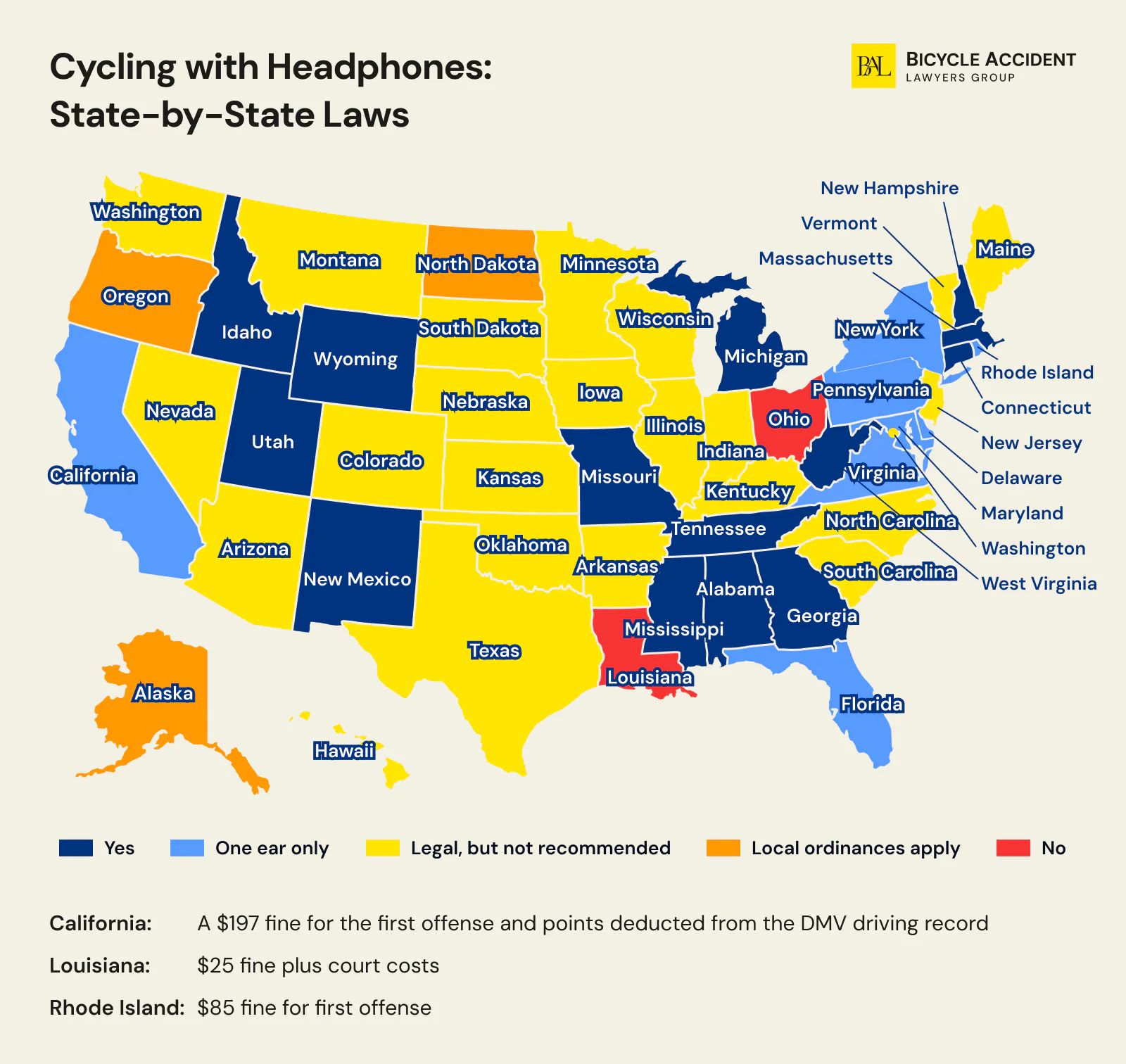
Every statute here was verified against the current code in July 2026. “No restriction” means no statewide provision touches headphone use for riders. Ordinary care still applies everywhere, and cities can write their own, stricter rule on top.
What is the fine for biking with headphones?
Where the law reaches a cyclist, the fine stays under $200 and lands as a noncriminal traffic infraction, not a criminal charge.
| State | Fine for a cyclist | Statutory basis |
| California | about $197 with assessments (reported; confirm the county schedule) | the statute names bicycles directly (CVC 27400) |
| New York | up to $150 first offense (the cap sits in VTL 375(32)) | bicycles named in VTL 375(24-a); a primary offense police can stop you for |
| Florida | noncriminal, nonmoving; amount set by the county | headsets reach cyclists through the vehicle definition (Fla. Stat. 316.304) |
| Rhode Island | $100 first offense, $110 second, $140 third and after | bicycles named in R.I. Gen. Laws 31-23-51 |
No criminal record follows, and because you weren’t behind the wheel of a car, most states add no points to your license. These statutes were drafted with drivers in mind, though, so whether the language stretches to cover a cyclist depends on how the local court reads it. In New York, the restriction is a primary offense — an officer can pull you over for wearing headphones alone, without needing a second traffic violation as pretext.
Is it legal to bike with one earbud or AirPods?
One earbud is legal in every state that restricts headphones for bicycling except Florida and Rhode Island. California, New York, Maryland, Virginia, and Delaware target covering both ears, not the device itself. A single AirPod or one earbud passes in all five of those states, where a full two-ear set would draw a citation.
These statutes test whether something is physically in or over both ears. Volume and listening mode don’t factor in an AirPod in transparency mode still counts as covering the ear. If you ride with one earbud, wear it facing away from traffic, so the ear closest to passing cars stays open and you can hear motorists and pedestrians approaching.
Florida and Rhode Island ban any headset or earphones outright; the only exceptions are a hearing aid or a single earpiece for a phone call. Riding with just one ear covered is still a violation in either state. If you cross state lines, keep one ear open as your default — that habit stays legal everywhere else.
Does Wearing Headphones Hurt Your Bicycle Accident Claim?
Headphones can cut into your bicycle accident compensation, even in states where wearing them breaks no law. The adjuster does not need a traffic violation to pin partial blame on you. Headphones are an easy target.
- Comparative negligence (most states). Every percentage point of fault comes straight out of your damages. A $100,000 insurance claim covering medical bills, lost wages, and pain and suffering at 20% fault pays $80,000. Hit 50% in many states and the recovery disappears entirely.
- Contributory negligence (Maryland, Virginia). Even the slightest fault bars the claim outright. Maryland’s highest court reaffirmed that bar in Coleman v. Soccer Ass’n of Columbia. In these states, the adjuster’s headphone story is not a discount, It is a total bar.
- Recorded statements work against you. Adjusters ask what you were doing, then convert your answer into a percentage of liability. Do not volunteer a statement before talking to a lawyer.
- Causation still has to connect. The carrier must prove the earbuds actually contributed to the crash. A driver who cut into your path in plain daylight, or one who never sounded a horn, leaves nothing for that argument to grab. Where hearing the car would not have changed the outcome, the distraction theory collapses.
- Preserve evidence early. Crash reports, camera footage, witness statements, and medical records rebut the carrier’s case.
Wearing headphones is not an admission that you caused the crash. The negligence that caused the collision belongs to the driver, not your earbuds.
Get Help After a Bicycle Crash Involving Headphones
A headphone-related crash case turns on causation, fault rules, and evidence that disappears fast. Our bicycle accident lawyers have watched adjusters inflate one earbud into an entire defense. Our firm handles bicycle injuries alongside distracted driving claims and other personal injury work, and we know how to keep the other party’s insurance company from reducing your case to a pair of headphones.
Call us at (888) 521-6377 for a free case review. We work on contingency. You pay nothing unless we recover money for you.

Robert Goldwater is a cyclist representing cyclists. He has practiced personal injury and wrongful death law for more than 20 years, graduating with Honors from Arizona State University Law School, and has helped recover over $1 billion for clients, including injured cyclists.