


You can legally ride a bicycle on most highways in the United States, but not on all of them. No federal laws prohibit bicycle use on the interstate highway system or other expressways, according to the Federal Highway Administration (FHWA). Each state sets its own bike laws and regulations. Controlled-access highways and freeways typically ban bicycles with posted signage, while standard state and federal routes generally allow them.
The legality depends on the state, the road type, and local ordinances. Five states permit bicycles on all interstate shoulders, 34 prohibit bicycles from all interstates, and the rest allow cycling on selected portions. Before riding on any highway, check your state’s Department of Transportation (DOT) website for current restrictions and permitted routes.
Key Takeaways
Local municipalities may impose their own bike laws for bicycle use on highways. The following general rules apply:
- No federal law bans bicycles from interstates; your access depends entirely on state rules and signage.
- Most highways are ordinary public roads where you may ride; freeways and interstates are the exception.
- Idaho, Montana, North Dakota, South Dakota and Wyoming let you ride all interstate shoulders.
- Thirty-four states bar you from every interstate, so check your state before planning a long route.
- You must obey posted restrictions, since controlled-access highways and freeways typically ban bicycles by signage.
- On a highway with a shoulder, ride the shoulder; without one, stay as far right as practicable.
- In 42 states impeding-traffic statutes cover only motor vehicles, so your slower speed breaks no law.
- Oregon allows interstate riding except marked I-84 and I-5 segments near Portland and Medford.
- A route legal in Nevada can earn you a fine in California, which bans limited-access highways.
- Carry working brakes, state-approved lights and reflectors, since highway riders must meet vehicle equipment standards.
Highway vs Limited-Access Highway: Which Bans Bicycles?
All public roads in the USA fall under the category of a highway. However, not all highways are expressways. A highway, an expressway, and an interstate are different road types with different regulations. Bicycles are classified as non-motorized vehicles in most states, which determines whether riders are permitted on controlled-access highways restricted to motorized traffic only.
The rural vs. urban distinction matters most. Rural segments often permit cycling because no alternative route exists and shoulders tend to be wider. Urban areas typically prohibit bicycles due to high volume, speed, and limited space. NHTSA data from 2023 reflects this: 81% of 1,166 cyclist fatalities occurred in urban zones, while only 18% occurred in rural zones.
Highways and State Routes: Bicycles Generally Allowed
This category includes numbered US routes (such as US 50 or US 101), state highways, county roads, and city streets. These roads feature intersections, stoplights, and varying speed limits, making them suitable for cycling.
Freeways and Controlled-Access Roads: Bicycles Prohibited
A freeway is a high-speed, controlled-access highway entered only through on-ramps. Freeways have no intersections or stop signs, and multiple lanes run in both directions. They are toll-free. Bikes are generally forbidden on freeways as part of the highway network rules restricting bicycle access. If you see a no-bicycles sign at a freeway ramp entrance, that road is off-limits.
What States Allow Bicycles on Interstates?
An interstate is a federally funded part of the highway network connecting major cities. Most interstates are free to use, but toll interstates exist as well. Lanes and shoulders on interstates are usually wider than on other road types, which can better accommodate cyclists in rural areas.
Some states allow bicycles on interstate shoulders in rural areas where the shoulder is wide enough and no alternative route exists. Western states allow bicycles in these cases because the highway system offers no other option. Currently, 5 states permit bicycles on all interstate shoulders (Idaho, Montana, North Dakota, South Dakota, and Wyoming), 9 permit cycling on selected portions, and 34 prohibit bicycles from all interstates. In congested areas, interstates are off-limits.
Interstate numbering: even numbers run east-west, odd numbers run north-south. Most interstates prohibit bicyclists unless state law says otherwise.
Bicycle Highway Laws in All 50 States
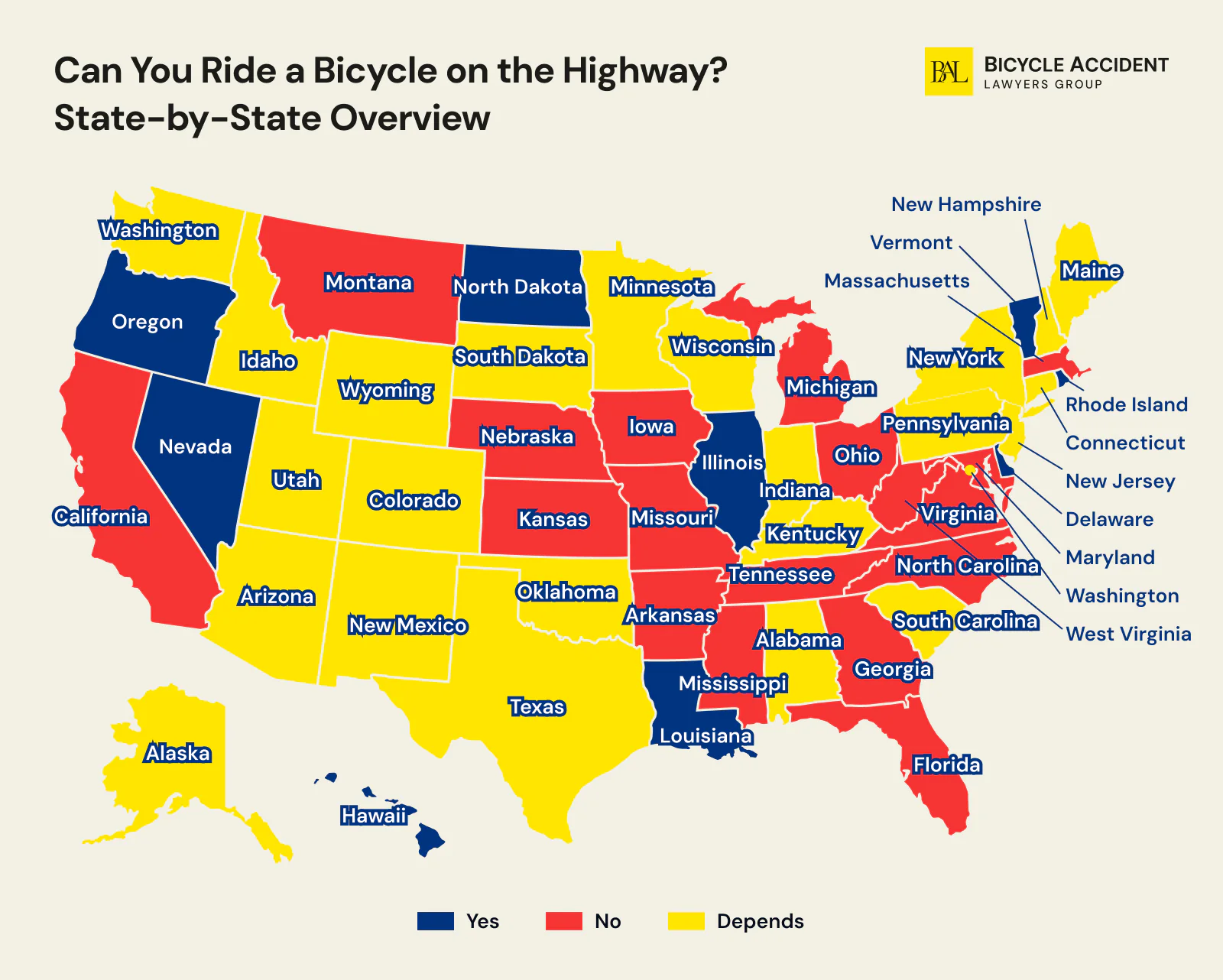
Cycling on a highway in the USA is not always illegal. Whether you can legally ride depends on your state’s laws and travel route.
| State | Highway riding | Interstate/expressway access | Key notes |
| Alabama | Allowed on public roads | No explicit restriction; local ordinances may apply | Bicycles classified as vehicles; forbidden on sidewalks |
| Alaska | Allowed; ride in bike lanes or far right side | Specific stretches restricted (Airport Way, Johansen Expressway, Steese Expressway) | Same rights as motorists |
| Arizona | Allowed with local ordinance compliance | Possible where not explicitly forbidden; serious risks | Check local postings |
| Arkansas | Allowed on all public roads | Forbidden on all expressways | Bicycles not classified as vehicles; same rights as motorists |
| California | Allowed on most public roads | Banned from expressways, toll bridges, and limited-access highways | Must match traffic speed or stay right; includes electric bicycle ban on expressways |
| Colorado | Allowed if compliant with local ordinances | Local municipalities may restrict | Per Colorado Statutes |
| Connecticut | Allowed on most roads, including sidewalks | Limited-access highways off-limits unless designated bike path exists | — |
| Delaware | Allowed on local roads | Not specified | Riders bear full responsibility for accidents |
| Florida | Most public roads accessible | Banned from any limited access or interstate highway | — |
| Georgia | Allowed on roadways if no bike lane exists | Barred from controlled expressways and interstates | Bicycles classified as vehicles |
| Hawaii | Allowed | Not restricted | Must use bike lanes when available; ride single file |
| Idaho | Allowed on local highways | No provision forbids interstate highways; local ordinances may restrict | Same rights as motorists |
| Illinois | Allowed under general traffic statutes | Not specified | Full lane at normal speed; otherwise far right |
| Indiana | Allowed with local ordinance compliance | Not specified | Use dedicated bike lanes when available |
| Iowa | Allowed on most roads | Banned from interstates | Bikes not classified as vehicles |
| Kansas | Allowed if no marked bike lane exists | Not permitted on interstates unless local ordinances override | — |
| Kentucky | Allowed on public roads | No statutes explicitly permit or prohibit bicyclists on interstate highways | Must use designated shoulders when available |
| Louisiana | Allowed if bike is properly equipped | Not specified | Stay far right side unless multiple lanes in same direction |
| Maine | Allowed on any road | Local governments may restrict divided highways | Not required to use bike lane |
| Maryland | Allowed; must comply with all traffic statutes | Restricted on specific highways and segments | Bicycles classified as vehicles |
| Massachusetts | Most public roads accessible | Interstates off-limits | Posted signs indicate restricted areas |
| Michigan | Allowed on roads and sidewalks | Banned from freeways | Rights of motor vehicle operators on roads |
| Minnesota | Allowed on most state and trunk highways | May be banned from controlled expressways if posted | — |
| Mississippi | Allowed on most roads | Forbidden on all interstates and controlled facilities | Same rights as car operators |
| Missouri | Allowed on most highways | Banned from interstates | Motorists prohibited from endangering cyclists on roadways |
| Montana | Allowed on local highways; state provides cycling guide | Prohibited on interstates | — |
| Nebraska | Allowed on most public roads | Banned from expressways and interstates | Must use designated bike lane if available |
| Nevada | Allowed | Permitted on interstates (rural state, lack of alternative routes) | Postings may require exiting at certain points |
| New Hampshire | Allowed; same rules as motorists | Local ordinances may restrict | — |
| New Jersey | Allowed on roads; sidewalk rules vary by town | Not specified | Young children only on sidewalks |
| New Mexico | Allowed, including certain controlled-access highways in rural areas | Allowed where designated shoulder exists; restricted highways posted | — |
| New York | Allowed on most public roads | Certain bridges, expressways, and controlled-access highways may prohibit bicycles | Regulations differ across New York State; consult a New York bicycle accident lawyer if injured |
| North Carolina | All public roads accessible except interstates | Banned from interstates and fully controlled highways | Bicycles classified as vehicles |
| North Dakota | Allowed (not on sidewalks) | Permitted on interstate highways | — |
| Ohio | Generally not allowed on highways | May use expressway only when directed by police; bike lanes adjacent to expressways allowed | — |
| Oklahoma | Generally permitted | No direct provision allows or restricts; consult local ordinances | — |
| Oregon | Allowed on streets, highways, interstates, and expressways | Restricted sections: I-84 (MP 0–MP 10.25 EB / MP 15.14 WB) in Portland; I-5 (MP 27.58–MP 30.29) in Medford | — |
| Pennsylvania | Allowed on most streets and highways | Expressways off-limits unless permitted by PA DOT | — |
| Rhode Island | Allowed on most public roads | Not specified | Over 60 miles of paved bike paths; same rights as car drivers |
| South Carolina | Allowed only if no bike lane alternatives exist or alternatives are unsafe | Not permitted on controlled highways unless dedicated facilities available | — |
| South Dakota | Allowed on all roads unless expressly prohibited | Not restricted | Exercise caution on high-speed highways |
| Tennessee | Allowed on most roads | Banned from interstates and limited-access highways | Bicycles classified as vehicles; all car traffic regulations apply |
| Texas | Allowed on most roads, including highways | Banned from toll roads and expressways (e.g., Sam Rayburn Tollway, US 75) | Texas Transportation Commission and Texas Department of Transportation TxDOT manage restricting bicycle use; e-bikes allowed within city limits; contact us for a free case review if injured |
| Utah | Allowed on most major roads | Some interstate sections restricted; alternative routes available | E-bikes follow same rules as standard bicycles |
| Vermont | Allowed on most highways | May cycle on shoulder of partially controlled routes with safe connections | — |
| Virginia | Allowed on most roads | Banned from all interstates | — |
| Washington | Allowed on highways and freeways | Some controlled-access highway sections closed; state provides restriction map | — |
| West Virginia | Allowed on public roads and sidewalks | Freeways off-limits | Follow motorist rule on roads; pedestrian rules on sidewalks |
| Wisconsin | Allowed on all roads open to motor vehicles | Certain controlled-access highways restricted | Wider shoulders on high-speed highways; faster cyclists may change lanes |
| Wyoming | Generally allowed (same rules as motor vehicle drivers) | Not specifically addressed; check local ordinances | Consider an alternative route for safety |
What to Do If You Are Hit While Riding a Highway
Highway cycling rules shift from one state line to the next, and a route that is perfectly legal in Nevada can carry a fine in California. Knowing which roads permit bicycles, where shoulders are wide enough to ride safely, and when local ordinances override state law is not optional information for any cyclist planning a long-distance route or daily commute on a high-speed road. A single oversight about restricted access highways or missing signage can put you in a dangerous and legally complicated situation.
If you have been struck by a vehicle while riding on or near a highway, the legal questions around fault and liability become even more complex. The Bicycle Accident Lawyers Group focuses exclusively on bicycle, e-bike, and e-scooter accident cases across the country. Contact us for a free consultation to discuss your case and understand your options.

Robert Goldwater is a cyclist representing cyclists. He has practiced personal injury and wrongful death law for more than 20 years, graduating with Honors from Arizona State University Law School, and has helped recover over $1 billion for clients, including injured cyclists.