

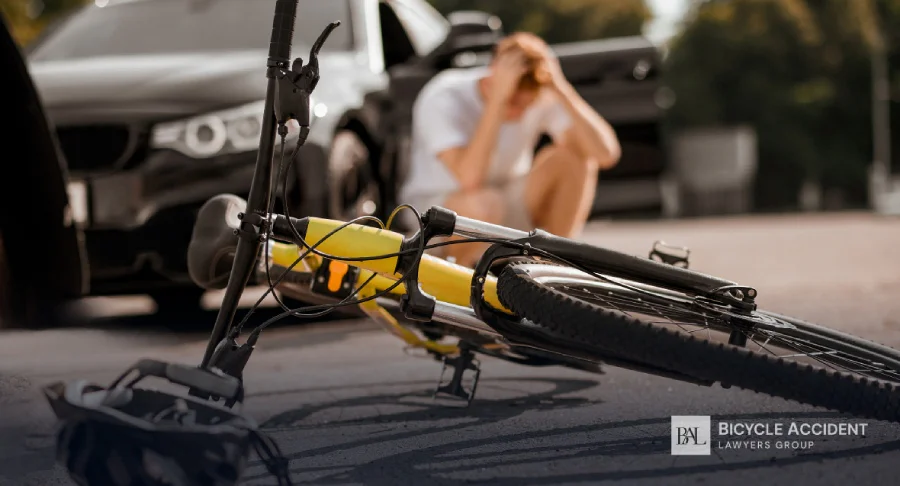
In most bicycle-vehicle incidents, the driver bears primary blame. Car vs bicycle accidents are among the most common cycling crashes across NYC. New York law holds motorists to a heightened duty of care to protect cyclists and pedestrians. However, the question of who is responsible is not always all-or-nothing. New York’s shared-blame system allows both parties to share a portion of blame. Even a cyclist who shares some blame can still recover money.
- Who Is Usually at Fault When a Car Hits a Bicycle in New York City?
- How New York’s Pure Comparative Negligence System Works
- What Evidence Proves the Driver Was Responsible?
- Legal Options for Injured Cyclists in NYC: No-Fault Insurance, Liability Claims, and Personal Injury Lawsuits
- Protect Your Legal Rights to Compensation
- Get a FREE case evaluation today
Who Is Usually at Fault When a Car Hits a Bicycle in New York City?
If you were struck by a vehicle while riding in New York City, you are likely not to blame. Under New York law, drivers are held to a heightened obligation toward cyclists and pedestrians. This legal standard plays a central role in determining fault and liability in bicycle accident claims in NYC.
When someone breaks a rule and that violation leads to a wreck, they are presumed negligent. Blame can be shared between both parties under New York’s shared-blame system. The rider’s role in the incident is weighed alongside the other party’s conduct to determine each party’s share. Who bears responsibility is assessed at multiple stages (police, coverage, trial), and each stage may reach a different conclusion.
When the Driver Is at Fault
A violation by the driver creates a presumption of negligence. This chain (violation leads to blame) is the foundation of every NYC bicycle accident case where the driver is responsible.
What Violations Establish Fault in Bicycle Crashes?
Three types of right-of-way violations and moving violations make up the majority of bicycle-related situations in NYC:
- Failure to yield the right of way is the leading cause of fatal and serious-injury bicycle crashes in New York City. VTL §1141–1143 governs right-of-way rules at intersections. Anyone who proceeds without yielding to a cyclist violates this statute.
- Distracted driving, especially texting while driving, violates VTL §1225-c. This statute prohibits using portable electronic devices behind the wheel. Cell phone records showing activity at the exact time of an incident prove the other party broke this rule. Witness statements from bystanders further strengthen your position.
- Unsafe turns and lane changes without checking for cyclists violate VTL §1160–1163. Drivers must signal and yield to cyclists in adjacent lanes, protected bike lanes, or marked bike lanes before turning. These violations often cause severe injuries and serious injuries in bicycle accidents, from fractures and broken bones to traumatic brain injuries.
NYC Crash Patterns: Dooring, Right-Hook Turns, and Intersection Collisions
Three common patterns show how blame is established through specific statute violations.
- Dooring happens when a person opens a car door into the path of a cyclist. VTL §1214 prohibits opening into oncoming traffic. The person who opened it is to blame.
- Right-hook turns happen when a motorist turns right across a bike lane, cutting off a rider traveling straight. The rider has the right of way. The person who fails to yield commits a right-of-way violation.
- Intersection collisions typically involve a left turn into an oncoming cyclist or running a red light. Under VTL §1141, a left-turning driver must yield to oncoming cyclists and pedestrians.
Identifying your car accident within one of these patterns strengthens your cycling injury situation.
When the Cyclist May Share Blame
Bicycles are vehicles, and cyclists must follow traffic laws just like other drivers on the road. A rider who breaks a rule may share blame in cycling accidents. However, the violation creates a presumption of negligence, not an automatic assignment of a specific share.
- Running a red light or stop signs typically results in a 25–40% blame share if the violation contributed to the wreck. The other party who also contributed still bears the remaining responsibility.
- Wrong-way riding can result in a 30–50% blame share because it creates an unexpected hazard.
- Adult sidewalk riding is also prohibited in New York City. A cyclist who enters the roadway from the sidewalk may share blame if the other party had no time to react.
Courts weigh both parties’ conduct when assigning blame. The heightened standard of care owed to cyclists and pedestrians frequently tips the balance, even when the rider also broke a rule.
When Is a Third Party Liable for a Bicycle Accident?
Blame is not always limited to motorists and cyclists. The City of New York is answerable when hazardous road conditions such as potholes, missing signage, or dangerous street design contribute to accidents. Car accidents involving cyclists are especially common, and pedestrians alike face these dangers on New York City streets. In wrongful death filings, a loved one may file on behalf of the deceased. Separate filings against the City require a notice within 90 days under General Municipal Code §50-e, far shorter than the 3-year personal injury statute of limitations. Missing this deadline permanently bars your right to file.
Employers may also be answerable when the responsible party was operating a commercial vehicle within the scope of employment. This provides an additional source of financial redress, which is especially critical in wrongful death cases where a loved one is seeking justice.
How New York’s Pure Comparative Negligence System Works
New York follows a proportional-blame rule under CPLR §1411. Your compensation is reduced by your share of blame, not eliminated. Partial blame does not bar recovery.
Here is how the math works on a $100,000 bicycle accident matter:
|
Your blame share |
Reduction |
You recover |
|
10% |
$10,000 |
$90,000 |
|
20% |
$20,000 |
$80,000 |
|
30% |
$30,000 |
$70,000 |
|
50% |
$50,000 |
$50,000 |
|
75% |
$75,000 |
$25,000 |
New York’s proportional system differs from the “modified” systems used in most other states. In those states, a cyclist who is 50% or 51% at fault loses their right to any compensation. In New York, even a cyclist found 99% at fault can technically recover 1% of their damages. New York protects your rights regardless of shared blame.
The blame share is determined by the jury at trial, not by the police officer who filed the official record and not by the insurer handling the matter. Under CPLR §1412, comparative negligence is an affirmative defense. This means the responsible party’s legal team must prove that you share blame. If they fail to raise this defense, you recover full damages.
What Evidence Proves the Driver Was Responsible?
The strongest evidence connects a specific violation to the car accident. Cell phone records prove distracted driving. Signal timing records from NYC DOT prove violations that lead to accidents. Surveillance footage from nearby businesses proves failure to yield. Witness statements and vehicle damage patterns (the angle and point of contact) establish how the wreck occurred.
The police report documents the officer’s observations, but it is not binding on the trial outcome. Keep in mind that the absence of a citation does not clear the other party of blame.
If the police report blames you for the bicycle accident, your fight is not over. You can challenge the record with contradicting witness statements, surveillance footage, and medical records showing the direction of impact. A bicycle accident attorney can subpoena records that you cannot obtain on your own. These records often change the outcome entirely.
Surveillance footage is typically overwritten within 48–72 hours. Delays weaken your position. Act fast to preserve key documentation.
Legal Options for Injured Cyclists in NYC: No-Fault Insurance, Liability Claims, and Personal Injury Lawsuits
New York’s “no-fault” insurance does not mean nobody is to blame for your NYC bicycle wreck. “No-fault” refers to the insurance payment system: benefits are paid regardless of blame. As an injured cyclist, you access no-fault Personal Injury Protection (PIP) through the responsible party’s auto policy. PIP coverage helps with immediate costs but does not address long-term economic damages like ongoing medical bills. PIP covers medical expenses and lost earnings up to $50,000. You must file within 30 days of the accident. Missing this deadline means losing these benefits.
A separate claim can be filed against the responsible driver’s insurance company to recover fully, including costs like medical bills and lost income: medical expenses beyond the PIP cap, lost wages, property damage, and hardship and distress. Insurance companies assign adjusters who evaluate the situation. Adjusters are known to minimize payouts by inflating the rider’s share of blame.
A legal action becomes necessary when your injuries meet New York’s “serious injury” threshold under §5102(d). This includes fractures and other serious injuries, significant disfigurement, permanent limitation of a body organ, or substantially full disability for 90 or more days. An injured cyclist pursuing a settlement can recover both economic damages and non-economic damages for pain and suffering. For a detailed breakdown, read our guide on bicycle accident settlement values.
The deadline is 3 years from the date of the accident under NY CPLR §214. The clock starts on the day of the incident.
Protect Your Legal Rights to Compensation
Understanding who is at fault is the foundation of your cycling claim. But protecting your right to file means acting within New York’s filing deadlines. Your blame percentage directly controls how much compensation you recover. And the proof that shows who is responsible fades quickly. A dedicated injury law firm with experienced NYC bicycle accident lawyers can make the difference in your outcome.
Attorneys at our law firm can evaluate the specific facts of your situation, preserve time-sensitive records, and fight for fair compensation. If you were hit while riding in NYC, learn what to do after an NYC bicycle accident and contact us for a free consultation. Call (888) 521-6377 today and protect your rights.

Since his academic days at the UC Berkeley School of Law, Robert Goldwater has remained a committed advocate for victims of other people’s negligence. His tort law background, together with his unquenchable thirst for justice, helped young Robert found a now-successful law firm – Bicycle Accident Lawyers Group, gathering same-minded and promising attorneys from all over the country.