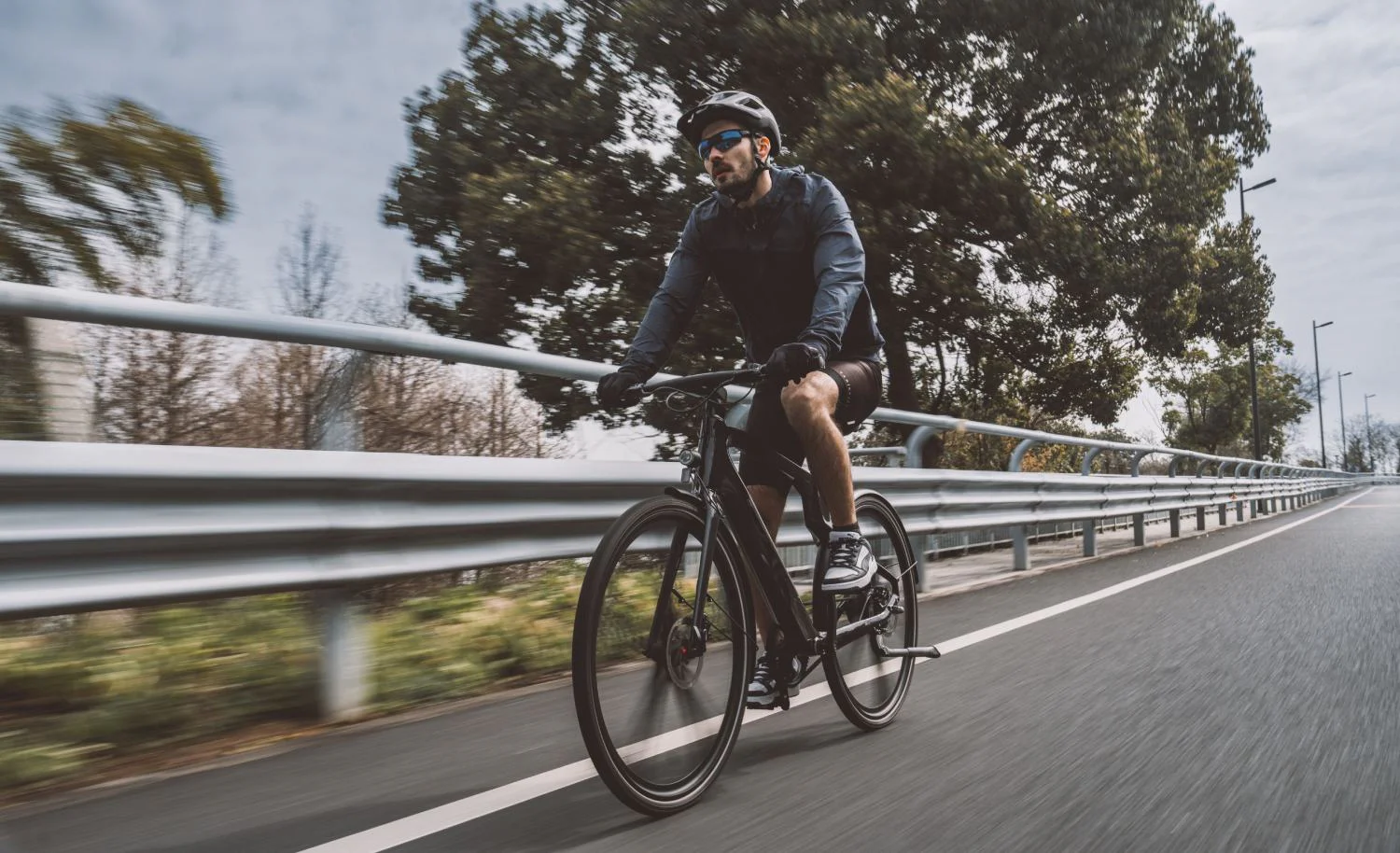


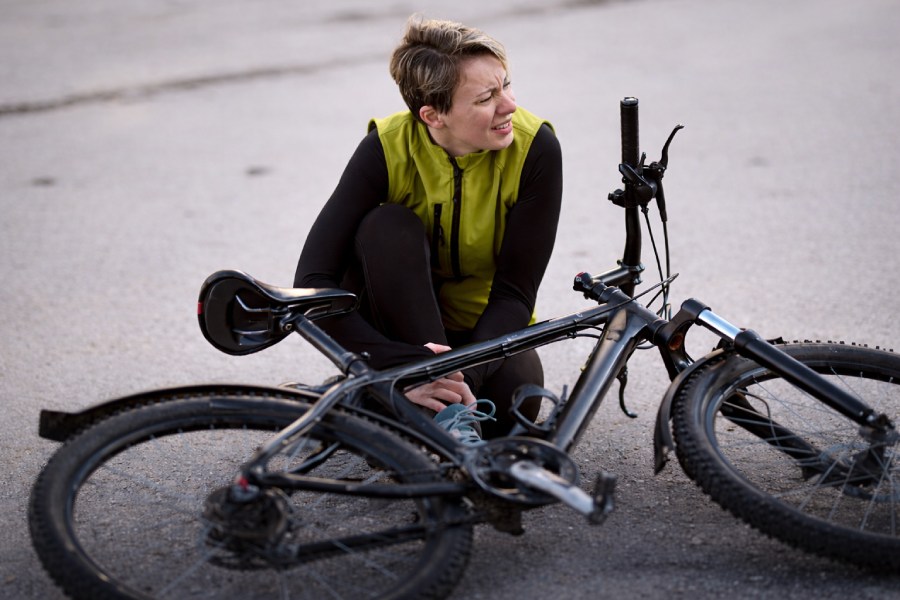
Bicycle helmets cut the odds of a fatal head injury by roughly two thirds and any brain injury by about half. Significant protection, not immunity. After a crash, a second number matters more. No state requires an adult cyclist to wear one, yet only a handful stop an insurer from using your bare head against you.
We ride, and we represent cyclists hit while riding. This article shows which statistic applies, where helmets stop working, and whether the missing-headgear argument is a defense or a bluff.
- Key Takeaways
- How Much Does a Helmet Change Your Odds of Dying?
- Why The Published Numbers Disagree With Each Other
- What Happens To Your Head In A Bicycle Crash Without A Helmet
- Where A Bicycle Helmet Stops Working
- Can An Insurer Use Your Missing Helmet Against You?
- Which States Bar Helmet Proof In A Civil Case
- Is It Illegal To Ride Without A Helmet?
- Does A Standard Helmet Protect An E-bike Rider?
- What To Do If You Hit Your Head In A Crash
- Get a FREE case evaluation today
Key Takeaways
- Helmet use among bicycle riders carried 65% lower odds of a fatal head injury and 69% lower odds of a serious one, pooled across 40 studies (Olivier et al bicycle helmet use study, 2017).
- The published figures disagree because each study counts a different outcome. The widely quoted 34% covers every killed or seriously injured cyclist, including chest and abdominal injuries helmets cannot reach.
- Of the 1,075 bicyclists killed in motor vehicle crashes in 2024, 68% wore no helmet and 13% did (IIHS).
- That share overstates the gap. Nobody counts unhelmeted cyclists who did not crash, and risk factors such as rider age, sobriety and road conditions shape the data.
- Certification testing drops a helmet onto a flat anvil at roughly 14 mph, so current standards say nothing about motor-vehicle speeds or rotational impact.
- No statute mandates bicycle helmets for adult cyclists, so riding without one is not a violation.
- Oregon, Florida and Pennsylvania bar a missing helmet from a civil case in language broad enough to cover any bicyclist, while California and Maryland have no such clause at all.
- Where the missing-helmet argument is allowed, it reaches the portion of your claim tied to the head, not your collarbone, your lost wages or your bicycle.
How Much Does a Helmet Change Your Odds of Dying?
Bicycle helmet use carries roughly two-thirds lower odds of a fatal cranial injury, though the benefit shrinks once you count injuries helmets cannot reach.
- 65% lower odds of a fatal head injury. Pooling 40 studies and over 64,000 cyclists with documented injuries, the study authors Olivier and Creighton found bicycle helmets linked to 51% lower odds of any head injury. The reduction was 69% for severe head injuries, 65% for fatal injuries and 33% for facial injury. Neck injuries showed no protective effect.
- 22% against 38% among subjects already in the trauma bay. A registry study of 1,256 hospitalized cyclists in Oslo found serious injury in 22% of helmeted cyclists and 38% of unhelmeted participants (Acta Neurochirurgica, 2024). In that cohort, cranial surgery followed in 6% of the helmeted group against 14% of the unhelmeted group.
Deaths are the outcome research pins down least reliably. In that cohort, 30-day mortality was 1.5% with a helmet and 2.9% without, a difference that did not reach statistical significance. Bicycle helmets reliably reduce the injuries that kill cyclists, but a single hospital study is too small to measure death rates on its own. Study findings from larger data sets confirm the benefit.
Helmets lower the injury severity the body absorbs at impact. Injury severity drives the risk of a brain injury, which kills a cyclist in a bicycle collision, explaining why helmets may offer narrower results than a slogan suggests, since protection only ever covers the head.
Why The Published Numbers Disagree With Each Other
A 34% and an 88% reduction can both be correct, because each figure counts a different outcome over a different population. A reader comparing them is comparing four different questions. Google’s AI Overview quotes 34%, 50 to 70% and 63 to 88% without reconciling them, so the confusion starts on page one.
- 34% measures all killed or seriously injured cyclists, not brain injuries alone. Hoye’s meta-analysis of 55 studies found head trauma reduced by half, serious injuries by 60%, and facial injuries by 23%. The 34% figure includes the chest, abdominal and spinal trauma no bicycle helmets reach.
- 63 to 88% is the oldest pooled estimate, not the strongest. That range comes from five case-control studies (1989 to 1996) pooled in the Cochrane review. A 2023 systematic review excluded it because four of the five were written by the review’s own authors, and the statistical method those authors used overstates the benefit when the outcome is common, as bicycle injuries among crashing cyclists are.
- The 68% fatality share provides no comparison at all. Helmet status was unknown for 19% of those 1,075 bicyclists, so the 68% covers only participants whose status was recorded, making the “over 80%” figure on other sites wrong. Helmet use tracks with rider age, sobriety and riding conditions. The controlled studies adjust for those factors while a raw percentage cannot.
For what helmets do for your head in a collision, the study data on injury points to about half. For the effect on the full national death toll, 34% is closer. Most of the toll involves damage below the neck.
What Happens To Your Head In A Bicycle Crash Without A Helmet
Without a helmet your skull absorbs the full impact a foam liner would crush, and the harm changes lives rather than weekends. In addition, bicycle related head injuries are a common cause of emergency department visits and hospital admissions for cyclists across every age group.
- Brain injuries get worse without head protection. Concussion, bruising, and bleeding inside the skull become more likely and more severe. Traumatic brain injury runs from disorientation to permanent memory loss, personality change or seizures. Unhelmeted cyclists in the Oslo registry study were more than twice as likely to need brain surgery.
- Facial injuries cluster in unhelmeted cyclists because the face is often the first point of contact. Skull fractures, jaw fractures, broken teeth and facial cuts show higher injury severity without a helmet. Helmets provide coverage reaching about 65% for the upper and middle face but nothing below the jaw (Cochrane review).
Helmet effectiveness is measurably larger in single-bicycle crashes than in collisions with motor vehicles, so a quiet bike path is not a reason to skip wearing helmets. Bicycle helmets protect best against the low-speed fall close to home, not the collision with a car.
Where A Bicycle Helmet Stops Working
A CPSC-certified bicycle helmet is tested at about 14 mph, well below collision speeds, and the certification measures only one type of force. Those facts separate honest safety from the claim that wearing a helmet makes a cyclist safe. Community programs and safety campaigns help clarify these limits, and ongoing evaluation of helmet effectiveness supports more informed choices across age groups.
- The tested speed is modest by road standards. Under Section 1203.17 of the federal standard issued through the American National Standards Institute (National Standards Institute ANSI framework), a helmet is dropped onto a flat anvil at about 14 mph and onto curved anvils at about 11 mph. Drivers turning across a bike lane at 30 mph create conditions no testing has covered. Liner materials affect performance at higher impacts.
- The tested force covers only linear deceleration. Helmets pass if peak acceleration stays under 300 g. The testing measures straight-line force, nothing else.
- Rotational force goes unmeasured. No national standards evaluate oblique impact, although rotational motion is involved in most real-world crashes and is what tears brain tissue rather than crushing bone (Scientific Reports, 2023). MIPS and WaveCel liners are designed to address that gap in helmet design, not for marketing.
- Nothing protects below the neck. Bicycle helmets do not reduce the total number of killed or seriously injured cyclists nearly as much as they reduce head injuries. Most of the damage happens to the torso, the pelvis and the spine, which no headgear covers.
Can An Insurer Use Your Missing Helmet Against You?
An adjuster will argue that your missing helmet makes the collision partly your fault. Where allowed, it reaches only the injury portion of your claim tied to the head, not the rest, so the first question is whether your state permits it, not whether it sounds reasonable.
Under comparative negligence, a fault share reduces your recovery by that percentage. A 20% share cuts only the portion tied to the head, not the collarbone, wages or the bicycle. Because no state requires adults to wear bicycle helmets, the argument is not that you broke legislation. It is a claim that a helmet would have prevented your specific injury, which requires evidence and proof.
In cases we see, helmet use is recorded on the crash report, and that entry is what the insurer builds its fault share on months later. Nobody revisits it unless you do. Proving a helmet would have prevented the specific injury requires a biomechanical expert, not an adjuster’s opinion, a cost that often discourages insurers from pressing the point.
A brain injury through a helmet does not mean it failed. The helmet lowered the odds, not removed them. An injury through that protection is information about how hard you were hit, not exaggeration.
Which States Bar Helmet Proof In A Civil Case
States fall into three tiers: an outright bar, a bar tied to a rule for minors, and no bar at all. The tier decides whether an insurer can raise the issue. Bicycle helmet laws and the effects of a bicycle helmet law vary by jurisdiction. Legislation reflects a community debate about balancing safety with cycling rates.
Bars that reach an adult rider
Oregon Section 814.489 makes proof of lack of protective headgear inadmissible and “ineffective to reduce the amount of damages or to constitute a defense” in any action brought by an injured bicyclist. Florida provides that “the failure of a person to wear a bicycle helmet” may not be considered negligence or contributory negligence, covering any cyclist. Pennsylvania bars the jury instruction as well.
Bars tied to children or a local ordinance
Delaware, Connecticut, Massachusetts and North Carolina protect against a missing-helmet argument, but each ties its bar to a minor or parental provision. These laws affect children of different age ranges. New York protects “any person” who fails to comply with its under-14 rule. Virginia attaches its bar to a local ordinance and forbids counsel from commenting. Community campaigns in several states promote bicycle helmet use among younger cyclists.
Where no admissibility clause exists
Arizona has no statewide helmet laws. California and Maryland have statutes with no admissibility provision. In all three, ordinary comparative-fault and mitigation legislation governs. Advocacy groups run community campaigns encouraging voluntary bicycle helmet use through public programs and activities. Community-based program evaluation and study after study confirm these programs serve as effective strategies for injury prevention without reducing the number of people riding bicycles.
State-by-State Comparison
|
State |
Primary Provision |
Bar |
|
Oregon |
ORS 814.489 |
Complete bar. Headgear inadmissible for any injured bicyclist |
|
Florida |
Section 316.2065(18) |
Complete bar. Failure to wear helmets cannot constitute negligence or comparative fault |
|
Pennsylvania |
75 Pa.C.S. Section 3510(c) |
Complete bar. Bars proof at trial and forbids the jury instruction |
|
New York |
VTL Section 1238(7) |
Limited bar. Under-14 noncompliance cannot show comparative fault |
|
Delaware |
21 Del. C. Section 4198K(e) |
Limited bar. Negligence bar for persons under 18 |
|
Connecticut |
Section 14-286d(b) |
Limited bar. Child-mandate failure inadmissible as negligence |
|
Massachusetts |
Chapter 85 Section 11B1/2 |
Limited bar. Cannot constitute contributory negligence |
|
North Carolina |
Section 20-171.9(c) |
Limited bar. Minor requirements inadmissible as civil proof |
|
Virginia |
Section 46.2-906.1 |
Local bar. Ordinance violations barred; counsel forbidden from commenting |
|
California, Maryland |
Veh. Code 21212, Transp. 21-1207.1 |
No bar. Statutes with no admissibility provision |
Check your own state’s source text. Two similar-looking states can treat an unhelmeted cyclist differently. Consult the applicable legislation and review recent findings from legal articles.
Is It Illegal To Ride Without A Helmet?
No federal legislation and no state law requires adults to wear bicycle helmets. Riding bare-headed is not a traffic violation, though a handful of local ordinances do require helmets for all riders.
State mandates apply only to children, usually under 16 or 18 depending on jurisdiction. Outside a local all-ages ordinance, an officer will not cite an adult for riding without helmets. The law in most states defines specific age thresholds, and enforcement data varies by community.
The debate is not about helmet effectiveness. Nearly everyone agrees helmets reduce risk, but whether legislation should require them, since mandatory laws have been linked to reduced cycling rates overall. Study after study has examined this, and findings across types of evaluation remain mixed. Community-level programs and safety campaigns offer alternative strategies, with several programs showing higher rates of voluntary bicycle helmet adoption. Research articles and program data suggest community campaigns combined with education activities and information prove effective without reducing cycling participation among any age group.
Your uncovered head can break no law and still become an argument in your injury claim, a gap that state helmet laws close in some states, not others.
Helmets are a sound decision, not a legal duty, and a cyclist who skipped one is not at fault for a driver who turned across their path.
Does A Standard Helmet Protect An E-bike Rider?
Helmets however face a mismatch against e-bike speeds: a bicycle helmet certified near 14 mph cannot match a class 3 e-bike built to reach 28 mph. Helmets still help, but they cannot prevent the types of injuries that occur at speeds no test covers. The study of how helmets perform and which construction characteristics matter continues to evolve.
- E-bike subjects suffer worse injuries in comparable crashes. Among 1,878 bicyclists admitted after bicycle related incidents, e-bike subjects were 1.6 times as likely to suffer severe traumatic brain injury. They were 1.5 times as likely to fracture a skull bone (Injury, 2025). These study results confirm risk increases with speed, and that preventing head injuries matters for this growing group of cyclists.
- The exposure involves more cyclists every year. At one London hospital, e-bikes grew from 3.8% to 16.0% of cycling emergency visits in three years, with 81% of e-bike riders arriving without helmets (2026 cohort study). The data confirms a need for community outreach to younger groups who ride bicycles.
- NTA-8776 is the certification that covers the speed. This Dutch standard tests harder impacts and covers more of the skull, including temples and back. Bicycle helmet use among these cyclists is linked to higher Glasgow Coma Scale scores and fewer ventilator days. Study of different types of helmet materials and protection characteristics shows construction affects injury severity at speed. Community program efforts distribute helmets rated to this certification, and program data show lower rates of severe injury among subjects who received them.
Match your helmet to the speed you ride, not the category on the frame.
What To Do If You Hit Your Head In A Crash
- Get a medical record on the day of the incident. Concussions and brain bleeds can surface hours later, and a same-day record ties the injury to the event.
- Keep the helmet, damaged or not. A liner can compress with no visible mark on the shell. Even an intact helmet is unsafe to reuse and valuable proof of the impact your skull did not absorb.
- Do not give a recorded statement to the other driver’s insurer. Adjusters use them to pin down fault, and one comment about not wearing a helmet can give them the argument your state’s law may have blocked.
- Photograph the scene and collect the driver’s information. Vehicle, road position, lane markings and insurance card matter more while fresh.
- Check the filing deadline early. An ordinary claim runs on the statute of limitations, but a claim against a city or county can require notice within months.
If a driver caused your collision, you do not have to argue alone. We handle bicycle injury cases on contingency: you pay nothing unless we recover.

Robert Goldwater is a cyclist representing cyclists. He has practiced personal injury and wrongful death law for more than 20 years, graduating with Honors from Arizona State University Law School, and has helped recover over $1 billion for clients, including injured cyclists.