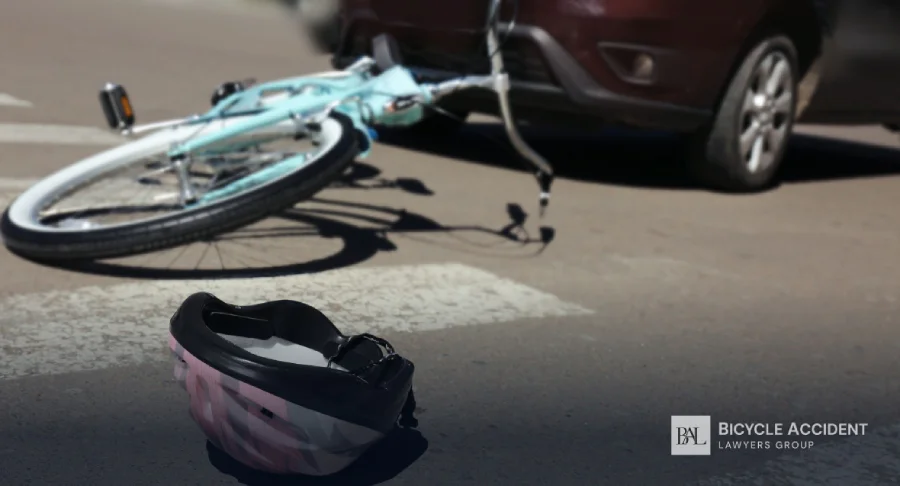



If a car hit you on your bike, get checked by a doctor today even if you feel fine, collect the driver’s contact information, insurance policy details, and plate number, and then avoid discussing fault or your injuries with their insurance company.
The driver’s liability insurer usually pays for your injuries in the end, but your own health and auto insurance often pay first. The steps below explain what to do right away, how liability and negligence laws work, and when lawyers are worth involving.
What to Do If You’re Hit by a Car While Riding a Bike
The first step is to protect your body, then call 911 and collect the driver’s details and the evidence before anyone leaves the scene.
- Stay still if your head, neck, or back hurts. Wait for paramedics, since moving can worsen a spinal injury. Move only to clear a live traffic lane, then wait at the side of the road.
- Call 911 and ask for police and an ambulance. Ask the responding officer to document witness information, photographs, measurements, and other objective details from the scene
- Get the driver’s insurance details and license plate. Write down their name, phone number, driver’s license, insurer, and policy details, then photograph the license plate. A motorist who promises to “just pay for it” is not the one who decides, because their insurer controls the payout.
- Take photographs of the scene and find witnesses. Shoot one video sweep first, then stills of your bicycle, the car, the road, traffic signals, skid marks, and any visible cuts or bruises, and get witness names and phone numbers. Note nearby dashcams, video doorbells, and security cameras, because that footage is often erased within days.
- Don’t speculate about fault to the driver or police. Stick to what you directly observed and avoid guessing about speed, distance, or who was responsible. An insurer may later point to statements such as “I’m sorry” or “I didn’t see the car” when disputing liability
- Preserve your damaged bicycle, helmet, and gear. Don’t repair, clean, or discard anything until you have photographed it. A cracked helmet is your best evidence of the force of impact.
Deciding the incident was minor and skipping these steps carries its bill. The driver’s insurer can send you a demand letter for damage to their car months later, once witnesses have scattered and video has been overwritten.
Why You Need a Doctor After a Bicycle Crash
You need a doctor the same day as the bicycle crash, at an emergency room or urgent care, even if you feel fine and rode home. Adrenaline hides pain, so many people don’t notice they are hurt right after the impact, and a concussion, internal bleeding, and soft tissue damage can take hours or days to produce symptoms.
The visit is also the step that creates the first medical records tying your injuries to the accident. Wait two weeks and the insurer will argue that other issues caused them. Mention all of your symptoms, keep every appointment, follow your doctor’s advice, and don’t tell anyone you’re “fine” in a text, a phone call, or online. Say instead that you don’t know yet and are waiting to be examined.
We see those two words quoted back months later in the insurer’s arithmetic on blame, and riders who skipped the exam reach us with a treatment gap that the insurer prices against your recovery. Tell the registration desk the injury came from a motor vehicle collision and give them the driver’s policy details, because that routes the bill to the right payer instead of to you. A pain journal and dated photos of bruises as they heal show how the incident affects your daily life.
Who Is at Fault If a Car Hits a Bicycle?
A driver may be at fault for a bicycle crash if they violated a traffic law or failed to exercise reasonable care. A cyclist may also share responsibility depending on the circumstances. Determining liability starts with the traffic laws where the accident occurred. In most states, the law treats bicycles as vehicles, giving cyclists the same rights and duties as motorists, and an officer’s report or ticket is evidence of fault, not a finding of fact.
Many state laws also require drivers to give a bicyclist at least three feet of space when passing, and a violation of that passing law can serve as evidence of negligence. A door works the same way. California forbids any person, passengers included, from opening a car door into moving traffic unless it is reasonably safe to do so (Cal. Veh. Code 22517), and most states have their own version, so check yours.
Common Driver Actions That Can Lead to Bicycle Crashes
Common driver actions involved in bicycle crashes include:
- Turning right across a cyclist’s path (“right hook”) or left across their path (“left cross”)
- Opening a vehicle door into a cyclist’s path (“dooring”)
- Passing a cyclist too closely
- Failing to yield the right of way
- Running a red light or stop sign
- Speeding or driving while distracted
- Rear-ending a cyclist
- Driving or stopping in a marked bicycle lane where prohibited
Can You Sue If You Get Hit by a Car on a Bike?
You can sue the driver who hit you if their negligence caused the collision, and the claim is usually paid by their auto liability insurance. Most personal injury claims settle between the parties out of court, and a lawsuit becomes necessary only when liability issues stay unresolved or the insurer refuses to pay fairly.
To establish negligence, you generally must show that the driver owed you a duty of care, breached that duty, caused your injuries, and that you suffered damages. Depending on the circumstances, other parties may also bear some responsibility for the crash, including:
- The driver’s employer, if the driver was acting within the scope of their employment.
- A rideshare company or its insurer, if applicable coverage was in effect at the time of the crash.
- A city, state, or other public agency, if a dangerous road condition contributed and state law allows a claim.
- A bicycle, vehicle, or component manufacturer, if a defective product contributed to the crash or injury.
When more than one party contributed to the crash, responsibility and available compensation may depend on how liability is allocated under the law of the state where the accident occurred.
How Partial Fault and Comparative Negligence Affect What You Recover
Comparative negligence rules usually reduce your claim by your share of responsibility, but in a few states any share at all bars recovery. Which of these three rules your state follows matters more than what the officer wrote in the report.
| State rule | What it means for you |
| Pure comparative negligence | You can recover even if you were mostly at fault, minus your share of the blame.blame |
| Modified comparative negligence | Damages are reduced by your percentage of fault, but recovery is barred if your fault reaches the state’s cutoff, typically 50% or 51%. |
| Contributory negligence | Any share of responsibility on your part can bar you from recovering anything. |
A few states use hybrid or other variations that do not fit neatly into these three categories. Our guide to fault in a car and bicycle collision explains how shared-fault rules can affect liability negotiations and personal injury claims
How Riding without a Helmet Affects Your Compensation
Riding without a helmet does not automatically prevent you from making a claim. While no state requires all adult cyclists to wear a helmet statewide, some cities and local jurisdictions have their own rules.
If you suffered a head injury, the insurer may argue that a helmet could have made the injury less severe. How much this issue matters to your claim depends on state law and the circumstances of the crash.
Should You Talk to the Driver’s Insurance Company?
You should not give the driver’s insurance company a recorded statement, sign a broad medical release, or accept a quick offer before you know the full extent of your injuries. The adjuster works for the other side, and the job is to keep your claim cheap.
Attorneys at Bicycle Accident Lawyers Group watch the driver’s insurer work the same first 72 hours in car-versus-bicycle files, and all three requests arrive inside it, the first call landing before riders have a prognosis.
- Recorded statement. You generally don’t have to give one, the standard advice from lawyers is to decline, and what you say while sore or undiagnosed can be used to downplay your injuries.
- Medical authorization. The form we see handed to riders is open-ended, with no date range and no condition named, which lets the insurer search a whole medical history for an old condition to blame. Limit any release to records from this accident, and get advice before you sign anything broader.
- Early settlement offer. Once you sign the release and cash the check, your claim is closed for good, even if you need surgery later. Keep future medical treatment in mind. In the cases we have handled, these offers cluster in the first two weeks, while the medical picture is still open.
Your insurer is different, because your policy usually requires you to report the incident and cooperate, often within strict deadlines.
After a collision with a car, your own health insurance, PIP, or MedPay pays your medical bills first, and the driver’s insurer reimburses you later as part of the final payout. A bodily injury claim does not pay bills as they come in. It pays once, when your treatment is far enough along to show the full cost.
If your plan pays, it may ask to be reimbursed from your recovery through a lien, so ask your plan those questions early. Our guide to bicycle accident insurance coverage explains each payer in detail.
Does Your Car Insurance Cover Bicycle Accidents?
The thing people most often get wrong when they call us is assuming their car insurance policy is irrelevant because they were on a bicycle. Several of these coverages apply to you personally, rather than just to. What applies to your situation varies by state and policy, so check your declarations page.
Uninsured and underinsured motorist coverage pays when the responsible party has no policy, too little, or can’t be found, and in most states it protects you while cycling.
Personal injury protection is required in about a dozen no-fault states and pays medical bills and some lost wages regardless of fault.
MedPay is optional and covers medical bills only, but it pays quickly and often reaches you on a bicycle.
What Damages Can You Recover After a Bike Crash?
You can recover compensation for your medical bills, lost income, pain and suffering, and property damage from a negligent driver. Your receipts will show your economic losses, and the rest will depend on the specific details of your case.
Medical bills, including future care
- Medical bills, including future care
- Lost wages and reduced earning capacity
- Pain, suffering, and emotional distress
- Loss of enjoyment of life
- Repair or replacement of your bicycle, clothing, and gear
How Much Is a Bicycle Accident Settlement Worth?
A bicycle accident settlement has no standard amount, because its value turns on your injuries, your recovery time, your share of the blame, and the driver’s policy limits. See our guide to average bicycle accident settlements or try our settlement calculator.
Who Pays to Repair or Replace Your Bicycle?
The at-fault driver’s insurer pays to repair or replace your bicycle, and you should ask for full replacement if the frame took a hit. Frames crack in ways you can’t see, so ask that insurer to pay for an ultrasound or carbon-specialist inspection when it values the bicycle. The property damage claim often settles sooner than the injury claim.
The first bicycle offer we see from insurance companies is the used resale value pulled from a pricing database, not the cost of the bicycle you were riding. Back a full request with photos taken before any repair, a shop repair estimate, and receipts. Your bike shop will build the itemized list for you, and it should carry your damaged gear and torn clothing even where they look undamaged. Or ask the insurer to source the replacement itself rather than argue its resale figure.
What to Do After a Hit-and-Run Bike Crash
After a hit-and-run, the same steps apply: call 911 right away, don’t chase the car, and write down all the information you remember. Many uninsured motorist policies require a prompt police report, sometimes within 24 hours, before they pay.
Note any part of the plate, the car’s color, make, and damage, its direction, and the time. Photograph any debris with your phone and look for nearby cameras, since a partial plate plus doorbell or business footage often identifies who was behind the wheel. If the driver is never found, your own uninsured motorist policy usually pays.
Statute of Limitations for Bicycle Accident Claims
The statute of limitations for these claims is usually two or three years from the crash date, but some states allow you only one. Tennessee law is the strictest, at one year, though Tenn. Code Ann. 28-3-104 stretches that to two, where the driver is criminally charged within the first year and you sue that same motorist. Miss the deadline and you lose your right to file a lawsuit.
Claims involving a government agency may be subject to much shorter notice deadlines, sometimes measured in months rather than years. These deadlines do not pause while you are still being treated.
When Do You Need a Bicycle Accident Lawyer?
You need a bicycle accident attorney when your case turns on disputed injuries, liability, or policy limits, and you can usually skip legal advice if you weren’t hurt and the driver’s insurer makes a fair offer for your bicycle. Talk to an biycile accident attorney if your situation matches any of these circumstances:
- You were seriously hurt or are still in treatment
- Anyone says you were partly at fault
- The driver fled, is uninsured, or carries low policy limits
- The insurer wants a recorded statement or your signature
- A government vehicle or public road was involved
- You received a ticket after the crash
BALG handle on a contingency fee basis, so you pay nothing up front and the first consultation is free.