
As of 2026, New York City permits electric bikes in three categories on city highways, bike lanes, and bridges. All e-bikes operating in NYC are subject to a 15 mph limit effective October 24, 2025, and must also be UL-certified for fire safety. Users must be at least 16 years old, and a helmet is mandatory for those aged 16 to 17 and all operators in the fastest category.
E-bikes are not classified as motor vehicles in New York and do not require a license, plates, or insurance. However, recent New York bicycle accident statistics show that 22 people were fatally injured in crashes over three years, from 2020 to 2023. That is why understanding and complying with NYC e-bike laws is essential for your safety and your legal rights.
- Key Takeaways
- Key E-Bike Rules in New York
- Definition of an Electric Bike in New York
- E-Bike Classes and How They Compare to Mopeds
- NYC 15 MPH Speed Limit for E-Bikes
- UL Certification Requirements
- Helmet Laws for E-Bike Riders
- Other Operating Guidance
- What Happens If You Violate E-Bike Laws
- Contact Our NYC E-Bike Accident Lawyers
- Get answers to commonly asked questions about our legal services and learn how we may assist you with your case.
- Get a FREE case evaluation today
Key Takeaways
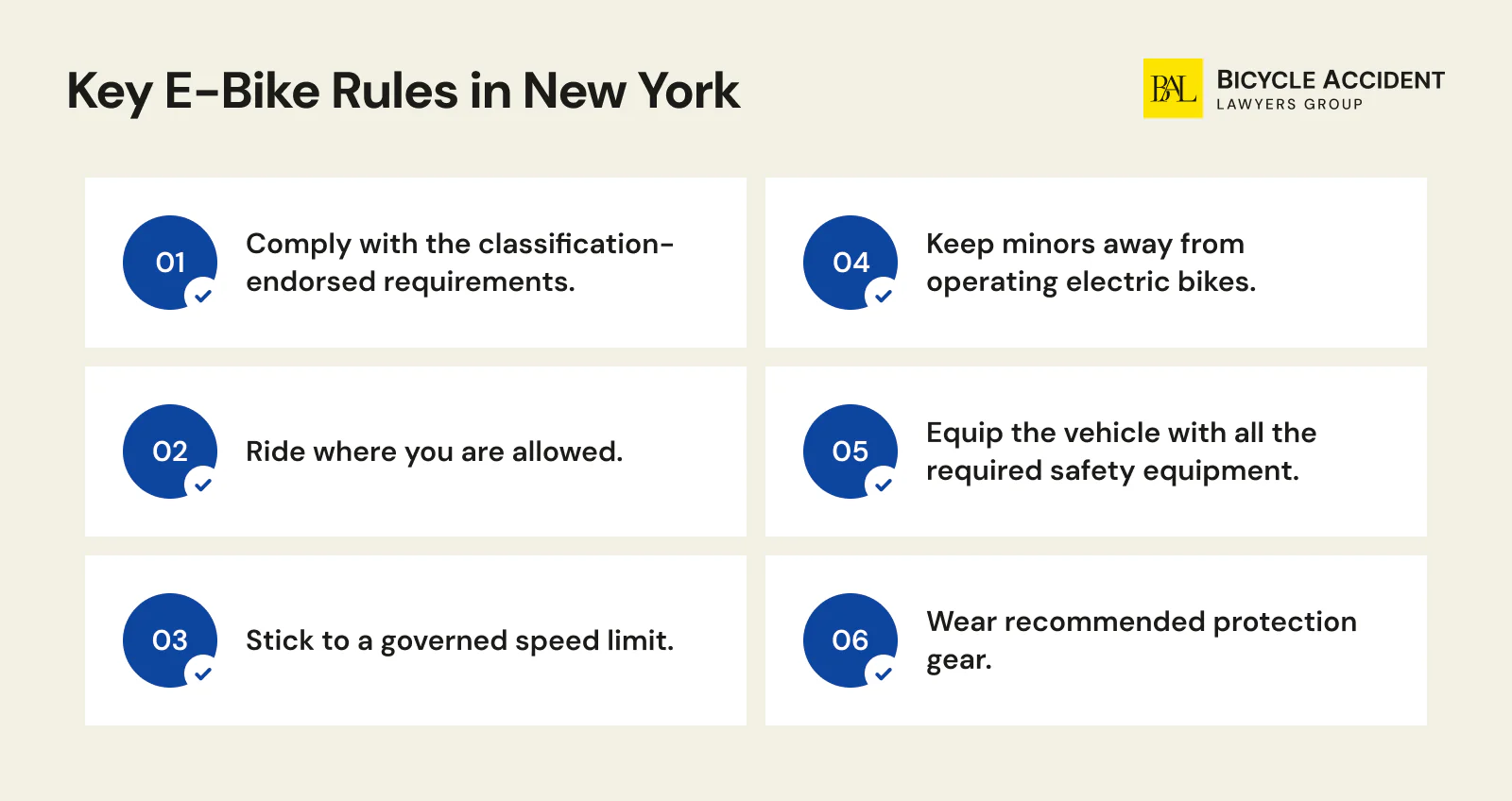
- NYC enforces a 15 mph posted speed limit for all e-bike units as of October 24, 2025.
- All micromobility devices and ion batteries sold, leased, or distributed in NYC must be UL-certified for fire safety and vehicle safety under Local Law 39 of 2023.
- Three categories of electric bikes (pedal-assist (20 mph), throttle (20 mph), and high-speed pedal-assist (25 mph)) are permitted on streets and greenways.
- A helmet is mandatory for those aged 16 to 17 on any e-bike and for all high-speed e-scooter and e-bike operators regardless of age. Certified headgear is strongly recommended for all other users.
- These devices must use designated bike lanes when available and are permitted only on ways with speed limits of 30 mph or less. Riding on sidewalks is prohibited. The same applies to e-scooters.
- A white headlight and red rear light are required equipment when riding after sunset.
- No driver’s license, registration, or license plate is required for any electric bike. Riders must be at most one person per device.
- Law enforcement may confiscate devices that are not UL-certified, appear modified to exceed their limits, or violate traffic laws.
Key E-Bike Rules in New York
Definition of an Electric Bike in New York
New York State defines electric bicycles under Vehicle and Traffic Law §102-c, enacted in 2020. An e-bike is a two-wheeled bicycle equipped with an electric motor and operable pedals meeting the manufacturing requirements. There are multiple classes of these models based on whether they use a throttle, electric assist via an electric motor, or both.
The state requires that the electric motor power does not exceed 750 watts, aligning with the federal Consumer Product Safety Commission standard. VTL §125 explicitly exempts these units from the statutory definition, which is why operators need no driver’s license, DMV registration, or auto insurance. Electric scooter devices and electric scooters were among the first bicycles adopted into New York State transportation law as part of the 2020 legislation.
Beyond the current categories, pending New York State legislation (Assembly Bill A271) would create a new category for cargo bicycles with electric assist, for larger bicycles capped at 12 mph and up to 48 inches wide. The bill has been introduced but has not been enacted as of 2026.
E-Bike Classes and How They Compare to Mopeds
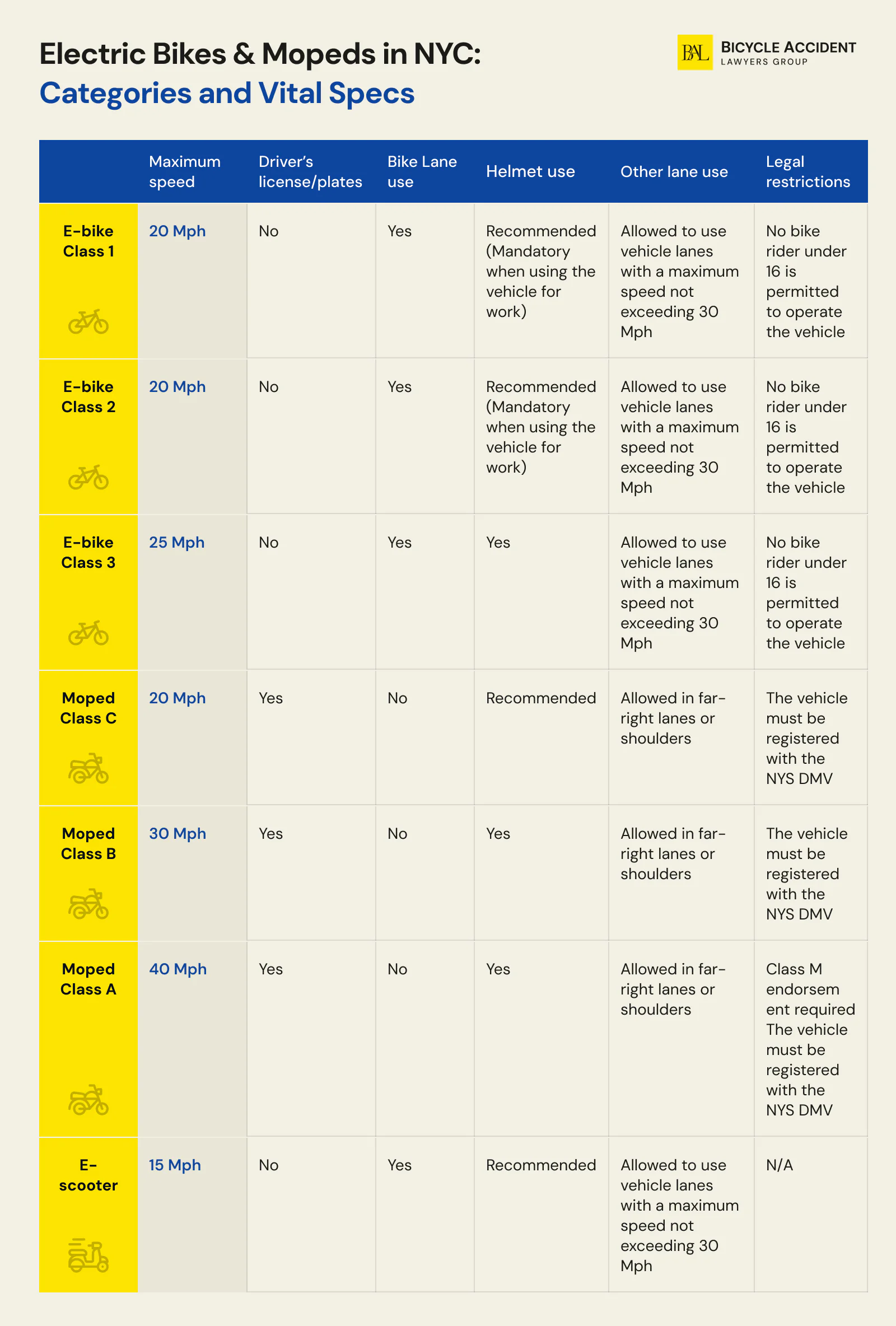
For many cyclists, all such models may seem the same. However, there are distinct categories, and different NYC cycling standards apply to each one. Beyond e-bikes, there are also electric scooters, mopeds, and limited use motorcycle models with their own rules.
Each type and category has specific standards for maximum speed, headgear usage, licensing, and where you can ride on a street, trail, or highway. Our experts have compiled the existing electric bike laws into a single table so that you can spot the difference without effort and remain aware of your rights when operating an electric-powered vehicle on the streets of New York City. The table below outlines the key differences:
| Criteria | E-bike Class 1 | E-bike Class 2 | E-bike Class 3 | Moped Class C | Moped Class B | Moped Class A | E-scooter |
| Classification speed | 20 mph | 20 mph | 25 mph | 20 mph | 30 mph | 40 mph | 15 mph |
| NYC operating limit | 15 mph | 15 mph | 15 mph | 20 mph | 30 mph | 40 mph | 15 mph |
| Driver’s license/plates | No | No | No | Yes | Yes | Yes | No |
| Bike lane use | Yes | Yes | Yes | No | No | No | Yes |
| Helmet | Req. ages 16-17 | Req. ages 16-17 | Required all | Recommended | Yes | Yes | Recommended |
| Road use | Roads with 30 mph limit or less | Roads with 30 mph limit or less | Roads with 30 mph limit or less | Far-right vehicle lanes or shoulders | Far-right vehicle lanes or shoulders | Far-right vehicle lanes or shoulders | Roads with 30 mph limit or less |
| Age requirement | 16+ | 16+ | 16+ | License req. | License req. | Class M req. | 16+ |
| UL certification (NYC) | Required | Required | Required | N/A | N/A | N/A | Required |
E-Bike Category 1
This is also known as class one. An electric bike in this category is similar to a traditional bicycle. You have to pedal to keep moving, but the electric motor provides assistance to your effort. The electric motor stops providing assistance when the bicycle reaches 20 mph. The motor cuts out as the bicycle reaches this threshold. In NYC, cyclists must observe the 15 mph operating limit.
E-Bike Category 2
Also known as class two, unlike the first category, an electric bike in the second category can move without pedaling through a throttle mechanism. It cuts off at 20 mph. The same NYC 15 mph operating limit applies to this similarly sized device.
E-Bike Category 3
Also known as class three, this is the fastest category, designed to operate in both pedaling and motor-driven modes. The electric assist mechanism keeps providing assistance up to 25 mph, while the throttle cuts off at 20 mph. In NYC, all operators are still subject to the 15 mph limit. All cyclists on these e-bikes must wear a helmet regardless of age due to the higher label rating. These electric assist units are used exclusively in cities with a population above one million — that is, areas with a population of one million or more, and this designation is used exclusively for NYC in New York State.
NYC 15 MPH Speed Limit for E-Bikes
As of October 24, 2025, NYC enforces a 15 mph limit for all e-bikes, e-scooters, and electric scooter models operating within the five boroughs. This ordinance applies to all categories, regardless of their label rating.
It is important to understand the distinction between the label rating and the operating limit:
- The label rating is the rate at which the electric motor is designed to provide assistance. The first and second categories are rated at 20 mph, and the third at 25 mph. These label designations determine which New York State rules and the relevant rules apply to your unit.
- The NYC operating limit is the legal maximum you can ride within New York City: 15 mph for all e-bikes. Exceeding this limit can result in fines and potential confiscation.
E-bikes are permitted only on highways with speed limits of 30 mph or less. Riding on a sidewalk is prohibited, and pedestrians always have the right of way. When a designated bike lane is available on your route, you must use bike lanes.
Keep in mind that an electric scooter, e-scooter, or unit that has been modified to exceed its label rating is illegal to operate on the streets. Failing to comply with these local rules may impact your chances of receiving a fair bicycle accident settlement in NYC if an incident occurs.
The 15 mph limit is currently a DOT regulation, not a City Council statute. In April 2026, the Council introduced Intro 1312-2025 to codify this into NYC Administrative Code, which would give it stronger legal standing.
UL Certification Requirements
Local Law 39 of 2023 requires that all e-bikes and batteries sold, leased, or distributed in NYC be certified to UL certification standards. The specific certifications are UL 2849 for e-bike models, UL 2272 for each e-scooter, and UL 2271 for batteries. This certification confirms that the unit and its lithium-ion cell meet fire safety standards.
The regulation was passed after a series of deadly lithium-ion battery fires across the city. In 2023, the FDNY responded to 268 lithium-ion battery fires that caused 18 fatalities and 150 injuries. In the first year after the statute took effect, fire deaths dropped 79%, from 14 to 3 in comparable nine-month periods. The city issued press releases and guidance highlighting the safe use of lithium-ion batteries and charging equipment.
What this means for cyclists:
- Purchasing. Only buy units with a UL certification label on it. Uncertified units cannot legally be sold in NYC.
- Charging. Use only the charger provided by the manufacturer. Third-party or mismatched chargers increase fire risk. Never charge near a seat sat upon by the operator, floorboard, or handlebars area.
- Confiscation risk. Law enforcement may red tag and confiscate units that are not UL-certified, appear modified beyond their rating, or are involved in traffic violations. Unregistered vehicles and limited use models such as modified scooters or a use motorcycle moped hybrid may also be seized.
- Enforcement. Since the regulation took effect, NYC has conducted more than 650 inspections and issued more than 275 violations to retailers selling uncertified equipment. Information about enforcement actions and compliance information is available on the NYC government site.
If you own an e-bike that was purchased before this statute took effect, check with the manufacturer to confirm whether your model meets the standard. For more information, reach out to them directly or visit their site for product details and website accessibility.
Helmet Laws for E-Bike Riders
Any experienced New York bicycle accident attorney would tell you that e-bikes are not all about convenience. You must ensure proper protection when riding, and certified headgear can make the difference between a minor injury and a life-altering one. This guidance applies to every person who rides on city streets, bike lanes, trails, greenways, bridges, highways, and park drives.
NYC e-bike headgear rules by group:
- Fastest-category operators. Must wear headgear at all times, regardless of age. This is the only adult mandate for cyclists in New York State.
- Riders aged 16 to 17. Must wear helmets on any e-bike.
- Commercial cyclists. Delivery operators and couriers must wear headgear provided by their employers during work hours. Their duties include safe operation at all times.
- Adult cyclists (18+) on other e-bikes. Head protection is strongly recommended but not legally required.
Other Operating Guidance
Local e-bike laws in New York State do not require a license or plates for any e-bike. However, the rider must comply with the following:
- Minimum age. An individual must be at least 16 to operate any electric assist bicycle on a street, road, or highway. Highway regulations and highways enforcement follow New York State standards. This rule also applies to ATV trails and park drives managed by park authorities.
- Operable pedals. All e-bikes must have working gear. The rider must be able to pedal it like a regular bicycle powered by human power. Without functional gear, it may be classified as a motorcycle or limited-use vehicle, requiring a license and plates.
- Lights and reflectors. A white front light and red rear light are required when riding after sunset. Reflectors must be visible from the front, rear, and sides of the bicycle.
- Sidewalk prohibition. E-bikes, e-scooters, and similar scooters are not permitted on sidewalks in New York City. Violations can result in fines starting at $100.
What Happens If You Violate E-Bike Laws
As of March 27, 2026, minor motor vehicle traffic offenses by cyclists and e-scooter operators are handled through civil summons rather than criminal court appearances. This means violations like running a red light or riding without illumination result in a civil ticket similar to a parking violation.
However, serious violations such as reckless riding, cycling under the influence, or fleeing the scene of an accident may still result in criminal charges. Authorities also have the authority to confiscate e-bikes that are not UL-certified, appear modified beyond their rating, or are operated in violation of traffic laws. ATV and motorcycle limited operation as well as unlicensed ATV usage on city streets is also subject to confiscation.
Cycling tickets do not add points to your driver’s license and generally do not carry the mandatory surcharges that apply to standard traffic violations. However, unpaid fines can lead to additional penalties and may be referenced in future legal proceedings.
To make sure you handle everything correctly after an incident, it is important to know what to do after a bicycle accident in New York to protect your interests and strengthen your potential claim. For additional information and services related to your bike needs after an accident, contact us for assistance.
Contact Our NYC E-Bike Accident Lawyers
An e-bike is a practical and eco-friendly way to get around New York City. However, the convenience comes with legal responsibilities. If you ride in NYC, you must comply with UL certification rules, headgear mandates, and traffic regulations.
If you’ve been involved in an accident, please contact our team for a free consultation. Our experienced New York bicycle accident lawyers will evaluate your claim and advise you on how to protect your case and recover fair compensation. We offer support and services to cyclists across all five boroughs. Visit our site for more information on this page about your legal options, or browse our comments, reviews, and community comments from past clients.
If you’re a cyclist who has been in an accident, call today for a free initial consult about your legal claim. We’re here to help with your legal questions. Contact our law firm for coast-to-coast bike accident and personal injury representation.

Get answers to commonly asked questions about our legal services and learn how we may assist you with your case.
What Is the Max Speed an Electric Bike Can Go?
The maximum speed of an electric bike is predefined by its class. Classes 1 and 2 can’t go over 20 mph, while Class 3 bikes can develop riding speeds up to 25 miles per hour. Exceeding either speed limit can lead to various implications in the form of physical injuries, financial strain, and legal problems.
Are E-Bikes Legal in New York?
There are three legal types of electric bicycles in New York: Class 1, Class 2, and Class 3. Each class should feature necessary equipment, including but not limited to operable pedals, state-approved electric motors, lights, and reflectors.
What to Do If I Get Injured in an E-Bike Accident in New York?
The most important things to do if you get in a biking accident would be to prioritize your safety and legal rights. That is why you should always notify law enforcement about the incident, get yourself checked by a trained medic, and contact a personal injury lawyer for immediate consultation.

Since his academic days at the UC Berkeley School of Law, Robert Goldwater has remained a committed advocate for victims of other people’s negligence. His tort law background, together with his unquenchable thirst for justice, helped young Robert found a now-successful law firm – Bicycle Accident Lawyers Group, gathering same-minded and promising attorneys from all over the country.