
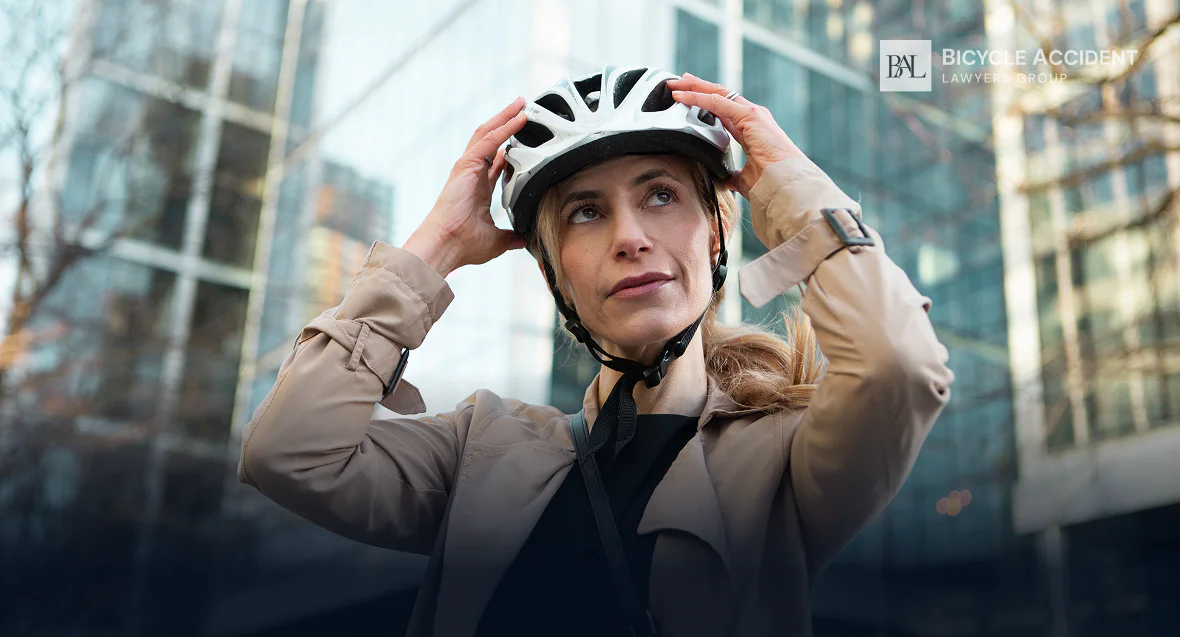
In New York City NY certified headgear is legally required for minors under 14 years old, commercial cyclists, and all who ride Class 3 e-bikes. Adults on standard bikes are not required to wear approved bicycle helmets by state or city law, though headgear is strongly recommended by the NYC Department of Transportation for all bicyclists.
As of 2026, bicycle safety statistics show that over 5,000 bicyclists were seriously injured on city streets in 2024, many involving motor vehicle collisions and car accidents. Almost 54% of bicyclists killed in crashes were not wearing protective headgear. According to the New York State Department of Health, a properly fitted helmet reduces the risk of head injuries by 85% and traumatic brain injuries by 88%. Head injuries from cycling accidents remain among the leading causes of serious harm. Not wearing one can also affect the outcome of your personal injury claim after a crash.
- Key Takeaways
- NYC Helmet Requirements: Who Needs to Wear One
- Helmet Standards and Legal Definition
- Citi Bike, Free Helmets, and NYC Safety Resources
- Bike Accidents and Helmet Use: New York Statistics
- What Should You Do If You Get Injured in a Bike Accident Without a Helmet?
- Can You Still Recover Compensation If You Were Not Wearing a Helmet?
- Contact Our Experienced NYC Bike Accident Attorney for Free Today!
- Get answers to commonly asked questions about our legal services and learn how we may assist you with your case.
- Get a FREE case evaluation today
Key Takeaways
- Minors under 14 must wear a certified helmet when riding a bike, scooter, skateboard, or as a passenger. Those under 1 are prohibited from being carried on a bike.
- Commercial cyclists (delivery workers, couriers) are required to wear certified headgear provided by their employers. Employers face $100 to $250 in fines for failing to provide headgear that meets safety standards.
- All who ride Class 3 e-bikes (pedal-assist up to 25 mph maximum speed) are required to have headgear. E-bike cyclists under 18 need a helmet on any class of e-bike.
- Adults 14 and older are not legally required to have headgear on standard bicycles in New York.
- Parents or guardians face a $50 fine if a minor under 14 rides without headgear, though the court will waive the fine if one is purchased before the court date. Headgear must meet CPSC, ANSI, or Snell safety standards.
- Citi Bike adults are not required to have headgear, though free bike helmets are available through NYC 311.
- VTL §1238(8) provides a critical protection: failure to have headgear cannot be used as contributory negligence or assumption of risk in a personal injury claim.
NYC Helmet Requirements: Who Needs to Wear One
Current helmet laws do not require most adult cyclists in New York to have headgear, but state law does mandate it for specific groups. Bicycle crashes are the number one cause of head injury in minors, which is why Vehicle and Traffic Law §1238 and NYC cycling regulations set the following requirements:
- Children under 14. All cyclists under 14 need headgear while biking, skateboarding, in-line skating, or riding a scooter.
- Adults 14 and older. Not legally required to have headgear when riding standard bikes in the city or state.
- Class 3 e-bike cyclists. All bicyclists operating Class 3 electric bikes (top assisted speed of 25 mph) are required to have headgear at all times. This requirement was added in 2020 and is the only adult mandate of its kind in the state.
- E-bike users under 18. Required to have headgear on any class of e-bike, not just Class 3. For more details on e-bike classifications and traffic laws, see our guide to e-bike regulations.
- Children as passengers. Those from one to five are required to have headgear when transported as bike passengers. Those under one are prohibited from being carried on a bike.
Commercial Cyclist Requirements
People who use bikes for work, such as delivery staff and couriers, are required to wear certified headgear provided by their employers. NYC Administrative Code §10-157 requires employers to provide each delivery worker with headgear in good condition that fits properly. Law enforcement may issue citations for non-compliance.
Penalties for non-compliance:
- Employer penalty: Business owners who fail to provide headgear face fines of $100 to $250.
- Cyclist penalty: Commercial bicyclists who fail to comply face personal fines of $25 to $50.
Helmet Standards and Legal Definition
Headgear must be certified by CPSC, ANSI, or Snell. These organizations test whether headgear can absorb enough impact to protect against serious injuries. Look for a CPSC sticker inside the headgear, which is the most common certification in the US.
VTL §1238(2)(a) defines “wearing a helmet” as having one of good fit fastened securely upon the skull with the straps. A loose or unfastened helmet does not meet the legal requirement.
Fines and Waivers
Bicyclists violating helmet laws in the city face NYC cycling tickets and a $50 fine. The penalty applies to the parent or guardian, not the minor.
Two ways the court can waive the fine:
- Purchase. The court will waive the fine if the guardian provides proof that headgear was purchased or rented between the date of violation and the court appearance.
- Economic hardship. The court may also waive the fine in cases of documented economic hardship.
Citi Bike, Free Helmets, and NYC Safety Resources
Citi Bike adult cyclists are not required to have headgear. The NYC Department of Transportation strongly encourages everyone to use this critical safety measure to help prevent accidents and traumatic brain injuries such as concussions, skull fractures, and intracranial hemorrhage. Free bike helmets are available through NYC 311. For information, phone 311 or visit your local office.
Local Ordinances That Go Beyond State Law
VTL §1238(9) authorizes counties, cities, towns, and villages to enact local helmet requirements for adults 14 and older. No major municipality has adopted a universal adult mandate, but some areas on both sides of the road have taken action:
- Greenburgh and Rockland County. All bicyclists, regardless of age, are required to wear headgear while biking.
- Erie County. May have stricter local ordinances for specific properties.
- Suffolk County. Introduced Resolution 1293-2021 as another example of local jurisdictions exploring broader requirements.
- Parks and recreational areas. Some parks impose their own rules, including requirements for reflectors, a bell horn, and that vehicles yield on shared surfaces. Bicyclists especially should check if bike lanes and paths have additional biking rules.
Check local regulations before riding in any new location.
Pending Legislation
As of the 2025-2026 legislative section, five active bills would expand coverage under helmet laws, including S1542 and S2526. None have been enacted yet, but the activity signals growing momentum toward broader helmet laws in the state. These proposed changes could affect bicyclists, motorists, and pedestrians alike.
Bike Accidents and Helmet Use: New York Statistics
The NYS bicycle data for 2024 shows:
- 54% of bicyclists who died were not using protective headgear.
- 59% of severely injured bicyclists had no headgear on.
Around 1,650 people require hospitalization after a cycling accident annually, according to the Department of Health. One-third of all patients have traumatic brain injuries that could have been prevented. Helmet use among cyclists and motorists on two-wheeled vehicles remains a public concern.
NYC Borough Data (2023)
According to the NYC DOT 2023 Bicycle Crash Data Report, bicycle traffic injuries were reported across all boroughs:
- Brooklyn: 1,882 bicyclist crashes, 9 fatalities (highest in NYC).
- Manhattan: 1,479 bicyclist collisions, 3 fatalities.
- Bronx: 493 bicyclist injuries, 3 fatalities.
The state and local municipalities run educational programs and distribution initiatives to improve compliance. For details, contact your local center or phone the city’s bicycle safety office.
What Should You Do If You Get Injured in a Bike Accident Without a Helmet?
New York follows the pure comparative negligence rule, meaning that even if you didn’t have protective headgear at the moment of the crash, you are still eligible for fair compensation. Here is what to do after a cycling accident to avoid further physical, financial, and legal harm:
- Inspect yourself and check the scene. Assess the situation calmly. Document the road conditions, traffic, and the positions of all parties involved.
- Talk to first responders. Wait for the medics and the police. Let a medical professional examine you and provide the information for your accident report to the officer.
- Gather evidence. Take pictures of every relevant detail. Document damage to your bike and any motor vehicle involved. Document the positions of all parties.
- Notify the insurance company. Injured bicyclists who didn’t wear helmets can still recover their losses. Postponing the report may affect your claim, so reach out to the at-fault party’s insurer soon. On the other hand, an experienced personal injury attorney can handle this on your behalf.
- Consult a specialized personal injury lawyer. Many New York attorneys offer free case evaluations on a no-win, no-fee basis. A strong case depends on gathering the right information and documentation early.
A personal injury attorney will ensure the insurance company doesn’t reduce your recovery amount unfairly. Whether you are dealing with bicycle accidents, motorcycle crashes, truck accidents, premises liability claims, or wrongful death and dog bites, our office handles all types of personal injury matters.
Can You Still Recover Compensation If You Were Not Wearing a Helmet?
New York provides legal protection for bicyclists injured without headgear. VTL §1238(8) states that failure to comply with the helmet law “shall not constitute contributory negligence or assumption of risk.” This statutory shield means:
- Not wearing a helmet cannot be used to reduce your compensation.
- Not having headgear cannot bar your claim entirely.
- This protection applies regardless of the cyclist’s age or the type of bike.
This protection is rare. Most states allow insurers to argue that the absence of headgear contributed to harm severity, reducing the settlement amount. New York’s statute specifically prevents this defense.
What happens in practice: Insurance companies may still argue that an unhelmeted cyclist’s injuries were worse than they would have been otherwise. While VTL §1238(8) protects against formal negligence reduction, an attorney can ensure this statutory shield is enforced and that the insurer does not unfairly reduce your compensation.
If you are injured without headgear, your settlement may still be affected by disputed liability or insufficient evidence. Document the accident thoroughly regardless. If you’ve been injured, see our guide on what to do after a cycling accident.
Contact Our Experienced NYC Bike Accident Attorney for Free Today!
Awareness on the road depends on many factors, and headgear is at the top of the list. Helmet laws only require young riders to wear one, but that should not make other cyclists ignore the risk. Heavy traffic, dangerous conditions, and negligent motorists can leave you facing serious injuries, mounting medical costs, and emotional distress.
A cycling accident can happen whether or not you use headgear. Consulting an attorney early can protect your claim and help prevent future harm. Contact our team today to make sure your rights are protected. Phone our office now for immediate help and documentation of your case. On the other hand, you can always reach us by visiting our office in person.
If you’re a cyclist who has been in an accident, call today for a free initial consult about your legal claim. We’re here to help with your legal questions. Contact our law firm for coast-to-coast bike accident and personal injury representation.


Since his academic days at the UC Berkeley School of Law, Robert Goldwater has remained a committed advocate for victims of other people’s negligence. His tort law background, together with his unquenchable thirst for justice, helped young Robert found a now-successful law firm – Bicycle Accident Lawyers Group, gathering same-minded and promising attorneys from all over the country.
Get answers to commonly asked questions about our legal services and learn how we may assist you with your case.
Do adults have to wear a helmet in NYC?
No. Adults 14 and older are not legally required to have headgear when riding standard bikes in the city. The NYC Department of Transportation strongly encourages all bicyclists, motorists on two-wheeled vehicles, and pedestrians to prioritize bicycle safety and prevent bicycle accidents. If you are riding a Class 3 e-bike, headgear is required.
Do you need headgear for a Citi Bike?
No. Citi Bike adult bicyclists are not required to wear helmets. There is no helmet law for adults on standard bikes or bike-share programs. Free headgear is available through NYC 311. For details on bicycle safety and biking rules, phone 311.
What is the fine for not wearing headgear in NYC?
Parents or guardians face a $50 fine if a minor under 14 rides without certified headgear. There is no fine for adults who ride without headgear on standard bikes. Commercial bicyclists and Class 3 e-bike riders who fail to comply may also receive tickets. The court will waive the fine if the guardian can prove headgear was purchased or rented before the court date, or in cases of documented economic hardship.
Can I still get compensation if I was not wearing a helmet in a bike accident?
Yes. The law provides stronger protection than most states. VTL §1238(8) states that failure to comply cannot constitute contributory negligence or assumption of risk. Your recovery cannot be formally reduced because you were not using headgear. Insurers may still argue that headgear would have reduced your injuries. A lawyer can enforce this statutory protection and fight for your full claim value.
What other types of accidents do your attorneys handle?
Our attorneys handle a range of personal injury matters beyond bicycle accidents, including motor vehicle accidents, motorcycle crashes, pedestrian claims, and premises liability. We also assist with cases involving motorists and other parties. Contact our office at our East Main Street location in Rochester NY or our Buffalo NY center for a free consultation. You can also call our phone line for information. We serve clients in New York NY and surrounding areas. Our firm with a white front on Main Street is easy to find, and we offer options by phone or in person. We handle cases involving risks from motor vehicles, turns at intersections, uneven surfaces, missing reflectors, and other hazards on the road side. Always check the right side before making turns.