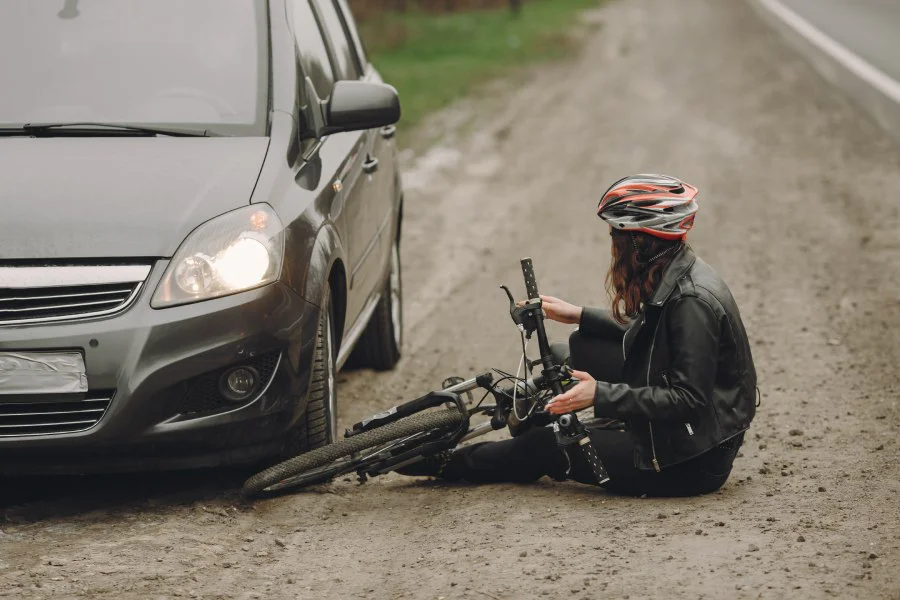
A police report holds the officer’s opinion of who caused the accident, which can sway an insurance company but is never a verdict on fault. It is the first of three views: the report, the liability assessment from the driver’s insurer, and the decision a court may make once a lawsuit is filed. Evidence missing from the report may still change the outcome at either later step.
- What Is in a Police Accident Report?
- What Unit 1 and Unit 2 Mean on a Police Report
- Who Really Decides Fault After a Car and Bike Crash?
- How a Strong Claim Actually Proves Fault
- What to Do if the Accident Report Is Wrong or Blames You
- How to Make Sure Your Side Is in the Police Report
- Can You Prove Fault in a Bike Accident Without a Police Report?
- Talk to a BALG Bicycle Accident Attorney About Your Police Report
- Get answers to commonly asked questions about our legal services and learn how we may assist you with your case.
- Get a FREE case evaluation today
What Is in a Police Accident Report?
A police accident report is a standard crash form recording the date, time, location, drivers, passengers, witness statements, diagram and conditions.
- Names, contact and insurance policy details for the driver, you and witnesses, with license numbers for drivers involved.
- A diagram showing the car, your bike, each direction of travel and the point of impact at the crash site.
- Weather, road and lighting conditions, plus visible vehicle damage and property damage.
- The officer’s view of fault, which appears in any citation, the contributing factors and the narrative. These are the fields to read first.
What Unit 1 and Unit 2 Mean on a Police Report
Unit numbering is never a legal fault determination. The officer’s opinion shows mainly in the citation, contributing factor codes and narrative. In some states, such as Illinois, the order may also reflect the officer’s preliminary view of fault.
|
State |
Form |
How units are ordered |
|
Texas |
CR-3, filled in per the CR-100 instructions |
A motor vehicle accident must be Unit 1, so in a car and bike crash your bike (a Pedalcyclist unit) is Unit 2 |
|
Illinois |
SR 1050 |
Statewide, the apparent at-fault driver unit first, or the striking unit if fault is not evident, while Chicago police start from the striking unit, with “Pedal” as a unit type |
In Pennsylvania, the officer’s opinion sits in the Prime Factor data, whose unit number can name your bike.
Codes like “failed to yield”, “disregarded stop signal” or a distracted driving code record what went wrong. On the car’s unit, a traffic citation and a “failed to yield” code mean the officer believes the negligent driver caused the accident, even if the report names no at-fault party.
Who Really Decides Fault After a Car and Bike Crash?
The driver’s insurer makes a liability assessment from the whole file, weighing the report alongside witness statements, photos and scene evidence. A court may decide fault only once a lawsuit is filed. Depending on the state, the share of fault assigned to you reduces your recovery or bars it.
|
State |
When your fault bars recovery |
Source |
|
Arizona, California |
Never, damages fall by your share |
A.R.S. § 12-2505, CACI No. 405 (jury instruction) |
|
Georgia |
At 50% or more |
O.C.G.A. § 51-12-33(g) |
|
Illinois, Texas |
Above 50% |
735 ILCS 5/2-1116, Tex. Civ. Prac. & Rem. Code § 33.001 |
|
Pennsylvania |
When it is greater than the defendants’ |
42 Pa.C.S. § 7102(a) |
|
New York |
In Insurance Law Article 51 injury actions filed on or after May 26, 2026, when it is greater than the defendant’s or the defendants’ combined, otherwise never |
N.Y. CPLR § 1411(a) and (b) |
|
Alabama, Maryland, North Carolina, Virginia |
At any share, even 1% (contributory negligence) |
The share assigned to each party controls who recovers and how much, so establishing fault early matters.
How a Strong Claim Actually Proves Fault
Evidence beyond the police report can establish fault the officer missed or got wrong. Proof that helps determine fault may include:
- Video footage from a dashcam, helmet camera, doorbell, storefront or traffic camera, which can correct a report built on the driver’s account alone.
- Independent witnesses the officer never reached, whose statements carry weight because they have no stake in the case.
- Photos of where the damage sits on the car and your bike, along with skid and debris marks, which show the point of impact and each direction of travel.
- An accident reconstruction expert, who works out speed, timing and position from physical evidence when the accounts of drivers and riders conflict.
A clear video can carry more weight with insurers than a report that blames you.
What to Do if the Accident Report Is Wrong or Blames You
You can usually get a factual error (an incorrect name, plate, street or insurer) corrected by contacting the police department with proof.
- The police officer’s fault opinion rarely changes, though an officer may amend a report when shown new evidence.
- A supplemental statement adds your account without erasing the original.
- A report that blames you does not end your case. You can still gather evidence to establish fault.
The steps for correcting a police report are in a separate guide.
How to Make Sure Your Side Is in the Police Report
Give the officer facts without guessing or admitting fault, and get legal advice before any recorded statement to the driver’s insurer.
- Have witnesses talk to the officer, and copy their details.
- “I’m sorry” can enter the report as an admission that may work against you in an insurance claim.
- In bike accidents, an ambulance ride before your statement can leave the report with only the driver’s account.
Can You Prove Fault in a Bike Accident Without a Police Report?
You can prove fault without a police report, but determining fault is harder from photos, witnesses and traffic laws alone. Without legal representation the claim may be your word against the driver’s, which you can answer with photos, witness names and camera video. If you were partially responsible, a personal injury attorney can still help determine whether the negligent driver bears most of the fault.
Talk to a BALG Bicycle Accident Attorney About Your Police Report
If the report blames you, gets the facts wrong or leaves out your account, send Bicycle Accident Lawyers Group (BALG) the report number, photos and witness names. An accident attorney who rides, will review them in a free consultation and explain your fault state rule.
BALG handles bicycle accident cases on a contingency fee basis, so you pay no fee unless the firm recovers compensation for you. With no recovery, there are no case costs. Call our Houston office for a free case review.
Get answers to commonly asked questions about our legal services and learn how we may assist you with your case.
How Do Police Determine Fault After an Auto Accident?
Police determine fault by reviewing evidence at the scene, traffic rules, and accounts from all drivers, passengers and riders involved. Police officers document their finding in the report, and adjusters use that finding as one factor when determining fault for the insurance claim.
How Do Adjusters Determine Who Is at Fault?
The driver’s insurance adjuster assesses fault by comparing the police report with the rest of the file, including:
- Photos of the vehicles involved and the damage to each vehicle and bike.
- Statements from you, the driver and any witnesses.
- The traffic rules that applied at the place and time of the crash.
Is a Crash Report the Same as a Police Report?
A crash report and a police report are usually the same document. The fields tell you more than either title because many reports name no at-fault party.
Robert Goldwater is a cyclist representing cyclists. He has practiced personal injury and wrongful death law for more than 20 years, graduating with Honors from Arizona State University Law School, and has helped recover over $1 billion for clients, including injured cyclists.