
Almost 2 million adult New Yorkers ride a bike occasionally, and over a third of daily commuters in the city cycle on a regular basis, according to NYC DOT. In New York City, bicyclists must follow the same traffic laws as motor vehicle drivers, including obeying signals, riding with traffic, and using bike lanes when available.
Other important rules cover the 15 mph speed limit for e-bikes, mandatory helmets for children 13 and under, sidewalk restrictions, and required lights and a bell at night. Understanding these laws protects your safety, your rights, and your ability to seek compensation if a negligent party causes an accident.
Recent US bicycle accident statistics indicate that 24 people lost their lives in bicycle accidents in NYC in 2024, and over 5,000 sustained severe injuries. Many incidents occurred because of traffic errors, inattention, and a lack of legal knowledge. New York City and New York State have a variety of traffic laws concerning bicyclist safety, all of which are covered in this guide.
- Key Bicycle Laws in NYC
- Why Do These Rules Apply to Cyclists?
- E-Bike Laws in NYC
- Safe Passing Laws
- Dooring Laws
- Right-of-Way Laws
- Law Regulating Bicycles Passing on the Right
- Bike Lane Laws
- Bicycle Safety Equipment Laws
- Bicycle Helmet Laws in NY
- Riding on the Sidewalk, on Beaches, and in Parks in NYC
- Riding Single File or No More Than 2 Abreast
- Bicycle Seats and Pedals Laws
- Distraction Laws: Earphones, Phones, and Electronic Devices
- NYC Laws Regulating Children on Bikes
- Safety Guidelines and Tips for NYC Cyclists
- Conclusion
- Any questions?
- Get a FREE case evaluation today
Key Bicycle Laws in NYC
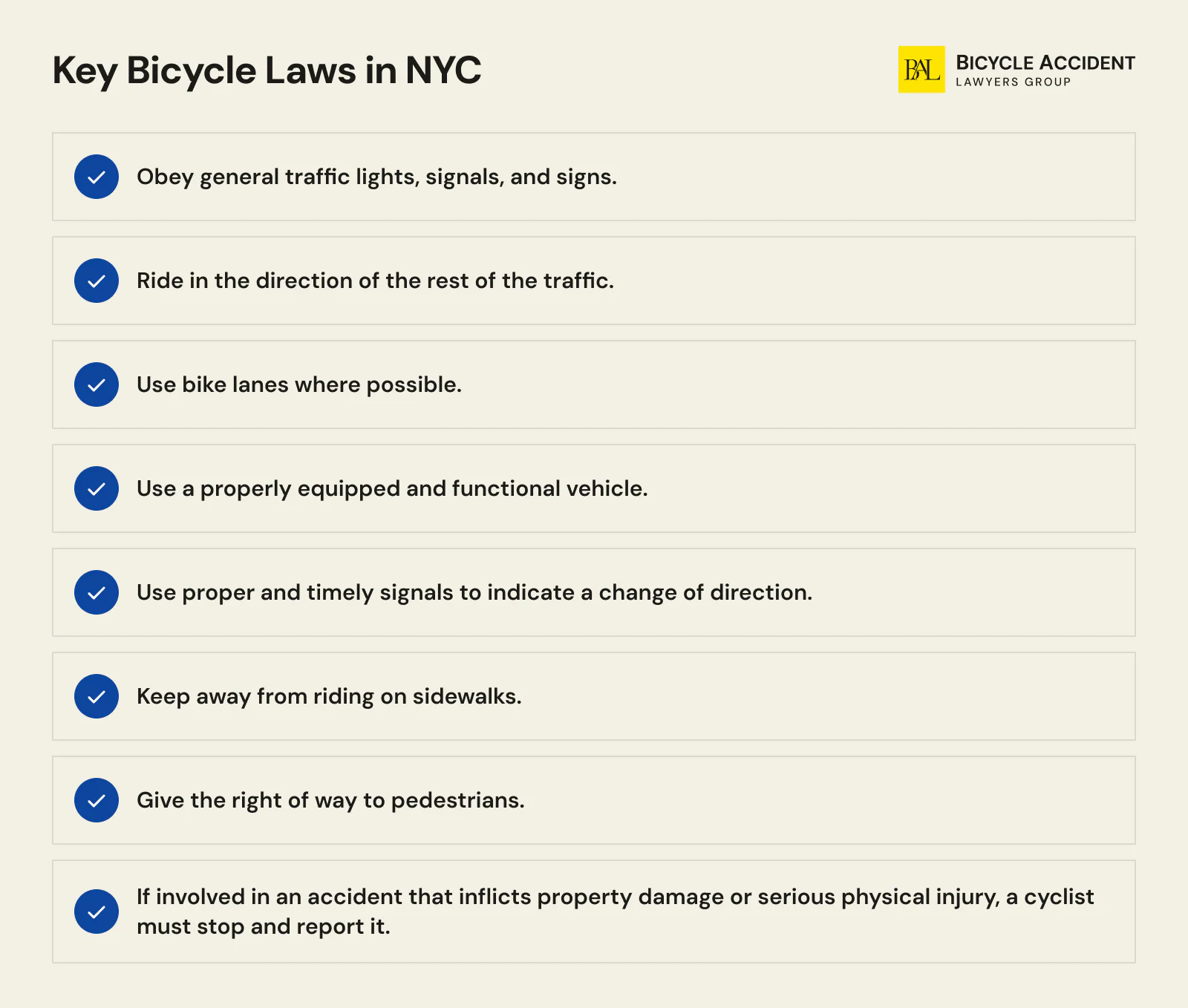
The following list summarizes the most important bicycle laws and rules that every cyclist in New York City must know:
- Traffic Laws: Cyclists must obey all traffic signals, signs, and pavement markings (VTL § 1231)
- Riding Direction: Ride in the same direction as traffic; riding against traffic (“salmoning”) is prohibited
- Bike Lanes: Use designated bike lanes when available, unless blocked or unsafe (RCNY § 4-12(p))
- Sidewalks: Riding on sidewalks is prohibited; exception for children under 12 with wheels under 26 inches
- Helmets: Mandatory for children 13 and under (under 14 years old); strongly recommended for all riders
- Lights & Reflectors: White front light and red rear light required between dusk and dawn; bell or horn required
- E-Bike Speed Limit: 15 mph maximum on all city streets and bike paths
- E-Bike Minimum Age: Riders must be at least 16 years old
- Passengers: Children under 1 year old are prohibited from being transported on a bicycle
- Pedestrians: Cyclists must always yield the right of way to pedestrians
- Distractions: Do not use phones or text while riding; only one earphone permitted (VTL 375 24-a).
Why Do These Rules Apply to Cyclists?
Bicycle laws in New York State and in the city are designed to promote the safety of vulnerable road users and regulate overall traffic flow. Bike riding laws are defined in the NY Vehicle and Traffic Law (VTL) and the Rules of the City of New York (RCNY). Key legal foundations include:
- VTL § 1231: All traffic laws that apply to motor vehicle operators also apply to cyclists.
- RCNY § 4-02(a): New York City traffic rules and regulations apply to all road users, including bike riders.
- RCNY § 4-12(h): Dictates the precise course of action to take after an accident.
- RCNY § 4-12(p): All cyclists in the city must use bike lanes where available.
- § 19-176: Forbids riding on the sidewalks in the city.
Failure to comply with these cycling laws can create dangerous situations on the road or even lead to a serious incident. Knowing what to do after a bicycle accident is crucial for protecting your health and your future legal claim.
E-Bike Laws in NYC
Electric bicycles (e-bikes) have become one of the fastest-growing modes of transportation in New York City. Under New York Vehicle and Traffic Law § 102-c, New York recognizes three classes of e-bikes, and under New York Vehicle and Traffic Law § 1242, cities such as New York City may further regulate where and how they are used.
E-Bike Classifications
- Class 1 (Pedal-Assist): Equipped with a motor that provides assistance only when the rider is pedaling. The motor stops assisting at 20 mph. These are permitted on streets, bike lanes, and multi-use paths.
- Class 2 (Throttle-Assist): Equipped with a throttle that can propel the bike without pedaling, up to 20 mph. Permitted on streets and bike lanes.
- Class 3 (Speed Pedal-Assist): Pedal-assist motor that stops assisting at 25 mph. Permitted on streets and bike lanes but may be restricted from certain multi-use paths.
E-Bike Speed Limit
All e-bikes are restricted to a maximum speed of 15 mph on all New York City streets and bike paths. This speed limit is enforced to protect cyclists, pedestrians, and other road users. Exceeding this limit can result in fines and penalties.
E-Bike Age Requirements
Riders must be at least 16 years old to operate an e-bike in New York City. This age restriction applies to all three classes of e-bikes. Additionally, e-bike riders under 18 are required to wear a helmet.
E-Bike Equipment and Registration
E-bikes must comply with all standard bicycle equipment requirements, including front and rear lights, reflectors, and a bell or horn. E-bikes do not require registration or a license plate in New York City, but they must have a label indicating their class. Throttle-assist and pedal-assist e-bikes must also meet federal equipment standards.
Safe Passing Laws
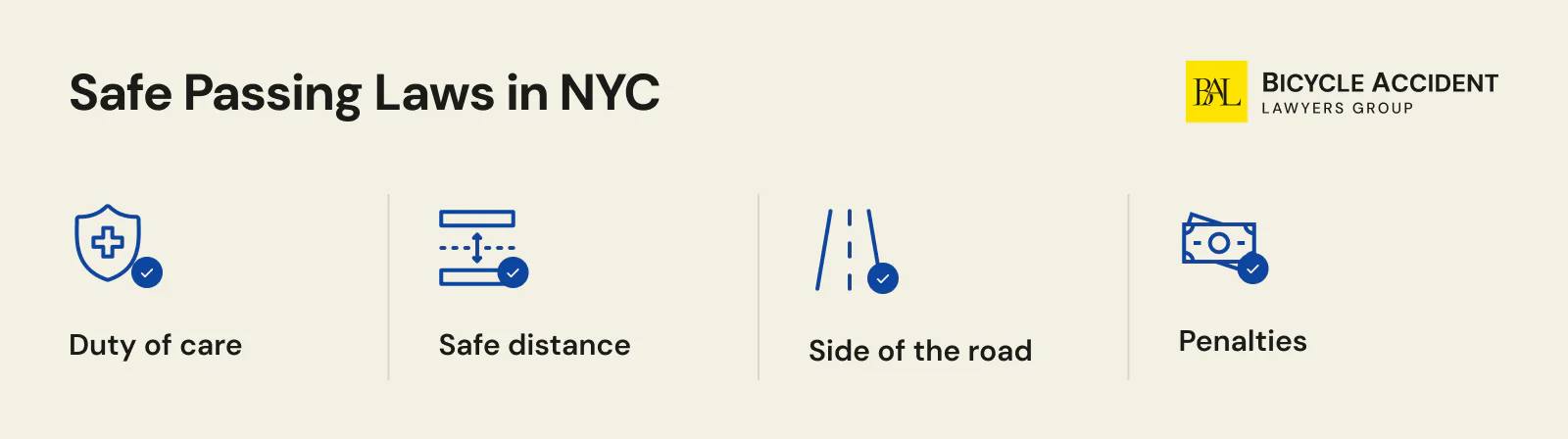
Accidents frequently involve multiple parties. All road users, including drivers and bike riders, must be aware of and adhere to safe passing laws. In New York City, the following safe passing rules apply:
- Duty of care: Section 1146 of the VTL stresses that all drivers must exercise exceptional care to avoid collisions with cyclists.
- Safe distance: According to Section 1122 of the VTL, motor vehicles must pass cyclists moving in the same direction on the left at a safe distance. Although there is no officially defined minimum distance, there should be enough room for the rider to maneuver safely.
- Side of the road: Section 1120 requires all vehicles to drive or ride as close to the right side of the road as practicable, with exceptions for passing or overtaking a vehicle moving in the same direction.
- Penalties: According to Section 19-190 of RCNY, any party found guilty of causing a traffic collision will be subjected to appropriate penalties.
Lane Positioning on Narrow Roads
When the road is too narrow for a bicycle and a motor vehicle to share a single lane safely, cyclists may ride in the center of the travel lane. This technique, often called “taking the lane,” is a legal and recognized safety practice that prevents dangerous close passes by motor vehicles. Once the road widens sufficiently, the cyclist should return to riding near the right-hand side of the lane.
Dooring Laws
A dooring incident occurs when a driver or passenger opens a car door into a traffic lane without checking for an approaching cyclist. Around 1,700 cyclists are injured in dooring bicycle accidents severely enough to seek medical treatment each year in New York City.
Local authorities enacted VTL 1214, which mandates that motor vehicle operators and their passengers inspect the path before opening any door and exiting the vehicle.
Dooring by a NYC Taxi Cab
There are over 13,000 taxi cabs registered in New York City, and they are frequently involved in dooring incidents. To reduce the risk to cyclists:
- RCNY 4-11(c): Taxi operators must stop and park their vehicles parallel to the curb but at least 12 inches away from it.
- RCNY 4-12(c): No taxi occupant may exit the vehicle from the side facing an active lane without first checking for approaching cyclists.
Right-of-Way Laws
The right of way is a legal principle that dictates how road users must act when one person must yield to another to prevent a dangerous traffic incident. Motor vehicle operators owe the right of way to bicyclists, and cyclists, in turn, must yield to pedestrians. When the responsible party fails to yield and that failure leads to an accident, they may be held accountable for the resulting damages and losses. To better understand NYC bicycle accident fault rules, it is important to examine how right-of-way violations affect fault in specific crash scenarios.
When the responsible party fails to do as they are obliged and that leads to an accident, they will be held accountable for the damages and losses that the collision brings. However, sometimes it takes a legal background, evidence, and field experience to handle the case. So, to ensure the best outcome for your claim, it is always a great idea to consult a trained New York bicycle accident attorney as soon as possible.
Law Regulating Bicycles Passing on the Right
In New York City, bike riders are required to ride on the right side of the road, in the same direction as the rest of traffic. Overtaking a vehicle on the right is generally forbidden. However, Section 1123 of the VTL provides two exceptions when passing on the right is allowed:
- When the vehicle in front signals that it is about to make a left turn.
- When there is sufficient space on the lane for two or more lines of vehicles moving in each direction, and the space is not occupied by parked cars.
Even when these conditions are met, cyclists must exercise exceptional caution when passing on the right. Hidden obstacles, opening car doors, and pedestrians stepping into the lane are all potential hazards that require adequate reaction time.
Bike Lane Laws
A bicycle lane is a designated space on the side of the road, outlined by pavement markings, signs, and sometimes physical barriers, for cyclists to navigate city streets safely. Two major laws apply to using a bicycle lane in New York:
- Mandatory use (RCNY § 4-12(p)): Cyclists must use a dedicated bike lane or path when one is available. Exceptions exist when the rider needs to make a turn or when an obstruction blocks the lane.
- Direction of travel: Even when riding in a bike lane, cyclists must travel in the direction of traffic. Riding against traffic in a bike lane is prohibited.
Vehicles Obstructing Bicycle Lanes
The City of New York has banned motor vehicles from bicycle lanes under RCNY § 4-12(p). Limited exceptions include entering or exiting private property and crossing intersections. Cars are forbidden to stop or park in a designated bike lane (RCNY § 4-08(e)(9)) unless it is an emergency or an instruction from law enforcement.
Bicycle Safety Equipment Laws
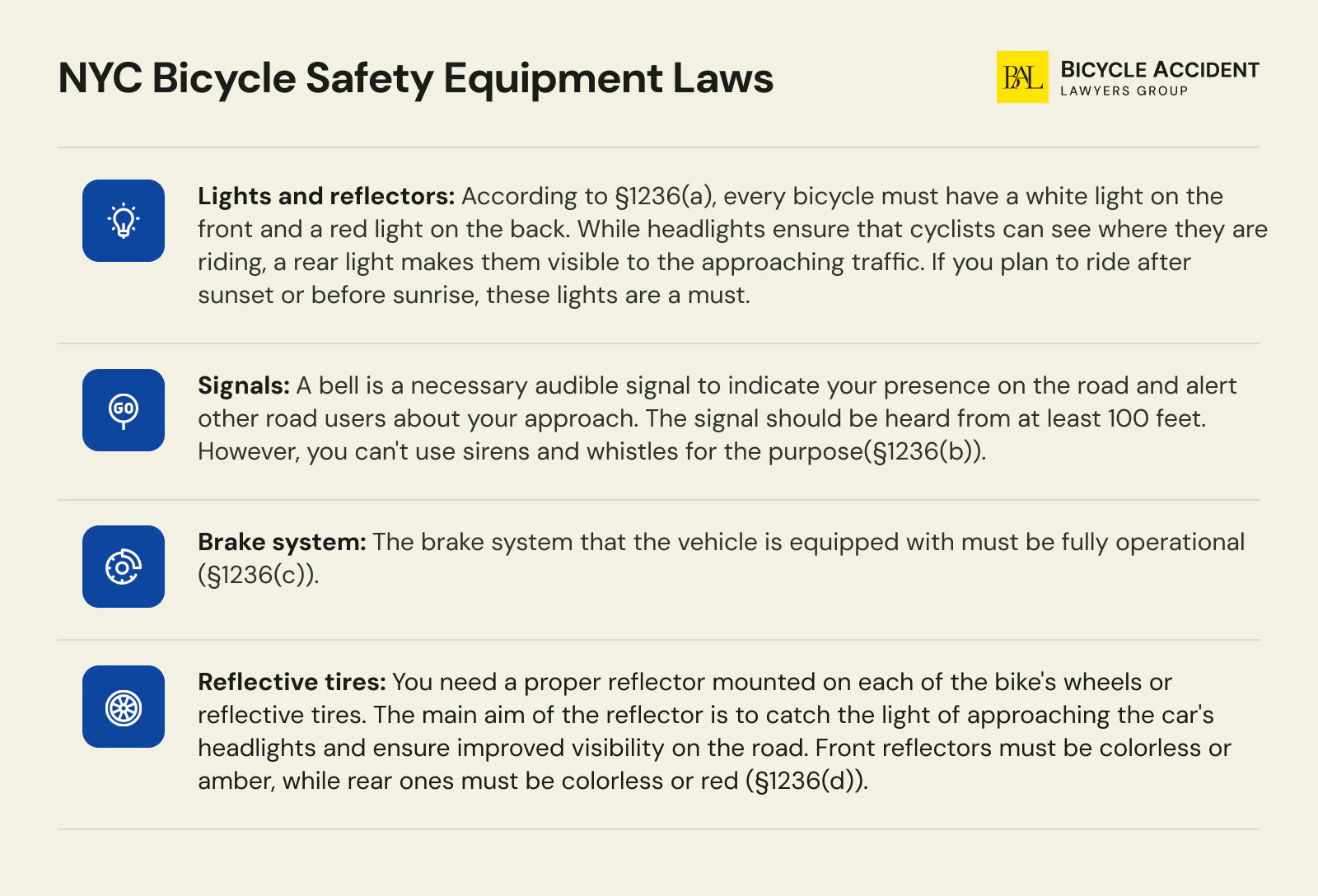
All bicycles ridden in New York City must comply with local equipment safety requirements defined by Section 1236 of the VTL:
- Lights and reflectors (§1236(a)): Every bicycle must have a white front light and a red rear light. Front lights help cyclists see the road ahead, while rear lights make riders visible to approaching traffic. These lights are mandatory when riding between dusk and dawn.
- Audible signal (§1236(b)): A bell or horn is a required audible signal to indicate your presence on the road. The signal must be audible from at least 100 feet. Sirens and whistles are not permitted.
- Brake system (§1236(c)): The brake system must be fully operational.
- Reflective tires or reflectors (§1236(d)): A proper reflector must be mounted on each wheel, or the bicycle must have reflective tires. Front reflectors must be colorless or amber; rear reflectors must be colorless or red.
Rider Visibility and Clothing Recommendations
In addition to bicycle-mounted equipment, cyclists are strongly encouraged to enhance their personal visibility on the road. During daylight hours, wearing bright-colored clothing significantly increases a rider’s visibility to motor vehicle operators. At night, wearing reflective materials or a reflective vest complements the bicycle’s lights and reflectors. While not legally mandated, these visibility measures substantially reduce the risk of accidents, particularly at intersections and in low-light conditions.
Bicycle Helmet Laws in NY
According to Section 1238 of the VTL, helmets are mandatory for children 13 and under (under 14 years of age), whether they are riders or passengers. Parents or legal guardians who fail to ensure a child wears a helmet may face a fine of up to $50. All protective helmets must comply with US Consumer Product Safety Commission (CPSC) standards.
Adults are not legally required to wear a helmet while cycling in New York City. However, it is strongly recommended. Research shows that a quality helmet can reduce serious head injuries by 60% and decrease fatalities among cyclists by 34%. E-bike riders under 18 are also required to wear a helmet.
Riding on the Sidewalk, on Beaches, and in Parks in NYC
In New York City, riding a bicycle on a sidewalk is prohibited under RCNY § 4-07(c)(3). Cyclists who violate this rule may receive a traffic ticket or have their bicycle confiscated.
Children under 12 years of age may ride on sidewalks in New York, provided the wheels of their bicycle are less than 26 inches in diameter. This exception balances safety concerns with practical access for younger riders.
Cycling is permitted in city parks only where a designated bike lane or path is available. If no dedicated path exists, you must walk your bicycle through the park (RCNY 4-07(c)(3)). Cycling on NYC beaches is prohibited.
Riding Single File or No More Than 2 Abreast
Section 1234 of the VTL establishes that cyclists should ride in single file or no more than two abreast, keeping as close to the right-hand curb as practicable when on the road. However, cyclists on a designated bike lane or shoulder may ride two or more abreast when sufficient space is available.
Bicycle Seats and Pedals Laws
According to Section 1232 of the VTL, a bicyclist must ride on a permanent seat attached to the bicycle, and the rider’s feet must remain on the pedals at all times. A single-person bicycle cannot be used to transport two or more persons unless it is specifically equipped for that purpose.
Distraction Laws: Earphones, Phones, and Electronic Devices
Distracted cycling is a leading contributor to bicycle accidents in New York City. The law addresses several forms of distraction:
- Earphones (VTL 375 24-a): A cyclist may use no more than one earphone at a time while riding. This regulation ensures that riders can hear approaching traffic, emergency vehicles, and other audible warnings.
- Phone and texting: Using a handheld phone or texting while cycling is strongly discouraged and treated as a dangerous distraction. Cyclists should pull over to a safe location before using their phone.
- General awareness: Cyclists should avoid any activity that diverts attention from the road, including adjusting GPS devices, reading, or eating while riding.
Maintaining full situational awareness while cycling is essential for preventing accidents with motor vehicles, particularly at intersections, in heavy traffic, and near parked vehicles where dooring risks are present.
NYC Laws Regulating Children on Bikes
New York City authorities prioritize children’s safety. Section 1238 of the VTL establishes the following rules:
- Infants under 12 months of age are prohibited from being transported as passengers on bicycles.
- All children 13 and under (under 14 years of age) must wear protective helmets while riding or being carried as passengers.
- Children from 1 to 5 years old may ride as passengers in a properly affixed child carrier.
- Children under 12 may ride on sidewalks in New York, provided the wheels of their bicycle are less than 26 inches in diameter.
- Parents or legal guardians who fail to comply with these laws may receive a penalty of $50.
Safety Guidelines and Tips for NYC Cyclists
Beyond legal requirements, following these safety best practices will significantly reduce your risk of injury:
- Yield to pedestrians: Always give pedestrians the right of way, especially at crosswalks and in shared spaces.
- Avoid distractions: Do not use phones, text, or wear more than one earphone while riding.
- Lane positioning: Ride in the center of the travel lane if the road is too narrow for a bicycle and a car to share safely. Return to the right when the lane widens.
- Wear visible clothing: Use bright-colored clothing during the day and reflective materials at night to maximize your visibility.
- Use hand signals: Always signal turns, stops, and lane changes to communicate your intentions to drivers and other cyclists.
- Check for doors: Watch for signs that a parked car occupant may open a door. Ride at least 3–4 feet from parked cars when possible.
- Inspect your bicycle: Before each ride, confirm that your brakes, tires, lights, reflectors, and bell are in proper working order.
Conclusion
New York City authorities have developed comprehensive cycling laws to promote bicyclist protection across the city. These regulations cover traffic compliance, bike lane usage, safety equipment, e-bike rules, helmet requirements, sidewalk restrictions, distraction laws, and rules for children on bicycles. Together, they establish a framework that governs nearly every aspect of urban cycling in NYC.
However, no regulatory framework can eliminate all risk. Collisions involving bike riders remain frequent. That is why, beyond compliance with existing bicycle laws, every cyclist must also understand their legal rights. For the full official guide, check out the NYC DOT Bike Rules.
If you or a loved one has been injured in a cycling accident in NYC, contact us for a free consultation to assess your situation. Our professional lawyers will evaluate the case and guide you toward the most favorable outcome and maximum compensation. Call us today.
Any questions?
We know that cycling laws might be complicated. Got more questions? Check out quick answers on most common questions regarding the New York State bicycle laws.
Are Cyclists Required to Wear a Helmet in NYC?
Adult bike riders are not legally required to wear a protective helmet. However, all cyclists 13 and under (under 14 years old) must wear a helmet that complies with CPSC standards. E-bike riders under 18 must also wear a helmet. All riders are strongly encouraged to wear one regardless of age.
Do Cyclists Have to Use Hand Signals When Turning?
Yes. Cyclists must use corresponding hand signals to notify other road users about changes in direction, turns, stops, and road hazards.
Can Bicyclists Ride on Sidewalks in NYC?
No adult cyclist is permitted to ride on a sidewalk in New York City. Children under 12 years old who ride bicycles with wheels less than 26 inches in diameter may use sidewalks.
What Is the Speed Limit for E-Bikes in NYC?
All e-bikes in New York City are subject to a 15 mph speed limit on all city streets and bike paths. This applies to Class 1, Class 2, and Class 3 e-bikes.
What Does “Salmoning” Mean in NYC Cycling?
Salmoning refers to riding a bicycle against the direction of traffic. This practice is illegal in New York City and significantly increases the risk of head-on collisions with motor vehicles and other cyclists.
Can I Use My Phone While Cycling in NYC?
Using a handheld phone or texting while cycling is strongly discouraged and considered a dangerous distraction. If you need to use your phone, pull over to a safe location first. Only one earphone is permitted while riding (VTL 375 24-a).
How Old Do You Have to Be to Ride an E-Bike in NYC?
You must be at least 16 years old to operate any class of e-bike in New York City.

Since his academic days at the UC Berkeley School of Law, Robert Goldwater has remained a committed advocate for victims of other people’s negligence. His tort law background, together with his unquenchable thirst for justice, helped young Robert found a now-successful law firm – Bicycle Accident Lawyers Group, gathering same-minded and promising attorneys from all over the country.