
Cyclists in New York are legally required to stop at stop signs, just like drivers. According to the Vehicle and Traffic Law of New York, bicycles are classified as vehicles. This means that every cyclist in the area must abide by existing traffic laws to avoid traumatic bicycle accidents.
If you choose to roll through an intersection, you risk not only serious injury and property damage but also legal consequences. New York City law takes such actions seriously. The more you understand your rights and responsibilities, the better prepared you’ll be to avoid legal trouble.
- Key Takeaways
- New York Law Requires Cyclists to Stop at Stop Signs
- Should All Cyclists Stop at a Stop Sign?
- Why Is It Important to Stop at Stop Signs?
- Can You Still Recover Compensation If You Ran the Stop Sign?
- Contact an Expert NYC Bicycle Accident Lawyer Today!
- What Should You Do After a Stop-Sign Crash?
- Get a FREE case evaluation today
Key Takeaways
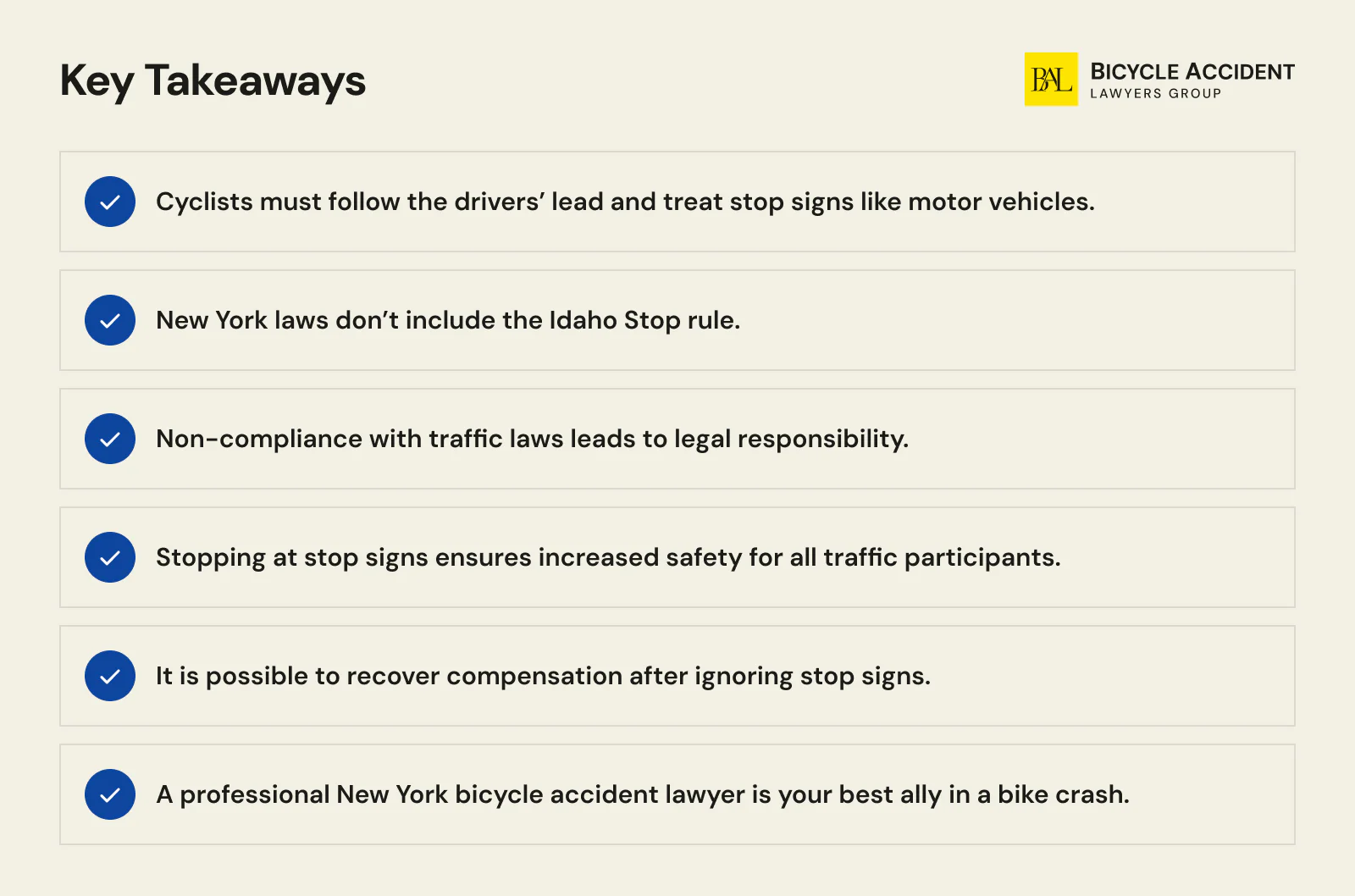
- New York law requires you to stop at every stop sign; VTL 1231 gives you a driver’s duties.
- Rolling through at three miles per hour does not count as a stop under VTL 1172.
- Stop at the marked line; with no line, stop before the crosswalk, then where you see cross traffic.
- Eight states let you treat stop signs as yield signs, but New York is not among them.
- A pending state bill would allow stop-as-yield, but it is not law and binds nobody today.
- In New York City the same duty binds you under RCNY 4-02(a), the city’s own traffic code.
- If you ran the sign and were hurt, you still recover, minus your share of fault.
- At thirty percent fault you keep seventy percent of your award, not nothing at all.
- You have three years to sue under CPLR 214, and ninety days if a city vehicle hit you.
- Never give an insurer a recorded statement before a lawyer hears what you plan to say.
New York Law Requires Cyclists to Stop at Stop Signs
New York traffic laws apply to cyclists in full. The Vehicle and Traffic Law grants every cyclist the rights and duties of a vehicle driver (NY VTL 1231), so signals, stop signs, and right-of-way rules all apply to you.
The stop itself has a defined shape. Stop at the marked stop line. Where there is no line, stop before the crosswalk. Where there is no crosswalk, stop at the point with a clear view of cross traffic (NY VTL 1172). Rolling through at three miles per hour does not count.
The duty runs both ways. Drivers owe you due care, and at least three feet of clearance when passing on the left (NY VTL 1146; NY VTL 1122-a). The law treats you as traffic, which is the strongest legal position a cyclist can hold. Hold it by stopping fully at every sign.
New York City Applies the Same Stop-Sign Rule (RCNY 4-02)
The same rule applies in New York City, under the city’s own code. The Rules of the City of New York apply every city traffic rule to bicycles and cyclists (RCNY 4-02(a)), so a stop sign in Brooklyn binds you exactly as one in Buffalo does.
The city adds rules of its own. Ride in a usable bike lane where one exists, unless it is blocked or unsafe (RCNY 4-12(p)). Stay off expressways and highways unless a sign allows bikes (RCNY 4-12(o)). Keep off sidewalks: riding there can bring a summons, and the city can confiscate the bike (NYC Administrative Code 19-176). For the rules that follow a crash, see what to do after a bicycle accident.
Check the local rule wherever you ride, because upstate municipalities set their own sidewalk laws.
Should All Cyclists Stop at a Stop Sign?
In the majority of states, including New York, all bike riders have to comply with general traffic rules and stop at stop signs. However, there are a few exceptions. In Idaho, Delaware, Arkansas, North Dakota, Oklahoma, Oregon, Utah, and Washington: bicyclists are allowed to treat stop signs as yield signs. This exception is often referred to as the “Idaho Stop” law.
The regulation was implemented into Idaho’s traffic regulation system in 1982. Under this rule, cyclists have to slow down at stop signs, evaluate the situation, and proceed if the road is clear. However, the law does not apply to New York City or the state in general.
Why Is It Important to Stop at Stop Signs?
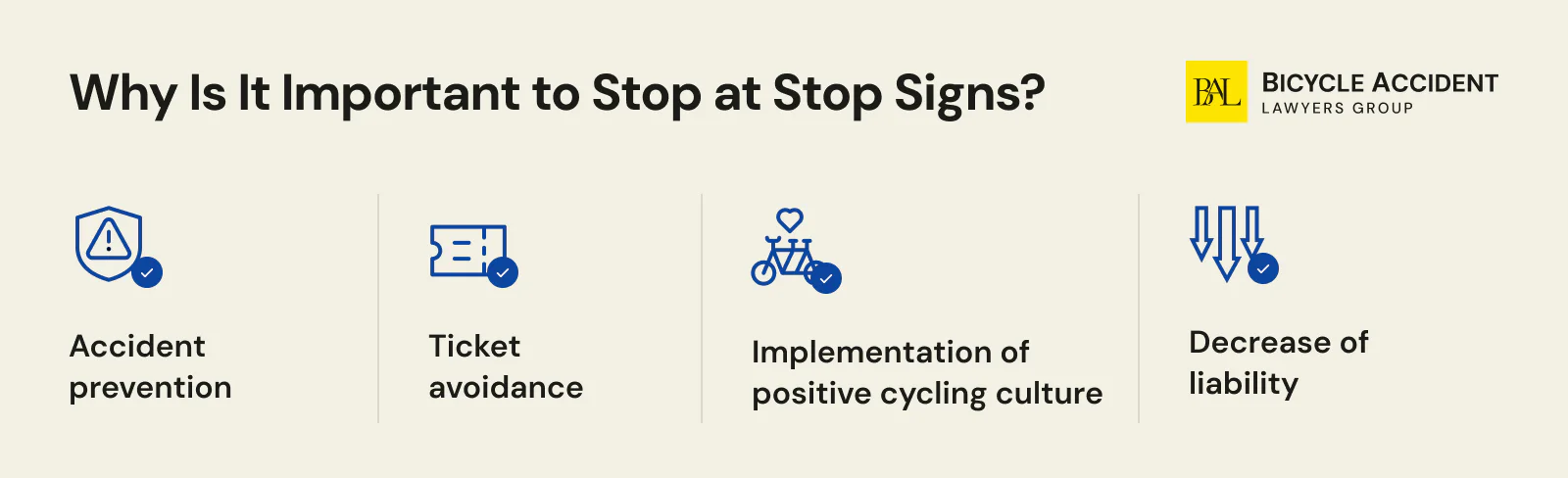
A bicycle accident with a car or any other vehicle can be highly traumatic and turn a person’s life upside down in an instant. However, obeying the stop signs isn’t just about your safety; it is also about respect toward other traffic participants and your legal protection. Here’s a list of reasons to consider before you choose to ignore a sign in New York City:
- Accident prevention: NY Bicycle accident statistics prove that recent years are among the deadliest for cyclists in the city. Although not all fatal incidents happen because of non-compliance with stop signs, halting at an intersection can help you assess the road situation better so that you can do everything possible to prevent a traumatic bicycle crash.
- Ticket avoidance: Since general traffic rules apply to bike riders, ignoring a sign can lead to a costly fine.
- Implementation of positive cycling culture: The more bicyclists abide by traffic regulations and stop at stop signs, the more positive reputation the activity in general gets. This will assist in creating a more bike-friendly society and decrease road rage rates.
- Decrease of liability: Most bicycle accidents involve several parties. If a rider fails to stop, they can be held liable and lose their right to fair compensation. Knowing exactly what to do after a bicycle accident can help you protect your claim even if liability is contested.
Can You Still Recover Compensation If You Ran the Stop Sign?
New York City, as well as the rest of the state, abides by a pure comparative negligence law. This law ensures that if you were injured on the city’s streets, you can still recover your damages even if you are partially responsible for the incident. A cyclist who is 99% at fault for a collision is entitled to rightful compensation.
However, the amount of contributory fault will be deducted from the final settlement. Let’s say you ignored a stop sign, which contributed to an accident, and you were assigned 30% fault. This means that you will be granted only 70% of the initial compensation you have filed for.
Contact an Expert NYC Bicycle Accident Lawyer Today!
Stop signs are an important part of NYC’s traffic regulation system that all the cyclists navigating the city’s streets must abide by.
However, it is human to make mistakes. If you’ve been ticketed for ignoring a sign or a negligent driver collided with you at an intersection, contact us for a free legal consultation. Our legal team will evaluate your claim and advise you on how to preserve your rights and get compensated. Together, we can build a strong and success-oriented case!
What Should You Do After a Stop-Sign Crash?
Document the scene and say little. The evidence you preserve in the first week decides more than the story anyone tells later.
- Call 911 and get a police report.
- Photograph the intersection, the sign, the vehicles, and your injuries.
- Collect witness names and note any cameras before the footage is overwritten.
- Do not admit fault or apologize, even if you rolled the sign.
- Get medical care the same day and keep the records.
- Watch the clock: three years to sue (CPLR 214), and only 90 days to file a notice of claim if a city or government vehicle hit you (General Municipal Law 50-e).
No insurance company will tell you this: the adjuster’s recorded statement exists to capture words that shrink your settlement, not to help you. We’re cyclists as well as injury attorneys, and we have read enough recorded statements to know how a stray apology gets priced. Talk to a lawyer before you give one.
If you’re a cyclist who has been in an accident, call today for a free initial consult about your legal claim. We’re here to help with your legal questions. Contact our law firm for coast-to-coast bike accident and personal injury representation.

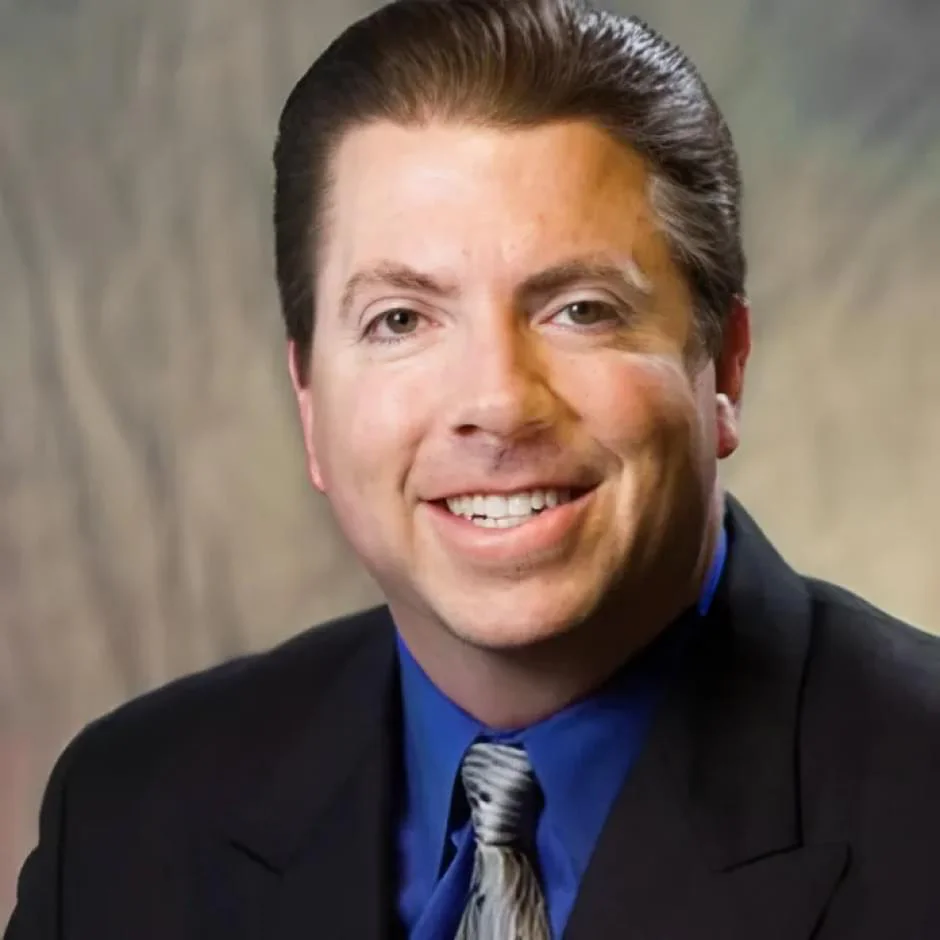
Robert Goldwater is a cyclist representing cyclists. He has practiced personal injury and wrongful death law for more than 20 years, graduating with Honors from Arizona State University Law School, and has helped recover over $1 billion for clients, including injured cyclists.